Menke Sebastian, Gillingham Mark A F, Wilhelm Kerstin, Sommer Simone
Institute of Evolutionary Ecology and Conservation Genomics, University of Ulm Ulm, Germany.
Front Microbiol. 2017 Jan 31;8:102. doi: 10.3389/fmicb.2017.00102. eCollection 2017.
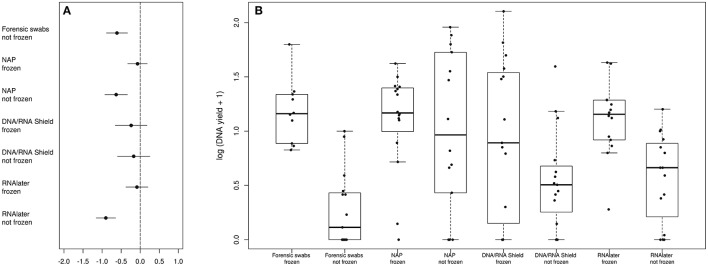
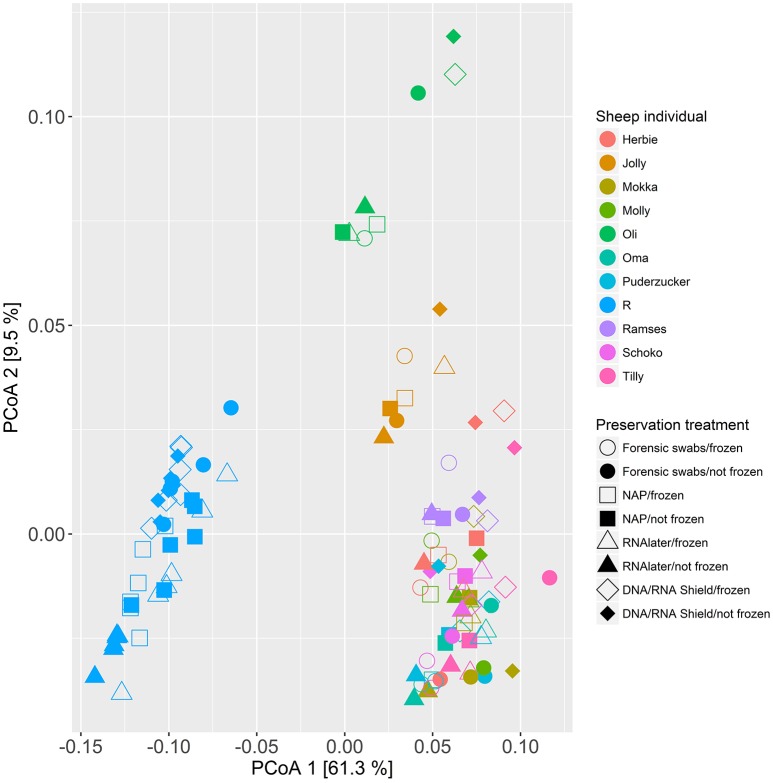
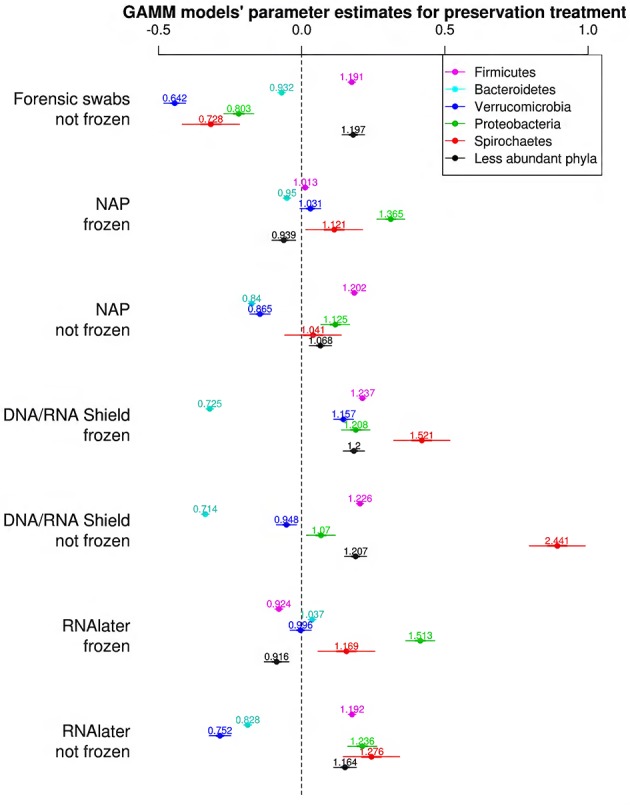
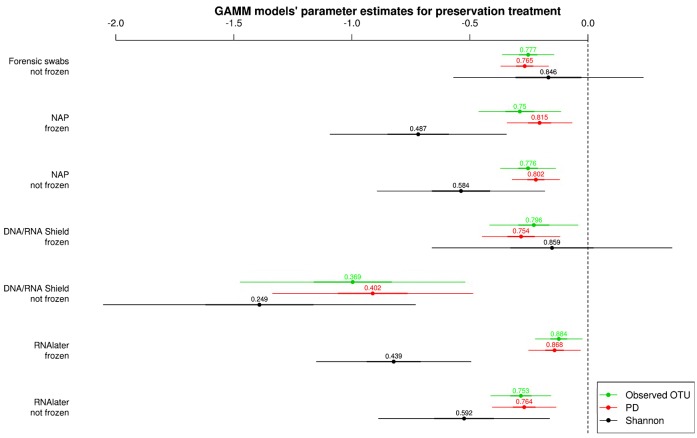
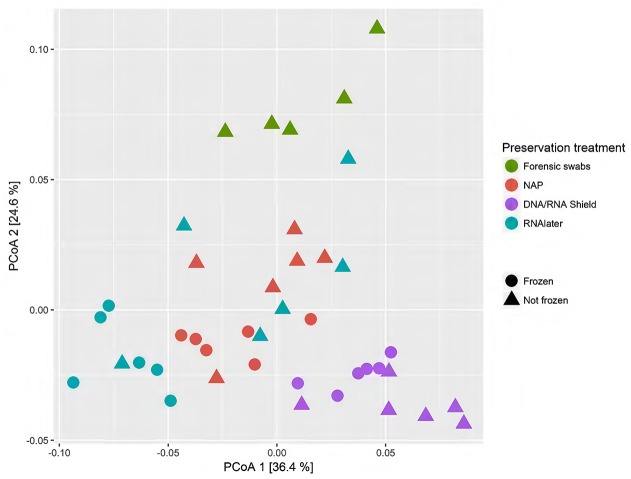
The investigation of wildlife gastrointestinal microbiomes by next-generation sequencing approaches is a growing field in microbial ecology and conservation. Such studies often face difficulties in sample preservation if neither freezing facilities nor liquid nitrogen (LQN) are readily available. Thus, in order to prevent microbial community changes because of bacterial growth after sampling, preservation buffers need to be applied to samples. However, the amount of microbial community variation attributable to the different preservation treatments and potentially affecting biological interpretation is hardly known. Here, we sampled feces of 11 sheep ( sp.) by using swabs and analyzed the effect of air-drying, an inexpensive self-made nucleic acid preservation buffer (NAP), DNA/RNA Shield™, and RNA®, each together with freezing (for 10 days) or storing at room temperature (for 10 days) prior to 16S rRNA gene high-throughput sequencing to determine bacterial communities. Results revealed that the proportions of operational taxonomic units (OTUs) belonging to a bacterial phylum were affected by the preservation treatments, and that alpha diversities [observed OTUs, Shannon index, and phylogenetic diversity (PD)] were lower in all preservation treatments than in samples taken by forensic swabs and immediately frozen which is considered as the favored preservation treatment in the absence of any logistic constraints. Overall, NAP had better preservation qualities than RNA® and DNA/RNA Shield™ making this self-made buffer a valuable solution in wildlife microbiome studies.
利用新一代测序方法对野生动物胃肠道微生物组进行研究,是微生物生态学和保护领域中一个不断发展的方向。如果没有冷冻设备或液氮,这类研究在样本保存方面往往会面临困难。因此,为防止采样后细菌生长导致微生物群落发生变化,需要对样本使用保存缓冲液。然而,不同保存处理导致的微生物群落变异量以及可能影响生物学解释的情况却鲜为人知。在此,我们用拭子采集了11只绵羊的粪便,并分析了风干、一种自制的廉价核酸保存缓冲液(NAP)、DNA/RNA Shield™和RNA®的效果,每种处理在进行16S rRNA基因高通量测序以确定细菌群落之前,都分别与冷冻(10天)或室温保存(10天)相结合。结果显示,属于某一细菌门的可操作分类单元(OTU)比例受保存处理的影响,并且所有保存处理中的α多样性[观察到的OTU、香农指数和系统发育多样性(PD)]均低于用法医拭子采集并立即冷冻的样本,在没有任何后勤限制的情况下,立即冷冻被视为首选的保存处理方法。总体而言,NAP的保存质量优于RNA®和DNA/RNA Shield™,使得这种自制缓冲液成为野生动物微生物组研究中的一种有价值的解决方案。