Horng Katti R, Ganz Holly H, Eisen Jonathan A, Marks Stanley L
Department of Medical Microbiology and Immunology, University of California, Davis, Davis, CA, United States of America.
William R. Pritchard Veterinary Medical Teaching Hospital, School of Veterinary Medicine, University of California, Davis, Davis, CA, United States of America.
PeerJ. 2018 May 23;6:e4827. doi: 10.7717/peerj.4827. eCollection 2018.
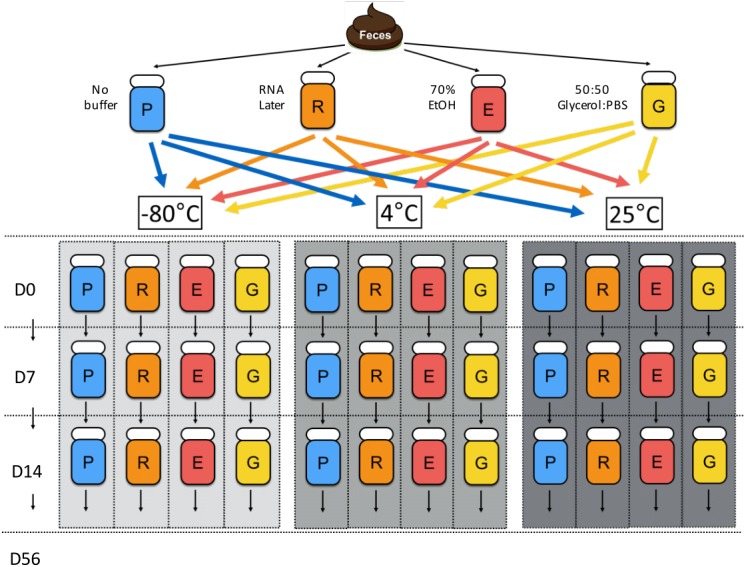
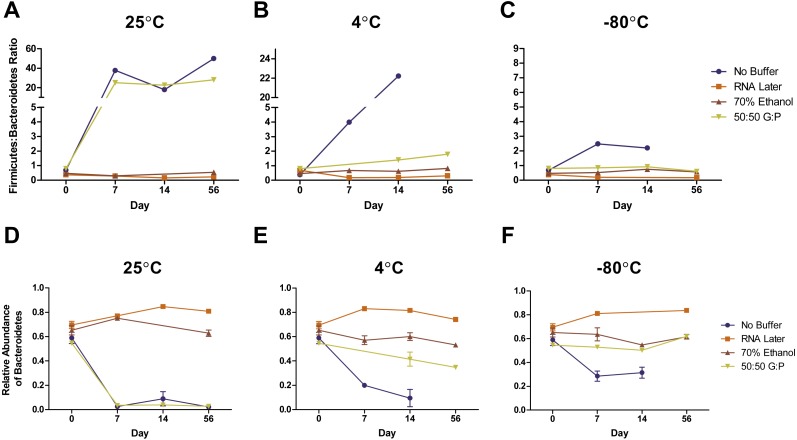
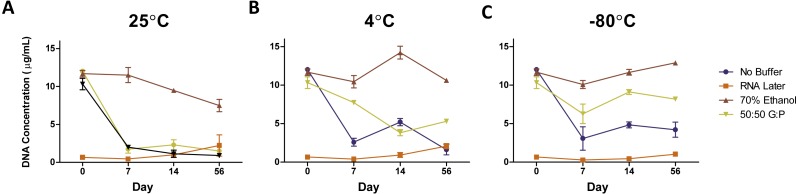
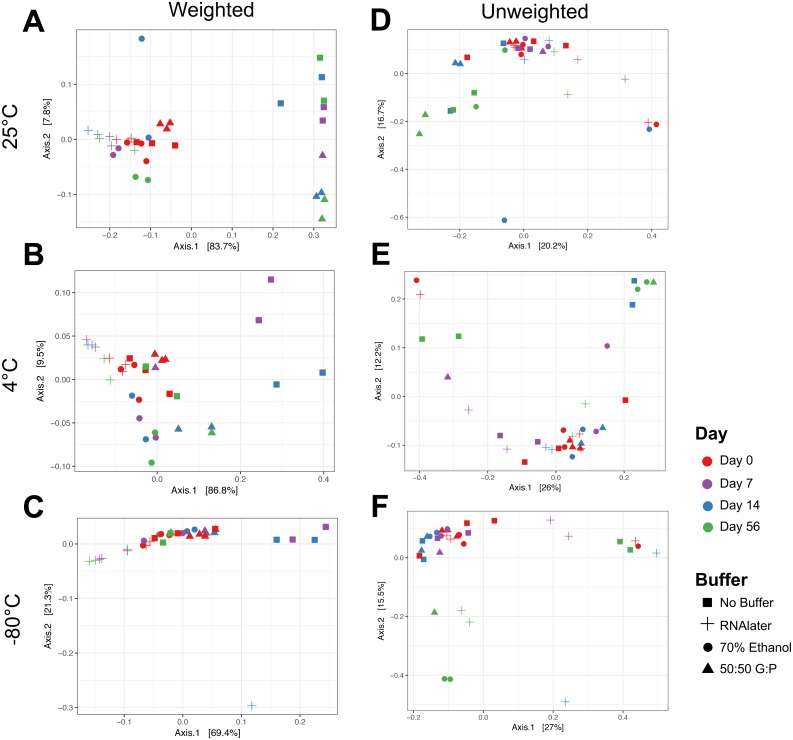
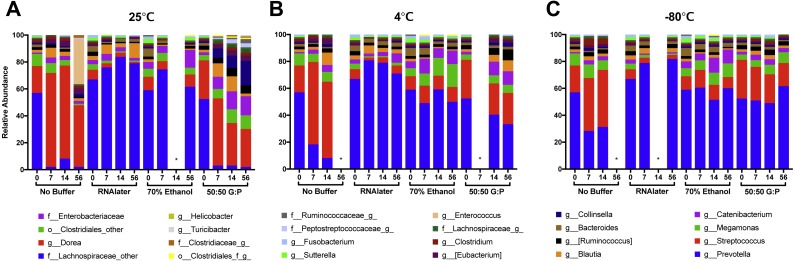
Studies involving gut microbiome analysis play an increasing role in the evaluation of health and disease in humans and animals alike. Fecal sampling methods for DNA preservation in laboratory, clinical, and field settings can greatly influence inferences of microbial composition and diversity, but are often inconsistent and under-investigated between studies. Many laboratories have utilized either temperature control or preservation buffers for optimization of DNA preservation, but few studies have evaluated the effects of combining both methods to preserve fecal microbiota. To determine the optimal method for fecal DNA preservation, we collected fecal samples from one canine donor and stored aliquots in RNAlater, 70% ethanol, 50:50 glycerol:PBS, or without buffer at 25 °C, 4 °C, and -80 °C. Fecal DNA was extracted, quantified, and 16S rRNA gene analysis performed on Days 0, 7, 14, and 56 to evaluate changes in DNA concentration, purity, and bacterial diversity and composition over time. We detected overall effects on bacterial community of storage buffer (-value = 6.87, = 3, < 0.001), storage temperature (-value=1.77, = 3, = 0.037), and duration of sample storage (-value = 3.68, = 3, < 0.001). Changes in bacterial composition were observed in samples stored in -80 °C without buffer, a commonly used method for fecal DNA storage, suggesting that simply freezing samples may be suboptimal for bacterial analysis. Fecal preservation with 70% ethanol and RNAlater closely resembled that of fresh samples, though RNAlater yielded significantly lower DNA concentrations ( = 8.57, < 0.001). Although bacterial composition varied with temperature and buffer storage, 70% ethanol was the best method for preserving bacterial DNA in canine feces, yielding the highest DNA concentration and minimal changes in bacterial diversity and composition. The differences observed between samples highlight the need to consider optimized post-collection methods in microbiome research.
涉及肠道微生物组分析的研究在评估人类和动物的健康与疾病方面发挥着越来越重要的作用。在实验室、临床和野外环境中用于DNA保存的粪便采样方法会极大地影响微生物组成和多样性的推断,但不同研究之间这些方法往往不一致且研究不足。许多实验室利用温度控制或保存缓冲液来优化DNA保存,但很少有研究评估将这两种方法结合起来保存粪便微生物群的效果。为了确定粪便DNA保存的最佳方法,我们从一只犬类供体收集粪便样本,并将等分样本储存在RNA Later、70%乙醇、50:50甘油:PBS中,或在25°C、4°C和 -80°C下不使用缓冲液保存。在第0天、第7天、第14天和第56天提取粪便DNA、进行定量,并进行16S rRNA基因分析,以评估DNA浓度、纯度以及细菌多样性和组成随时间的变化。我们检测到保存缓冲液(F值 = 6.87,自由度 = 3,P < 0.001)、保存温度(F值 = 1.77,自由度 = 3,P = 0.037)和样本保存时长(F值 = 3.68,自由度 = 3,P < 0.001)对细菌群落有总体影响。在 -80°C下不使用缓冲液保存的样本中观察到细菌组成的变化,这是一种常用的粪便DNA保存方法,表明简单地冷冻样本可能对细菌分析并非最佳选择。用70%乙醇和RNA Later保存的粪便与新鲜样本非常相似,不过RNA Later产生的DNA浓度显著更低(F = 8.57,P < 0.001)。尽管细菌组成随温度和缓冲液保存方式而变化,但70%乙醇是保存犬类粪便中细菌DNA的最佳方法,产生的DNA浓度最高,且细菌多样性和组成变化最小。样本之间观察到的差异凸显了在微生物组研究中考虑优化采集后方法的必要性。