Okahara Arihide, Sadamatsu Kenji, Matsuura Taku, Koga Yasuaki, Mine Daigo, Yoshida Keiki
Department of Cardiology, Saga-Ken Medical Centre Koseikan, Saga, Japan.
Cardiol Res. 2016 Feb;7(1):9-16. doi: 10.14740/cr456w. Epub 2016 Feb 20.
In this study, we investigated the feasibility of primary care physicians using carotid ultrasound to perform coronary artery disease screening in asymptomatic patients with multiple coronary risk factors.
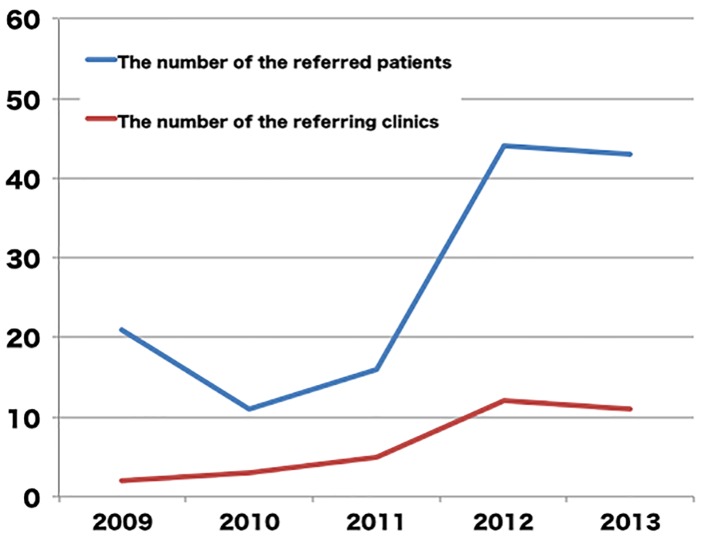
We retrospectively collected the data of 135 consecutive asymptomatic patients (mean age: 68.5 ± 8.4 years; male, 75%) who were referred to our institution due to abnormal findings on a carotid ultrasound performed by a primary care physician and who underwent coronary computed tomography angiography.
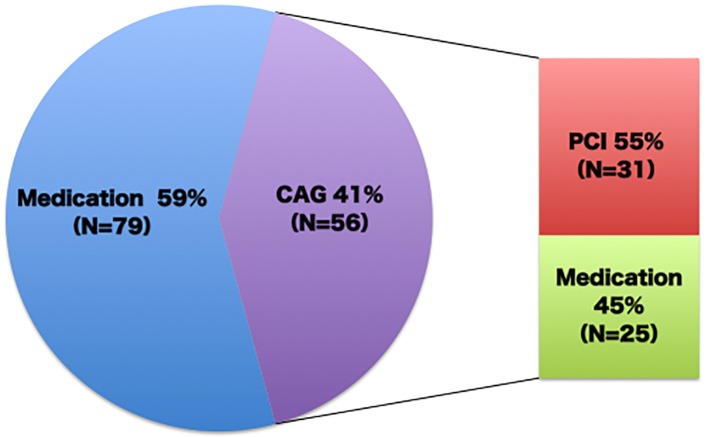
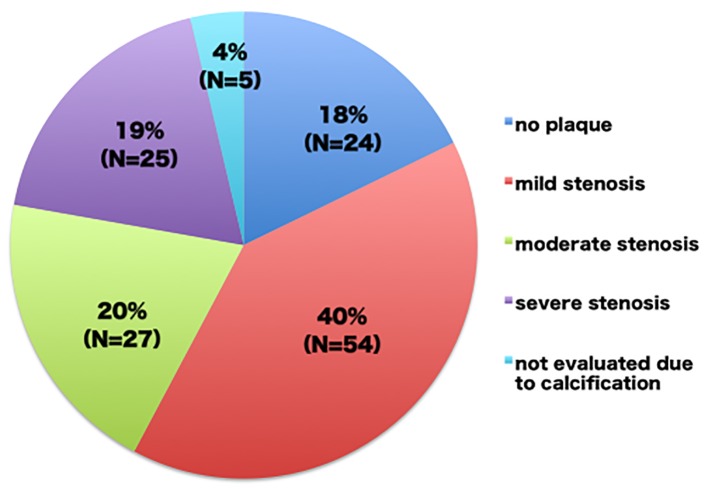
The mean number of risk factors was 4.1 ± 1.2 and the mean intima-media thickness was 2.00 ± 0.63 mm. Mild (≤ 50%), moderate (51-75%), and severe (> 76%) coronary stenosis was observed in 54 (40%), 27 (20%), and 25 patients (19%), respectively, while no plaque was found in 24 patients (18%), and five patients (4%) could not be evaluated due to calcification. Consequently, coronary angiography was performed in 56 (41%) patients and coronary intervention was required in 31 patients (23%). A multivariate logistic regression analysis demonstrated that the ratio of low-density lipoprotein cholesterol levels to high-density lipoprotein cholesterol levels, the use of calcium channel blockers and the value of the diastolic blood pressure were related to > 50% coronary stenosis.
The use of carotid ultrasound in the coronary artery disease screening by primary care physicians resulted in a high prevalence of coronary artery disease and high probabilities of coronary angiography and revascularization, and thus it is considered to be a useful and feasible strategy for the screening of asymptomatic patients.
在本研究中,我们调查了初级保健医生使用颈动脉超声对具有多种冠心病危险因素的无症状患者进行冠心病筛查的可行性。
我们回顾性收集了135例连续的无症状患者(平均年龄:68.5±8.4岁;男性,75%)的数据,这些患者因初级保健医生进行的颈动脉超声检查发现异常而转诊至我院,并接受了冠状动脉计算机断层扫描血管造影。
危险因素的平均数量为4.1±1.2,平均内膜中层厚度为2.00±0.63mm。轻度(≤50%)、中度(51 - 75%)和重度(>76%)冠状动脉狭窄分别在54例(40%)、27例(20%)和25例患者(19%)中观察到,24例患者(18%)未发现斑块,5例患者(4%)因钙化无法评估。因此,56例(41%)患者进行了冠状动脉造影,31例患者(23%)需要进行冠状动脉介入治疗。多因素逻辑回归分析表明,低密度脂蛋白胆固醇水平与高密度脂蛋白胆固醇水平的比值、钙通道阻滞剂的使用以及舒张压值与>50%的冠状动脉狭窄有关。
初级保健医生使用颈动脉超声进行冠心病筛查导致冠心病的高患病率以及冠状动脉造影和血运重建的高概率,因此它被认为是筛查无症状患者的一种有用且可行的策略。