Fay Kellie A, Villeneuve Daniel L, LaLone Carlie A, Song You, Tollefsen Knut Erik, Ankley Gerald T
Mid- Continent Ecology Division, US Environmental Protection Agency, Duluth, Minnesota, USA.
University of Minnesota-Duluth, Duluth, Minnesota, USA.
Environ Toxicol Chem. 2017 Jun;36(6):1429-1449. doi: 10.1002/etc.3770. Epub 2017 Mar 31.
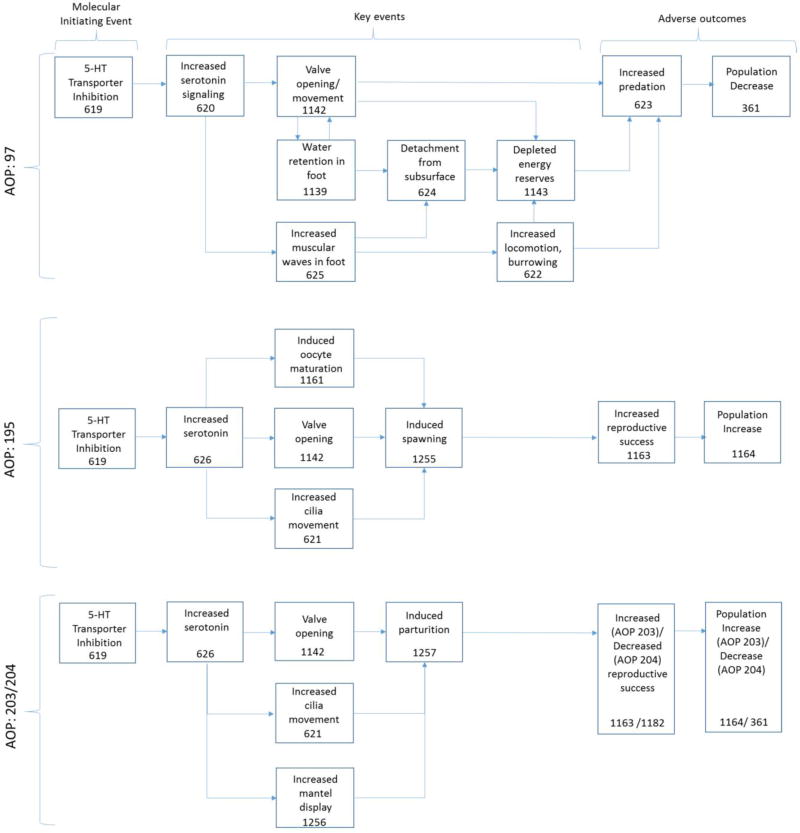
Adverse outcome pathways (AOPs) describe toxicant effects as a sequential chain of causally linked events beginning with a molecular perturbation and culminating in an adverse outcome at an individual or population level. Strategies for developing AOPs are still evolving and depend largely on the intended use or motivation for development and data availability. The present review describes 4 ecotoxicological AOP case studies, developed for different purposes. In each situation, creation of the AOP began in a manner determined by the initial motivation for its creation and expanded either to include additional components of the pathway or to address the domains of applicability in terms of chemical initiators, susceptible species, life stages, and so forth. Some general strategies can be gleaned from these case studies, which a developer may find to be useful for supporting an existing AOP or creating a new one. Several web-based tools that can aid in AOP assembly and evaluation of weight of evidence for scientific robustness of AOP components are highlighted. Environ Toxicol Chem 2017;36:1429-1449. © 2017 SETAC.
不良结局途径(AOPs)将毒物效应描述为一系列因果相关事件的连续链条,始于分子扰动,最终在个体或群体水平上导致不良结局。开发AOPs的策略仍在不断发展,很大程度上取决于开发的预期用途或动机以及数据的可用性。本综述描述了4个为不同目的而开发的生态毒理学AOP案例研究。在每种情况下,AOP的创建都以由其创建的初始动机决定的方式开始,并扩展到包括途径的其他组成部分,或在化学引发剂、易感物种、生命阶段等方面解决适用范围。可以从这些案例研究中收集一些通用策略,开发人员可能会发现这些策略有助于支持现有的AOP或创建新的AOP。文中强调了几种基于网络的工具,这些工具可以帮助进行AOP组装和评估AOP组件科学稳健性的证据权重。《环境毒理学与化学》2017年;36:1429 - 1449。© 2017 SETAC。