Jiangsu Key Laboratory of Atmospheric Environment Monitoring and Pollution Control, Collaborative Innovation Center of Atmospheric Environment and Equipment Technology, School of Environmental Science and Engineering, Nanjing University of Information Science &Technology, Nanjing, 210044, China.
Key Laboratory of Surficial Geochemistry, Ministry of Education, School of Earth Sciences and Engineering, Nanjing University, Nanjing 210093, China.
Sci Rep. 2017 Feb 13;7:40709. doi: 10.1038/srep40709.
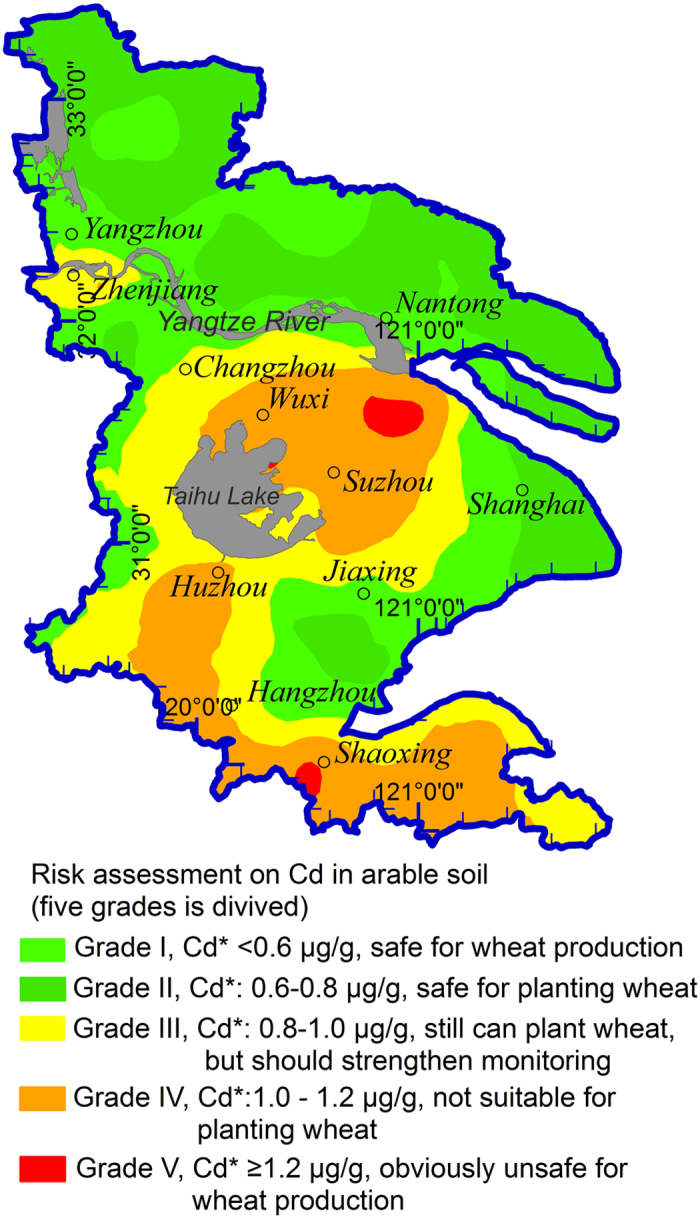
The bioavailability of heavy metals in soil is controlled by their concentrations and soil properties. Diffuse reflectance mid-infrared Fourier-transform spectroscopy (DRIFTS) is capable of detecting specific organic and inorganic bonds in metal complexes and minerals and therefore, has been employed to predict soil composition and heavy metal contents. The present study explored the potential of DRIFTS for estimating soil heavy metal bioavailability. Soil and corresponding wheat grain samples from the Yangtze River Delta region were analyzed by DRIFTS and chemical methods. Statistical regression analyses were conducted to correlate the soil spectral information to the concentrations of Cd, Cr, Cu, Zn, Pb, Ni, Hg and Fe in wheat grains. The principal components in the spectra influencing soil heavy metal bioavailability were identified and used in prediction model construction. The established soil DRIFTS-based prediction models were applied to estimate the heavy metal concentrations in wheat grains in the mid-Yangtze River Delta area. The predicted heavy metal concentrations of wheat grain were highly consistent with the measured levels by chemical analysis, showing a significant correlation (r > 0.72) with acceptable root mean square error RMSE. In conclusion, DRIFTS is a promising technique for assessing the bioavailability of soil heavy metals and related ecological risk.
土壤中重金属的生物有效性受其浓度和土壤性质的控制。漫反射中红外傅里叶变换光谱(DRIFTS)能够检测金属配合物和矿物质中的特定有机和无机键,因此已被用于预测土壤成分和重金属含量。本研究探讨了 DRIFTS 用于估算土壤重金属生物有效性的潜力。通过 DRIFTS 和化学方法分析了来自长江三角洲地区的土壤和相应的小麦籽粒样品。进行了统计回归分析,将土壤光谱信息与小麦籽粒中 Cd、Cr、Cu、Zn、Pb、Ni、Hg 和 Fe 的浓度相关联。确定了影响土壤重金属生物有效性的光谱中的主要成分,并用于预测模型的构建。建立的基于土壤 DRIFTS 的预测模型用于估算长江中游地区小麦籽粒中的重金属浓度。通过化学分析测量的重金属浓度与预测浓度高度一致,具有显著相关性(r > 0.72),误差可接受。总之,DRIFTS 是评估土壤重金属生物有效性和相关生态风险的有前途的技术。