Shlush Ekaterina, Maghen Leila, Swanson Sonja, Kenigsberg Shlomit, Moskovtsev Sergey, Barretto Tanya, Gauthier-Fisher Andrée, Librach Clifford L
CReATe Fertility Centre, 790 Bay Street, Toronto, Ontario, M5N 1G8, Canada.
Department of Obstetrics & Gynaecology, University of Toronto, Toronto, Ontario, Canada.
Stem Cell Res Ther. 2017 Feb 15;8(1):37. doi: 10.1186/s13287-017-0491-8.
First trimester (FTM) and term human umbilical cord-derived perivascular cells (HUCPVCs), which are rich sources of mesenchymal stem cells (MSCs), can give rise to Sertoli cell (SC)-like as well as haploid germ cell (GC)-like cells in vitro using culture conditions that recapitulate the testicular niche. Gamete-like cells have been produced ex vivo using pluripotent stem cells as well as MSCs. However, the production of functional gametes from human stem cells has yet to be achieved.
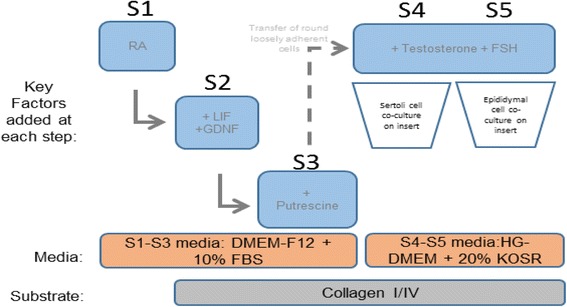
Three independent lines of FTM and term HUCPVCs were cultured using a novel 5-week step-wise in vitro differentiation protocol recapitulating key physiological signals involved in testicular development. SC- and GC-associated phenotypical properties were assessed by real-time polymerase chain reaction (RT-PCR), quantitative PCR immunocytochemistry, flow cytometry, and fluorescence in-situ hybridization (FISH). Functional spermatogonial stem cell-like properties were assessed using a xenotranplantation assay.
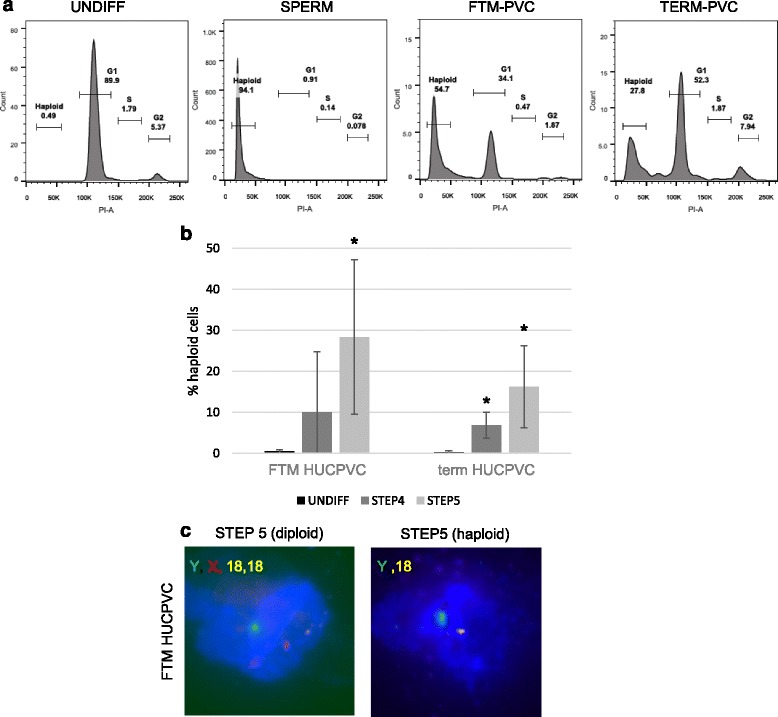
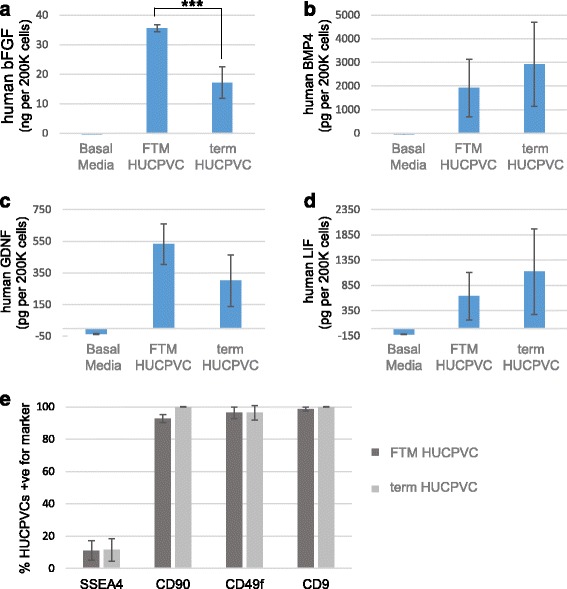
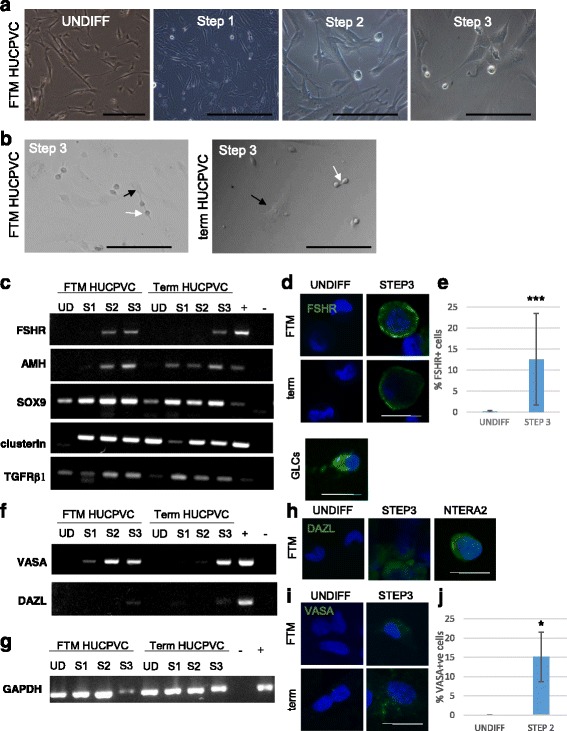
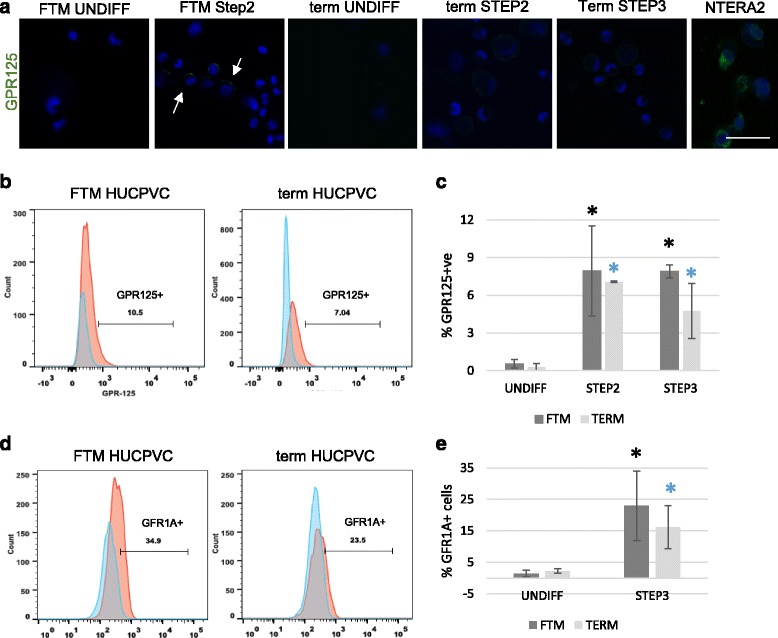
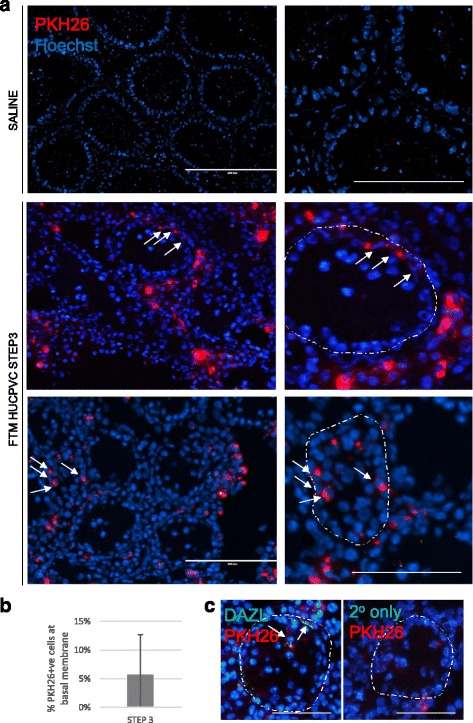
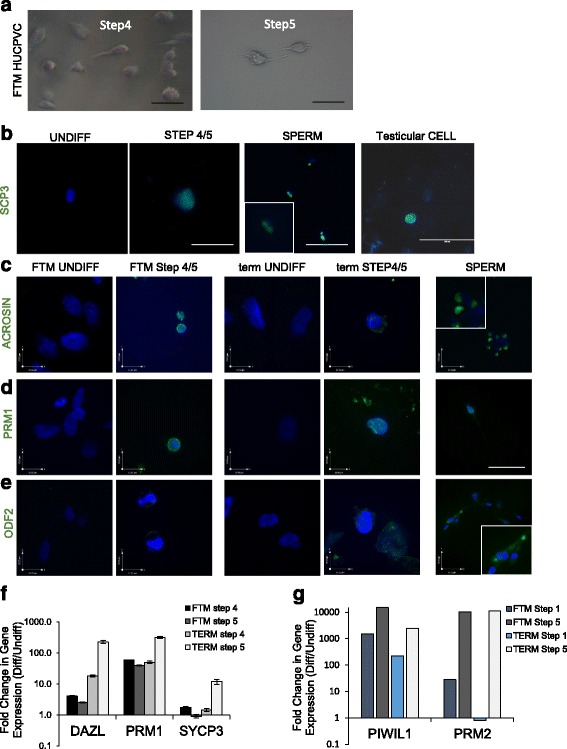
Within 3 weeks of differentiation, two morphologically distinct cell types emerged including large adherent cells and semi-attached round cells. Both early GC-associated markers (VASA, DAZL, GPR125, GFR1α) and SC-associated markers (FSHR, SOX9, AMH) were upregulated, and 5.7 ± 1.2% of these cells engrafted near the inner basal membrane in a xenograft assay. After 5 weeks in culture, 10-30% of the cells were haploid, had adopted a spermatid-like morphology, and expressed PRM1, Acrosin, and ODF2. Undifferentiated HUCPVCs secreted key factors known to regulate spermatogenesis (LIF, GDNF, BMP4, bFGF) and 10-20% of HUCPVCs co-expressed SSEA4, CD9, CD90, and CD49f. We hypothesize that the paracrine properties and cellular heterogeneity of HUCPVCs may explain their dual capacity to differentiate to both SC- and GC-like cells.
HUCPVCs recapitulate elements of the testicular niche including their ability to differentiate into cells with Sertoli-like and haploid spermatid-like properties in vitro. Our study supports the importance of generating a niche-like environment under ex vivo conditions aiming at creating mature GC, and highlights the plasticity of HUCPVCs. This could have future applications for the treatment of some cases of male infertility.
孕早期(FTM)和足月人脐带源血管周围细胞(HUCPVCs)是间充质干细胞(MSCs)的丰富来源,利用模拟睾丸微环境的培养条件,它们在体外可分化为支持细胞(SC)样细胞以及单倍体生殖细胞(GC)样细胞。已利用多能干细胞和间充质干细胞在体外产生了类配子细胞。然而,从人类干细胞产生功能性配子尚未实现。
使用一种全新的为期5周的逐步体外分化方案培养三株独立的FTM和足月HUCPVCs系,该方案可重现睾丸发育过程中涉及的关键生理信号。通过实时聚合酶链反应(RT-PCR)、定量PCR、免疫细胞化学、流式细胞术和荧光原位杂交(FISH)评估与SC和GC相关的表型特性。使用异种移植试验评估功能性精原干细胞样特性。
在分化的3周内,出现了两种形态上不同的细胞类型,包括大的贴壁细胞和半贴壁的圆形细胞。早期与GC相关的标志物(VASA、DAZL、GPR125、GFR1α)和与SC相关的标志物(FSHR、SOX9、AMH)均上调,并且在异种移植试验中,这些细胞中有5.7±1.2%植入到近基底膜内侧。培养5周后,10 - 30%的细胞为单倍体,具有精子细胞样形态,并表达PRM1、顶体素和ODF2。未分化的HUCPVCs分泌已知调节精子发生的关键因子(LIF、GDNF、BMP4;碱性成纤维细胞生长因子),并且10 - 20%的HUCPVCs共表达阶段特异性胚胎抗原4(SSEA4)、CD9、CD90和CD49f。我们推测,HUCPVCs的旁分泌特性和细胞异质性可能解释了它们分化为SC样细胞和GC样细胞的双重能力。
HUCPVCs重现了睾丸微环境的要素,包括它们在体外分化为具有支持细胞样和单倍体精子细胞样特性细胞的能力。我们的研究支持了在体外条件下营造类似微环境以产生成熟GC的重要性,并突出了HUCPVCs的可塑性。这可能在未来用于治疗某些男性不育病例。