Kristensen Tilde, Ivarsen Per, Povlsen Johan Vestergaard
Department of Renal Medicine, Aarhus University Hospital, Aarhus, Denmark.
Case Rep Nephrol Dial. 2017 Jan 6;7(1):1-5. doi: 10.1159/000454947. eCollection 2017 Jan-Apr.
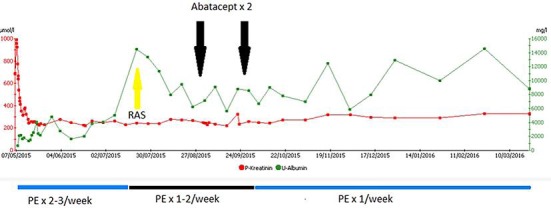
Recurrence of focal segmental glomerulosclerosis (FSGS) after renal transplantation occurs in up to 20-50% of FSGS patients and is associated with inferior allograft survival. Treatment of both primary FSGS as well as recurrent FSGS after transplantation with plasma exchange and immunosuppression is often unsuccessful and remains a major challenge as the disease still leads to end-stage renal disease and decreased graft survival. Previous case reports have described patients with recurrent FSGS who were successfully treated with a B7-1 inhibitor (abatacept) inducing partial or complete remission. The rational basis for believing in abatacept as a new therapeutic drug for the treatment of FSGS is the study by Yu et al. [N Engl J Med 2013;369: 2416-2423] showing B7-1 in immunostainings of the podocytes. The authors speculated that B7-1 immunostaining of renal biopsies might identify a subgroup of patients who would benefit from abatacept treatment. We present a case with recurrent FSGS after renal transplantation. The patient was unsuccessfully treated with B7-1 inhibitors. Although the patient was treated with abatacept 10 mg/kg body weight twice, the proteinuria and decreased graft function remained unchanged, and he never reached remission.
肾移植后局灶节段性肾小球硬化(FSGS)复发见于高达20% - 50%的FSGS患者,且与移植肾较差的存活情况相关。对原发性FSGS以及移植后复发性FSGS采用血浆置换和免疫抑制治疗往往不成功,仍然是一个重大挑战,因为该疾病仍会导致终末期肾病并降低移植肾存活率。既往病例报告描述了复发性FSGS患者成功接受B7 - 1抑制剂(阿巴西普)治疗并诱导部分或完全缓解的情况。相信阿巴西普可作为治疗FSGS的新治疗药物的合理依据是Yu等人的研究[《新英格兰医学杂志》2013年;369: 2416 - 2423],该研究显示足细胞免疫染色中有B7 - 1。作者推测肾活检的B7 - 1免疫染色可能识别出能从阿巴西普治疗中获益的患者亚组。我们报告一例肾移植后复发性FSGS病例。该患者接受B7 - 1抑制剂治疗未成功。尽管该患者接受了10 mg/kg体重的阿巴西普治疗两次,但蛋白尿和移植肾功能下降仍未改变,且他从未达到缓解。