The Aurum Institute, Johannesburg, 29 Queens Road, Parktown Johannesburg, Gauteng, 2193 South Africa.
Department of Global Health and Development, London School of Hygiene and Tropical Medicine, London WC1E 7HT, UK.
Health Policy Plan. 2017 Nov 1;32(suppl_4):iv48-iv56. doi: 10.1093/heapol/czw183.
This study describes the post-diagnosis care-seeking costs incurred by people living with TB and/or HIV and their households, in order to identify the potential benefits of integrated care.
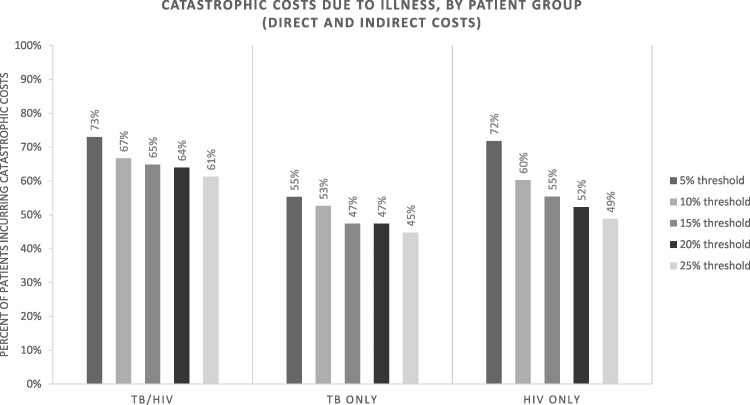
We conducted a cross-sectional study with 454 participants with TB or HIV or both in public primary health care clinics in Ekurhuleni North Sub-District, South Africa. We collected information on visits to health facilities, direct and indirect costs for participants and for their guardians and caregivers. We define 'integration' as receipt of both TB and HIV services at the same facility, on the same day. Costs were presented and compared across participants with TB/HIV, TB-only and HIV-only. Costs exceeding 10% of participant income were considered catastrophic.
Participants with both TB and HIV faced a greater economic burden (US$74/month) than those with TB-only (US$68/month) or HIV-only (US$40/month). On average, people with TB/HIV made 18.4 visits to health facilities, more than TB-only participants or HIV-only participants who made 16 and 5.1 visits, respectively. However, people with TB/HIV had fewer standalone TB (10.9) and HIV (2.2) visits than those with TB-only (14.5) or HIV-only (4.4). Although people with TB/HIV had access to 'integrated' services, their time loss was substantially higher than for other participants. Overall, 55% of participants encountered catastrophic costs. Access to official social protection schemes was minimal.
People with TB/HIV in South Africa are at high risk of catastrophic costs. To some extent, integration of services reduces the number of standalone TB and HIV of visits to the health facility. It is however unlikely that catastrophic costs can be averted by service integration alone. Our results point to the need for timely social protection, particularly for HIV-positive people starting TB treatment.
本研究描述了结核分枝杆菌(TB)和/或人类免疫缺陷病毒(HIV)感染者及其家庭在确诊后的就诊费用,以确定综合护理的潜在获益。
我们在南非埃库鲁莱尼北部分区的公立初级保健诊所开展了一项横断面研究,共纳入了 454 名结核分枝杆菌或人类免疫缺陷病毒或两者均有的参与者。我们收集了参与者及其监护人、照顾者就诊次数、直接和间接费用等信息。我们将“整合”定义为在同一设施、同一天接受结核分枝杆菌和 HIV 服务。我们对结核分枝杆菌/人类免疫缺陷病毒、仅结核分枝杆菌和仅人类免疫缺陷病毒患者的费用进行了呈现和比较。超过参与者收入 10%的费用被认为是灾难性的。
同时患有结核分枝杆菌和 HIV 的参与者面临更大的经济负担(74 美元/月),而仅患有结核分枝杆菌或仅患有 HIV 的参与者的经济负担分别为 68 美元/月和 40 美元/月。平均而言,结核分枝杆菌/人类免疫缺陷病毒患者就诊 18.4 次,高于仅患有结核分枝杆菌或仅患有 HIV 的患者(分别为 16 次和 5.1 次)。然而,结核分枝杆菌/人类免疫缺陷病毒患者的独立结核分枝杆菌(10.9)和 HIV(2.2)就诊次数少于仅患有结核分枝杆菌(14.5)或仅患有 HIV(4.4)的患者。尽管结核分枝杆菌/人类免疫缺陷病毒患者获得了“整合”服务,但他们的时间损失明显高于其他参与者。总体而言,55%的参与者遭遇了灾难性的费用。获得官方社会保护计划的机会微乎其微。
南非的结核分枝杆菌/人类免疫缺陷病毒患者有发生灾难性费用的高风险。在一定程度上,服务整合减少了独立结核分枝杆菌和 HIV 就诊次数。然而,仅通过服务整合不太可能避免灾难性费用。我们的结果表明,需要及时提供社会保护,特别是对开始接受结核分枝杆菌治疗的 HIV 阳性人群。