Jones Robert P, Sutton Paul A, Evans Jonathan P, Clifford Rachel, McAvoy Andrew, Lewis James, Rousseau Abigail, Mountford Roger, McWhirter Derek, Malik Hassan Z
North Western Hepatobiliary Unit, Aintree University Hospital, Liverpool, UK.
School of Cancer Studies, Institute of Translational Medicine, University of Liverpool, Liverpool, UK.
Br J Cancer. 2017 Mar 28;116(7):923-929. doi: 10.1038/bjc.2017.37. Epub 2017 Feb 16.
Activating mutations in KRAS have been suggested as potential predictive and prognostic biomarkers. However, the prognostic impact of specific point mutations remains less clear. This study assessed the prognostic impact of specific KRAS mutations on survival for patients with colorectal cancer.
Retrospective review of patients KRAS typed for advanced and recurrent colorectal cancer between 2010 and 2015 in a UK Cancer Network.
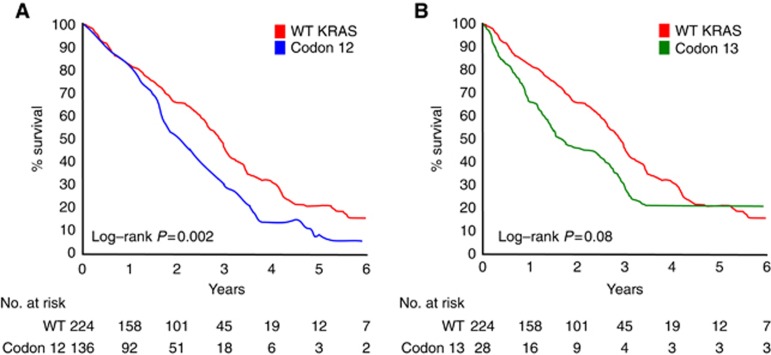
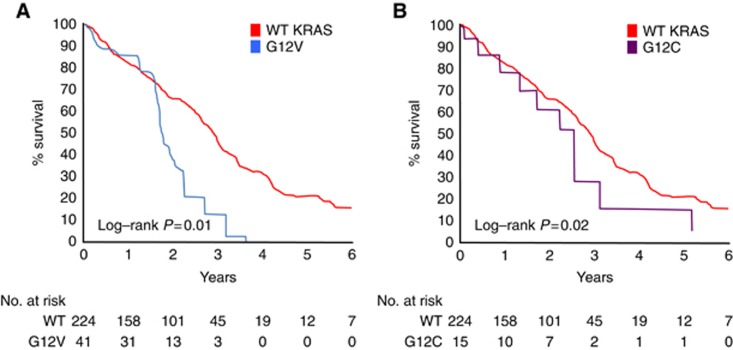
We evaluated the impact of KRAS genotype in 392 patients. Mutated KRAS was detected in 42.9% of tumours. KRAS mutations were more common in moderate vs well-differentiated tumours. On multivariate analysis, primary tumour T stage (HR 2.77 (1.54-4.98), P=0.001), N stage (HR 1.51 (1.01-2.26), P=0.04), curative intent surgery (HR 0.51 (0.34-0.76), P=0.001), tumour grade (HR 0.44 (0.30-0.65), P=0.001) and KRAS mutation (1.54 (1.23-2.12), P=0.005) were all predictive of overall survival. Patients with KRAS codon 12 mutations had worse overall survival (HR 1.76 (95% CI 1.27-2.43), P=0.001). Among the five most common codon 12 mutations, only p.G12C (HR 2.21 (1.15-4.25), P=0.01) and p.G12V (HR 1.69 (1.08-2.62), P=0.02) were predictive of overall survival.
For patients with colorectal cancer, p.G12C and p.G12V mutations in codon 12 were independently associated with worse overall survival after diagnosis.
KRAS激活突变被认为是潜在的预测和预后生物标志物。然而,特定点突变的预后影响仍不太明确。本研究评估了特定KRAS突变对结直肠癌患者生存的预后影响。
回顾性分析2010年至2015年在英国癌症网络中对晚期和复发性结直肠癌进行KRAS分型的患者。
我们评估了392例患者中KRAS基因型的影响。42.9%的肿瘤检测到KRAS突变。KRAS突变在中度分化肿瘤中比高分化肿瘤更常见。多因素分析显示,原发肿瘤T分期(HR 2.77(1.54 - 4.98),P = 0.001)、N分期(HR 1.51(1.01 - 2.26),P = 0.04)、根治性手术(HR 0.51(0.34 - 0.76),P = 0.001)、肿瘤分级(HR 0.44(0.30 - 0.65),P = 0.001)和KRAS突变(1.54(1.23 - 2.12),P = 0.005)均为总生存的预测因素。KRAS密码子12突变的患者总生存更差(HR 1.76(95%CI 1.27 - 2.43),P = 0.001)。在五个最常见的密码子12突变中,只有p.G12C(HR 2.21(1.15 - 4.25),P = 0.01)和p.G12V(HR 1.69(1.08 - 2.62),P = 0.02)可预测总生存。
对于结直肠癌患者,密码子12中的p.G12C和p.G12V突变与诊断后的总生存较差独立相关。