Beversdorf Lucas J, Weirich Chelsea A, Bartlett Sarah L, Miller Todd R
Joseph J. Zilber School of Public Health, University of Wisconsin-Milwaukee, Milwaukee, WI 53211, USA.
School of Freshwater Sciences, University of Wisconsin-Milwaukee, Milwaukee, WI 53204, USA.
Toxins (Basel). 2017 Feb 10;9(2):62. doi: 10.3390/toxins9020062.
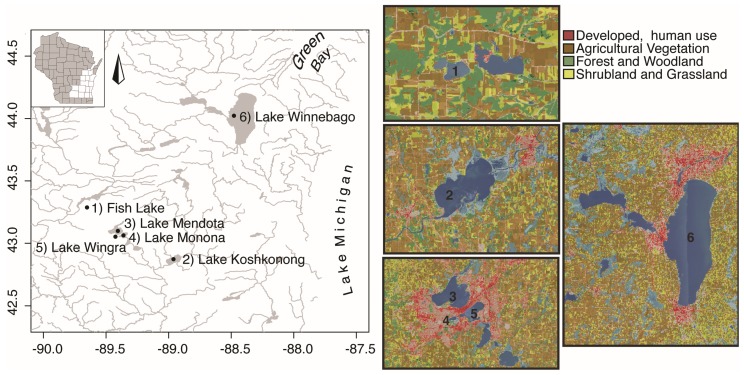
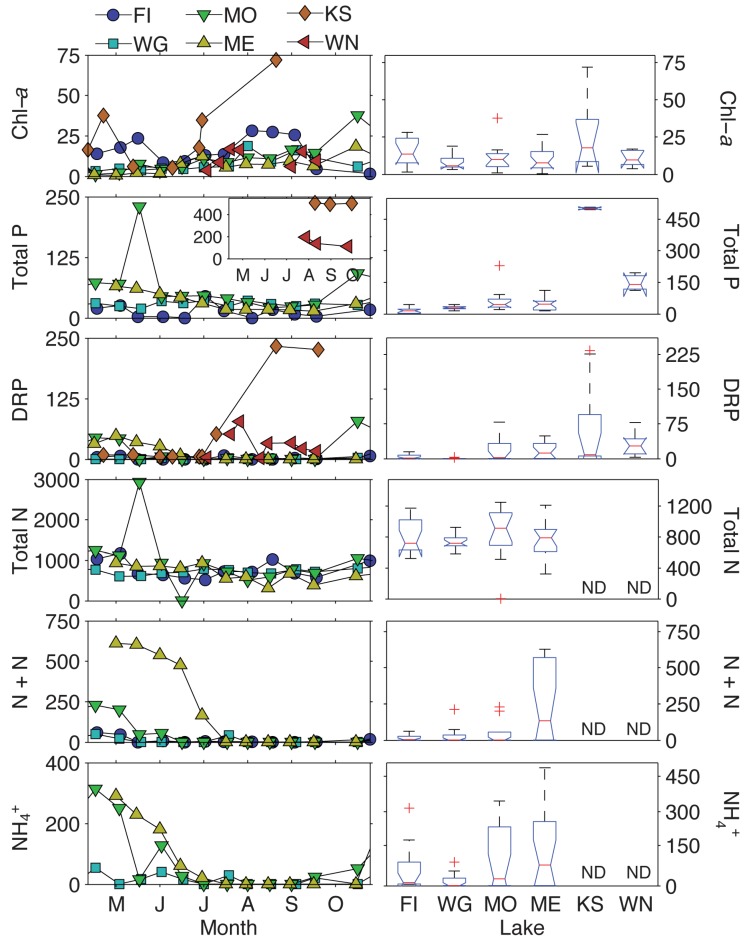
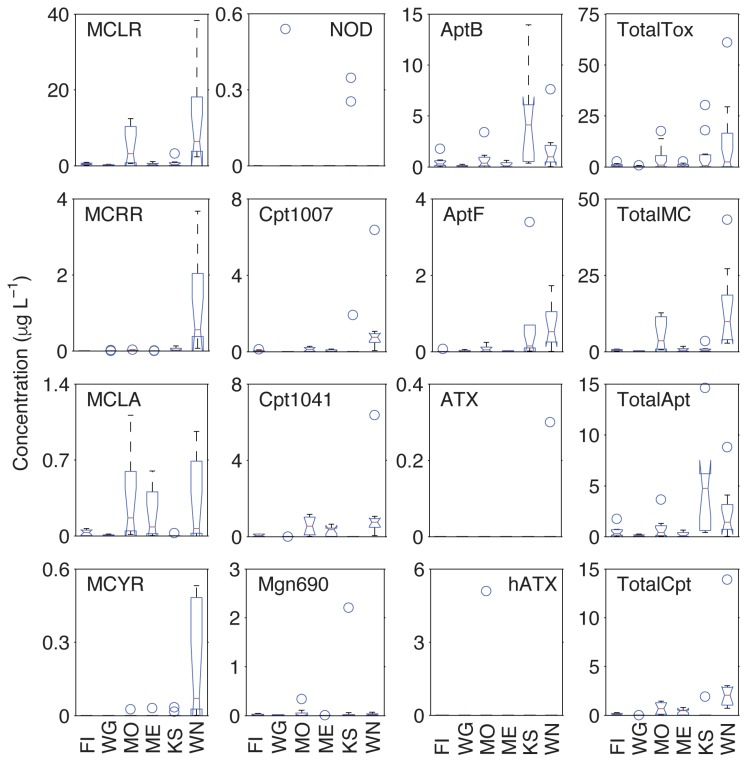
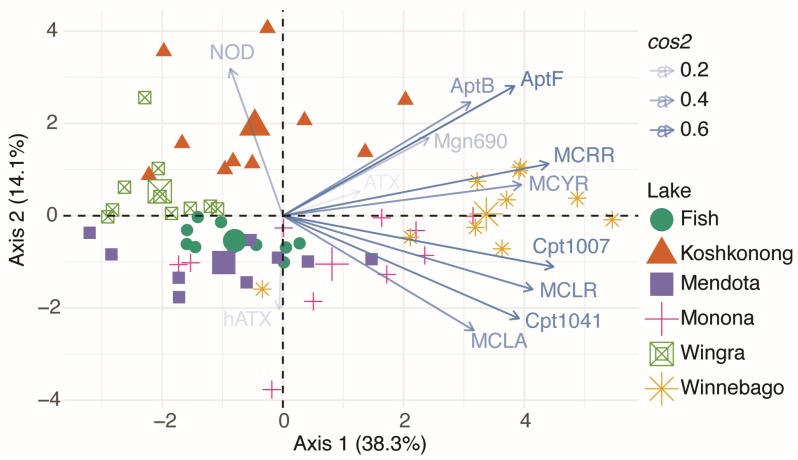
Future sustainability of freshwater resources is seriously threatened due to the presence of harmful cyanobacterial blooms, and yet, the number, extent, and distribution of most cyanobacterial toxins-including "emerging" toxins and other bioactive compounds-are poorly understood. We measured 15 cyanobacterial compounds-including four microcystins (MC), saxitoxin (SXT), cylindrospermopsin (CYL), anatoxin-a (ATX) and homo-anatoxin-a (hATX), two anabaenopeptins (Apt), three cyanopeptolins (Cpt), microginin (Mgn), and nodularin (NOD)-in six freshwater lakes that regularly experience noxious cHABs. MC, a human liver toxin, was present in all six lakes and was detected in 80% of all samples. Similarly, Apt, Cpt, and Mgn were detected in all lakes in roughly 86%, 50%, and 35% of all samples, respectively. Despite being a notable brackish water toxin, NOD was detected in the two shallowest lakes-Wingra (4.3 m) and Koshkonong (2.1 m). All compounds were highly variable temporally, and spatially. Metabolite profiles were significantly different between lakes suggesting lake characteristics influenced the cyanobacterial community and/or metabolite production. Understanding how cyanobacterial toxins are distributed across eutrophic lakes may shed light onto the ecological function of these metabolites, provide valuable information for their remediation and removal, and aid in the protection of public health.
由于有害蓝藻水华的出现,淡水资源的未来可持续性受到严重威胁,然而,大多数蓝藻毒素(包括“新兴”毒素和其他生物活性化合物)的数量、范围和分布情况却鲜为人知。我们在六个经常出现有害蓝藻水华的淡水湖中检测了15种蓝藻化合物,包括四种微囊藻毒素(MC)、石房蛤毒素(SXT)、柱孢藻毒素(CYL)、类毒素-a(ATX)和高类毒素-a(hATX)、两种节球藻肽(Apt)、三种环肽(Cpt)、微囊藻毒素(Mgn)和节球藻毒素(NOD)。MC是一种人类肝脏毒素,在所有六个湖泊中均有出现,且在所有样本的80%中被检测到。同样,Apt、Cpt和Mgn分别在所有湖泊中约86%、50%和35%的样本中被检测到。尽管NOD是一种显著的咸淡水毒素,但在两个最浅的湖泊——温格拉湖(4.3米)和科什科农湖(2.1米)中检测到了它。所有化合物在时间和空间上都具有高度变异性。湖泊之间的代谢物谱存在显著差异,这表明湖泊特征影响了蓝藻群落和/或代谢物的产生。了解蓝藻毒素在富营养化湖泊中的分布情况,可能有助于揭示这些代谢物的生态功能,为其修复和去除提供有价值的信息,并有助于保护公众健康。