Vincent Grace E, Aisbett Brad, Larsen Brianna, Ridgers Nicola D, Snow Rod, Ferguson Sally A
Appleton Institute, School of Health, Medical and Applied Sciences, Central Queensland University, Wayville 5034, Australia.
School of Exercise and Nutrition Sciences, Deakin University, Geelong 3220, Australia.
Int J Environ Res Public Health. 2017 Feb 12;14(2):180. doi: 10.3390/ijerph14020180.
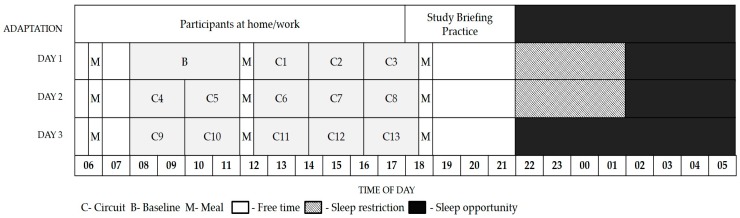
This study was designed to examine the effects of ambient heat on firefighters' physical task performance, and physiological and perceptual responses when sleep restricted during simulated wildfire conditions. Thirty firefighters were randomly allocated to the sleep restricted ( 17, SR; 19 °C, 4-h sleep opportunity) or hot and sleep restricted ( 13, HOT + SR; 33 °C, 4-h sleep opportunity) condition. Firefighters performed two days of simulated, intermittent, self-paced work circuits comprising six firefighting tasks. Heart rate, and core temperature were measured continuously. After each task, firefighters reported their rating of perceived exertion and thermal sensation. Effort sensation was also reported after each work circuit. Fluids were consumed ad libitum. Urine volume and urine specific gravity were analysed. Sleep was monitored using polysomnography. There were no differences between the SR and HOT + SR groups in firefighters' physiological responses, hydration status, ratings of perceived exertion, motivation, and four of the six firefighting tasks (charged hose advance, rake, hose rolling, static hose hold). Black out hose and lateral repositioning were adversely affected in the HOT + SR group. Working in hot conditions did not appear to consistently impair firefighters work performance, physiology, and perceptual responses. Future research should determine whether such findings remain true when individual tasks are performed over longer durations.
本研究旨在考察在模拟野火条件下睡眠受限期间,环境热对消防员身体任务表现、生理和感知反应的影响。30名消防员被随机分配到睡眠受限组(17人,SR组;19摄氏度,4小时睡眠机会)或热且睡眠受限组(13人,HOT + SR组;33摄氏度,4小时睡眠机会)。消防员进行了为期两天的模拟、间歇性、自主节奏的工作循环,包括六项消防任务。连续测量心率和核心体温。每项任务后,消防员报告他们的主观用力感觉评分和热感觉。每个工作循环后也报告努力感觉。随意饮用液体。分析尿量和尿比重。使用多导睡眠图监测睡眠情况。SR组和HOT + SR组在消防员的生理反应、水合状态、主观用力感觉评分、动机以及六项消防任务中的四项(带压水带推进、耙地、水带滚动、静态水带握持)方面没有差异。在HOT + SR组中,遮光水带和侧向重新定位受到不利影响。在炎热条件下工作似乎并没有持续损害消防员的工作表现、生理和感知反应。未来的研究应该确定当个体任务持续更长时间时,这些发现是否仍然成立。