van de Water Tanja, Huijgen Barbara, Faber Irene, Elferink-Gemser Marije
Center for Human Movement Sciences, University Medical Centre Groningen, University of Groningen, Groningen, The Netherlands.
Faculty of Physical Activity and Health, Saxion University of Applied Sciences, Enschede, The Netherlands; Radboud University Medical Centre, Radboud Institute for Health Sciences, IQhealthcare, Nijmegen, The Netherlands; Sports Science and Medical Committee, International Table Tennis Federation, Lausanne, Switzerland.
J Hum Kinet. 2017 Jan 30;55:149-159. doi: 10.1515/hukin-2017-0014. eCollection 2017 Jan 1.
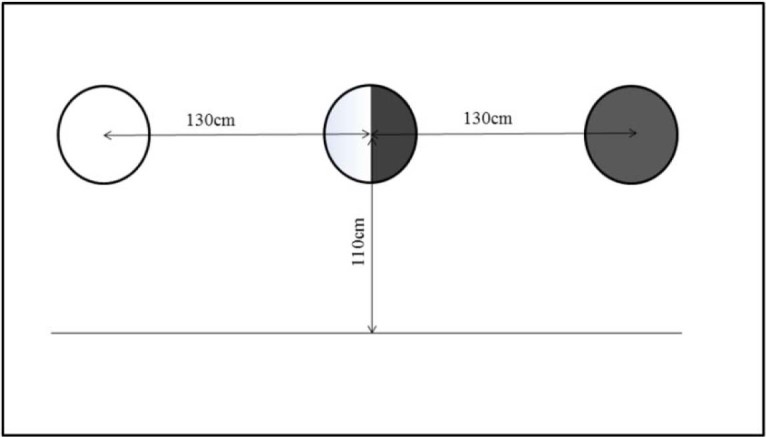
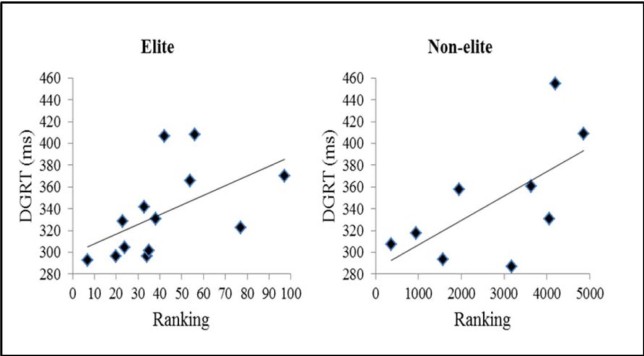
Fast reaction and good inhibitory control are associated with elite sports performance. To evaluate the reproducibility and validity of a newly developed Badminton Reaction Inhibition Test (BRIT), fifteen elite (25 ± 4 years) and nine non-elite (24 ± 4 years) Dutch male badminton players participated in the study. The BRIT measured four components: domain-general reaction time, badminton-specific reaction time, domain-general inhibitory control and badminton-specific inhibitory control. Five participants were retested within three weeks on the badminton-specific components. Reproducibility was acceptable for badminton-specific reaction time (ICC = 0.626, CV = 6%) and for badminton-specific inhibitory control (ICC = 0.317, CV = 13%). Good construct validity was shown for badminton-specific reaction time discriminating between elite and non-elite players (F = 6.650, p < 0.05). Elite players did not outscore non-elite players on domain-general reaction time nor on both components of inhibitory control (p > 0.05). Concurrent validity for domain-general reaction time was good, as it was associated with a national ranking for elite (p = 0.70, p < 0.01) and non-elite (p = 0.70, p < 0.05) players. No relationship was found between the national ranking and badminton-specific reaction time, nor both components of inhibitory control (p > 0.05). In conclusion, reproducibility and validity of inhibitory control assessment was not confirmed, however, the BRIT appears a reproducible and valid measure of reaction time in badminton players. Reaction time measured with the BRIT may provide input for training programs aiming to improve badminton players' performance.
快速反应和良好的抑制控制与精英运动表现相关。为评估新开发的羽毛球反应抑制测试(BRIT)的可重复性和有效性,15名精英(25±4岁)和9名非精英(24±4岁)荷兰男性羽毛球运动员参与了该研究。BRIT测量了四个组成部分:一般领域反应时间、羽毛球特定反应时间、一般领域抑制控制和羽毛球特定抑制控制。五名参与者在三周内对羽毛球特定组成部分进行了重新测试。羽毛球特定反应时间(ICC = 0.626,CV = 6%)和羽毛球特定抑制控制(ICC = 0.317,CV = 13%)的可重复性是可接受的。羽毛球特定反应时间在区分精英和非精英球员方面显示出良好的结构效度(F = 6.650,p < 0.05)。精英球员在一般领域反应时间以及抑制控制的两个组成部分上均未超过非精英球员(p > 0.05)。一般领域反应时间的同时效度良好,因为它与精英(p = 0.70,p < 0.01)和非精英(p = 0.70,p < 0.05)球员的全国排名相关。未发现全国排名与羽毛球特定反应时间以及抑制控制的两个组成部分之间存在关联(p > 0.05)。总之,抑制控制评估的可重复性和有效性未得到证实,然而,BRIT似乎是一种可重复且有效的羽毛球运动员反应时间测量方法。用BRIT测量的反应时间可为旨在提高羽毛球运动员表现的训练计划提供参考。