Jaarsma Tiny, Cameron Jan, Riegel Barbara, Stromberg Anna
Division of Nursing, Department of Social and Welfare Studies, Linköping University, campus Norrköping, s-581 83, Linköping, Sweden.
Mary Mackillop Institute, Australian Catholic University, Melbourne, Australia.
Curr Heart Fail Rep. 2017 Apr;14(2):71-77. doi: 10.1007/s11897-017-0324-1.
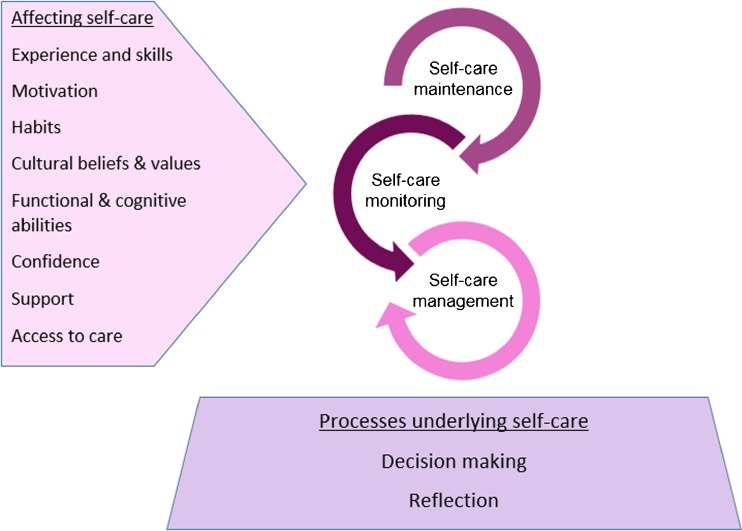
As described in the theory of self-care in chronic illness, there is a wide range of factors that can influence self-care behavior. The purpose of this paper is to summarize the recent heart failure literature on these related factors in order to provide an overview on which factors might be suitable to be considered to make self-care interventions more successful.
Recent studies in heart failure patients confirm that factors described in the theory of self-care of chronic illness are relevant for heart failure patients. Experiences and skills, motivation, habits, cultural beliefs and values, functional and cognitive abilities, confidence, and support and access to care are all important to consider when developing or improving interventions for patients with heart failure and their families. Additional personal and contextual factors that might influence self-care need to be explored and included in future studies and theory development efforts.
正如慢性病自我护理理论中所描述的,有多种因素可影响自我护理行为。本文的目的是总结近期心力衰竭文献中关于这些相关因素的内容,以便概述哪些因素可能适合被考虑以提高自我护理干预的成功率。
近期针对心力衰竭患者的研究证实,慢性病自我护理理论中所描述的因素与心力衰竭患者相关。在为心力衰竭患者及其家人制定或改进干预措施时,经验与技能、动机、习惯、文化信仰与价值观、功能与认知能力、信心以及护理支持与可及性都是需要考虑的重要因素。未来的研究和理论发展工作需要探索并纳入可能影响自我护理的其他个人和背景因素。