Sun Lei, Zhao Fen, Zeng Yan, Yi Cheng
Department of Second Internal Medicine, No. 4 West China Teaching Hospital, Sichuan University, Chengdu, Sichuan, China (mainland).
Department of Medical Oncology, Chengdu First People's Hospital, Chengdu, Sichuan, China (mainland).
Med Sci Monit. 2017 Feb 19;23:889-910. doi: 10.12659/msm.903328.
BACKGROUND Esophageal cancer has traditionally been associated with very poor outcomes. A number of therapies are available for the treatment and palliation of esophageal cancer, but little systematic evidence compares the efficacy of different treatment strategies. This meta-analysis aimed to investigate whether treatments in addition to radiotherapy could provide better efficacy and safety. MATERIAL AND METHODS We identified a total of 12 eligible studies with 18 study arms by searching PubMed, the Cochrane Library, EMBASE, and Clinical Trials.gov without time or language restrictions. The final search was conducted on 17 August 2016. We calculated mean differences (MD) and risk ratios (RR) with 95% confidence intervals (CI) for continuous and dichotomous data, respectively. Heterogeneity was calculated and reported using Tau², Chi², and I² analyses. RESULTS Twelve studies with 18 study arms were included in the analysis. Addition of surgery to chemo-radiotherapy resulted in improved median survival time (p=0.009) compared with chemo-radiotherapy alone, but all other outcomes were unaffected. Strikingly, and in contrast with patients with squamous cell carcinomas, the subset of patients with adenocarcinoma who received therapies in addition to radiotherapy showed a significant improvement in median survival time (p<0.0001), disease-free survival (p=0.007), 2-year survival rates (p=0.002), and 3-year survival rates (p=0.01). The incidence of adverse effects increased substantially with additional therapies. CONCLUSIONS This meta-analysis reveals stark differences in outcomes in patients depending on the type of carcinoma. Patients with squamous cell carcinoma should be educated about the risks and benefits of undergoing multiple therapies.
背景 食管癌传统上一直与非常差的预后相关。有多种疗法可用于食管癌的治疗和姑息治疗,但很少有系统的证据比较不同治疗策略的疗效。这项荟萃分析旨在研究除放疗外的其他治疗方法是否能提供更好的疗效和安全性。
材料与方法 我们通过检索PubMed、Cochrane图书馆、EMBASE和ClinicalTrials.gov,共识别出12项符合条件的研究,包含18个研究组,检索无时间或语言限制。最终检索于2016年8月17日进行。我们分别针对连续性数据和二分法数据计算了95%置信区间(CI)的平均差(MD)和风险比(RR)。使用Tau²、Chi²和I²分析计算并报告异质性。
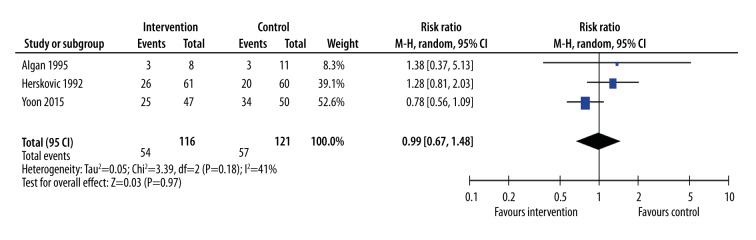
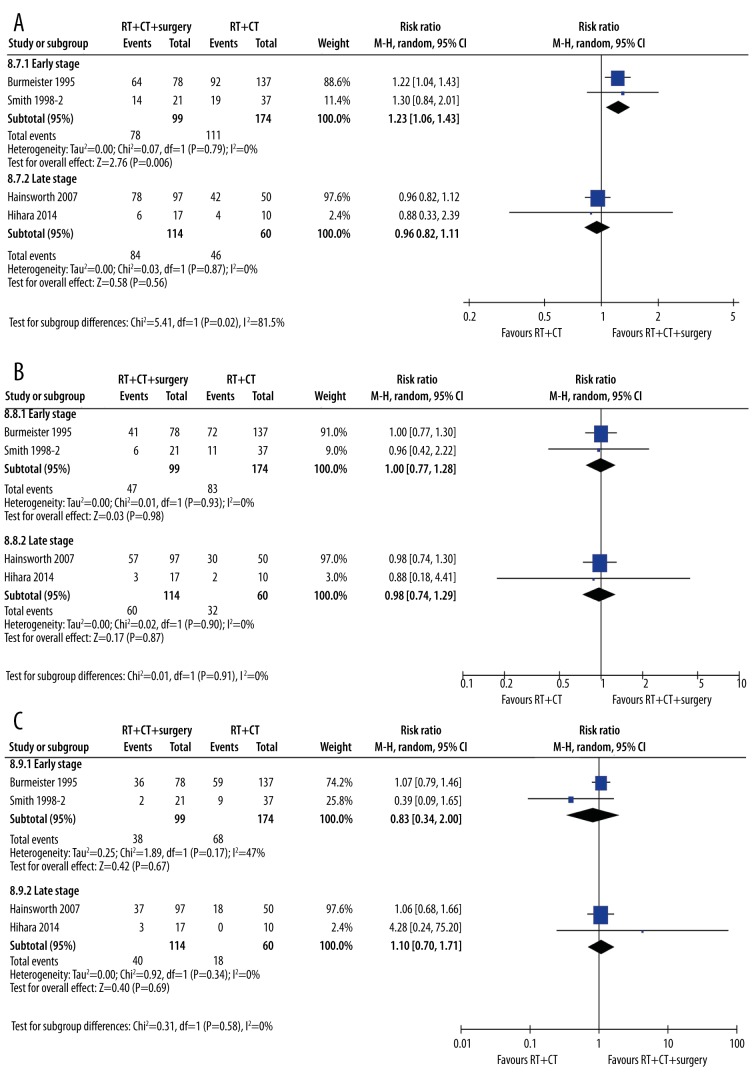
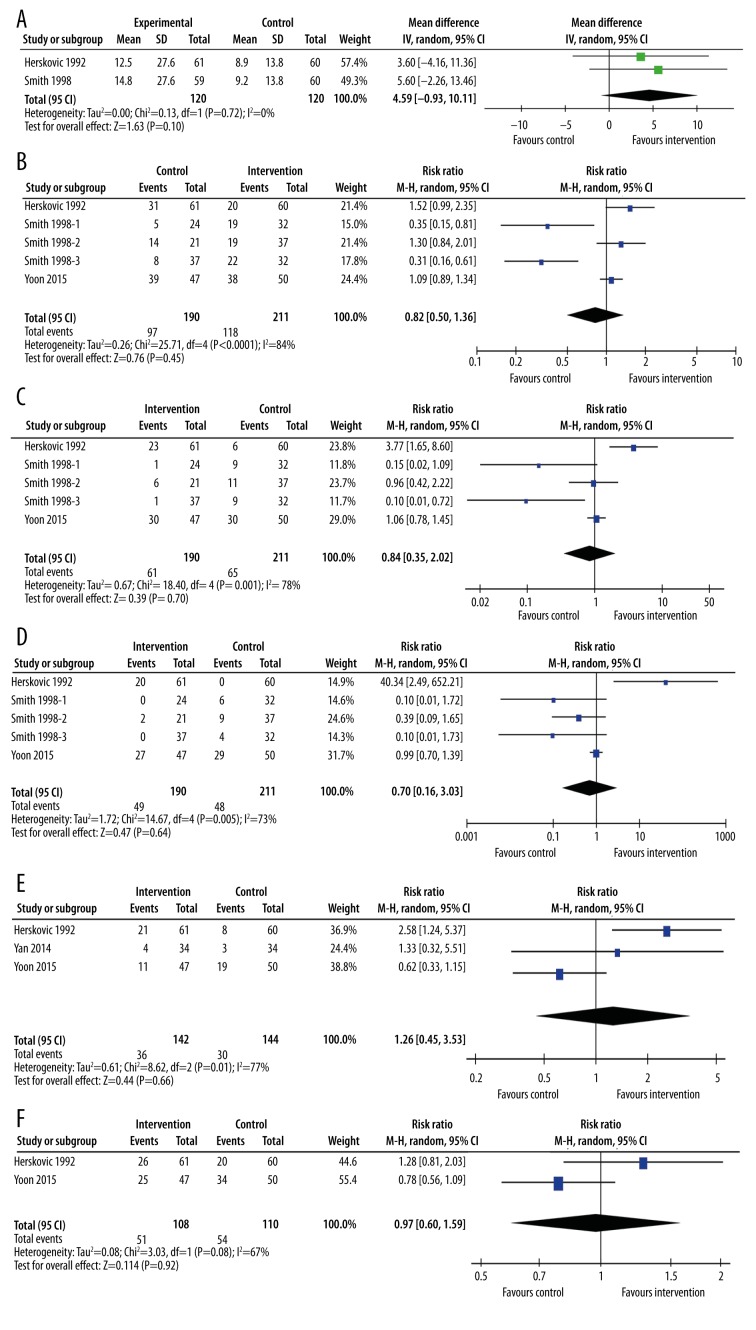
结果 分析纳入了12项研究,包含18个研究组。与单纯放化疗相比,放化疗联合手术可改善中位生存时间(p = 0.009),但所有其他结局均未受影响。令人惊讶的是,与鳞状细胞癌患者相反,接受放疗以外治疗的腺癌患者亚组在中位生存时间(p < 0.0001)、无病生存期(p = 0.007)、2年生存率(p = 0.002)和3年生存率(p = 0.01)方面均有显著改善。额外治疗使不良反应发生率大幅增加。
结论 这项荟萃分析揭示了不同类型癌症患者的预后存在明显差异。应让鳞状细胞癌患者了解接受多种治疗的风险和益处。