Jansen Pauline W, de Barse Lisanne M, Jaddoe Vincent W V, Verhulst Frank C, Franco Oscar H, Tiemeier Henning
Institute of Psychology, Erasmus University Rotterdam, Netherlands; Department of Child and Adolescent Psychiatry, Psychology, Erasmus MC-Sophia, Netherlands.
The Generation R Study Group, Erasmus MC, University Medical Center, Rotterdam, Netherlands; Department of Epidemiology, Erasmus MC, University Medical Center, Rotterdam, Netherlands.
Physiol Behav. 2017 Jul 1;176:101-106. doi: 10.1016/j.physbeh.2017.02.015. Epub 2017 Feb 16.
Fussy eating is common in young children, often raising concerns among parents. The use of pressuring feeding practices may provoke or worsen child fussiness, but these practices could equally be a parent's response to child fussy eating.
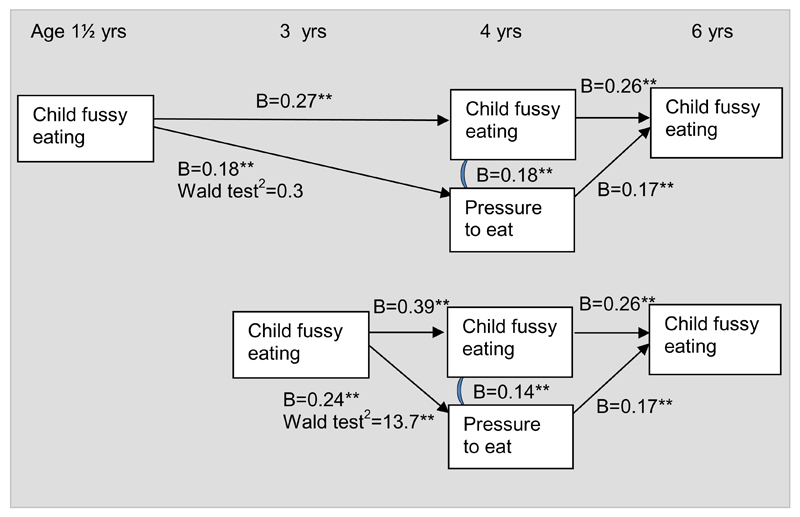
In longitudinal analyses, we assessed directionality in the relation between fussy eating and parent's pressure to eat across childhood.
Study participants were 4845 mother-child dyads from the population-based Generation R cohort in the Netherlands. The Child Behavior Checklist was used to assess fussy eating (2 items) at child ages 1½, 3 and 6years. Parents' pressure to eat was assessed with the Child Feeding Questionnaire (4 items) when children were 4years old. All scale scores were standardized.
Linear regression analyses indicated that preschoolers' fussy eating prospectively predicted higher levels of parents' pressure to eat at child age 4years, independently of confounders (adjusted B=0.24, 95% CI: 0.21, 0.27). Pressure to eat at 4years also predicted more fussiness in children at age 6years, independently of confounders and of fussy eating at baseline (adjusted B=0.14, 95% CI: 0.11, 0.17). Path analyses indicated that the relation from fussy eating at 3years to parenting one year later was stronger than from pressure at 4years to fussy eating two years later (p<0.001).
Our findings suggest bi-directional associations with parental pressuring feeding strategies being developed in response to children's food avoidant behaviors, but also seemingly having a counterproductive effect on fussiness. Thus, the use of pressure to eat should be reconsidered, while providing parents alternative techniques to deal with their child's fussy eating.
挑食在幼儿中很常见,这常常引起家长的担忧。强迫喂食的做法可能会引发或加剧孩子的挑食行为,但这些做法也可能同样是家长对孩子挑食的一种反应。
在纵向分析中,我们评估了整个儿童期挑食与家长喂食压力之间关系的方向性。
研究参与者是来自荷兰基于人群的“R世代”队列中的4845对母婴。使用儿童行为检查表在孩子1.5岁、3岁和6岁时评估挑食情况(2项)。当孩子4岁时,用儿童喂养问卷(4项)评估家长的喂食压力。所有量表分数均进行了标准化处理。
线性回归分析表明,学龄前儿童的挑食行为前瞻性地预测了孩子4岁时家长更高水平的喂食压力,不受混杂因素影响(调整后的B=0.24,95%置信区间:0.21,0.27)。4岁时的喂食压力也预测了孩子6岁时更多的挑食行为,不受混杂因素和基线时挑食情况的影响(调整后的B=0.14,95%置信区间:0.11,0.17)。路径分析表明,3岁时挑食与一年后育儿方式之间的关系比4岁时的压力与两年后挑食行为之间的关系更强(p<0.001)。
我们的研究结果表明,父母的强迫喂食策略与孩子的食物回避行为之间存在双向关联,而且似乎对挑食行为产生了适得其反的效果。因此,应重新考虑使用强迫喂食的方法,同时为家长提供应对孩子挑食的其他技巧。