Badheka Jigisha Prahaladray, Oza Vrinda Pravinbhai, Vyas Ashutosh, Baria Deepika, Nehra Poonam, Babu Thomas
Department of Anesthesiology, P. D. U. Medical College, Rajkot, Gujarat, India.
Indian J Anaesth. 2017 Jan;61(1):55-60. doi: 10.4103/0019-5049.198390.
Spinal anaesthesia (SA) with bolus dose has rapid onset but may precipitate hypotension. When we inject local anaesthetic in fractions with a time gap, it provides a dense block with haemodynamic stability and also prolongs the duration of analgesia. We aimed to compare fractionated dose with bolus dose in SA for haemodynamic stability and duration of analgesia in patients undergoing elective lower segment caesarean section (LSCS).
After clearance from the Institutional Ethics Committee, the study was carried out in sixty patients undergoing elective LSCS. Patients were divided into two groups. Group B patients received single bolus SA with injection bupivacaine heavy (0.5%) and Group F patients fractionated dose with two-third of the total dose of injection bupivacaine heavy (0.5%) given initially followed by one-third dose after 90 s. Time of onset and regression of sensory and motor blockage, intraoperative haemodynamics and duration of analgesia were recorded and analysed with Student's unpaired -test.
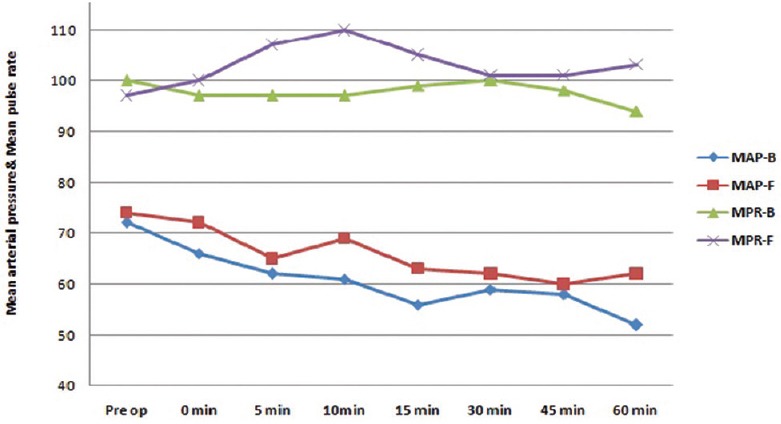
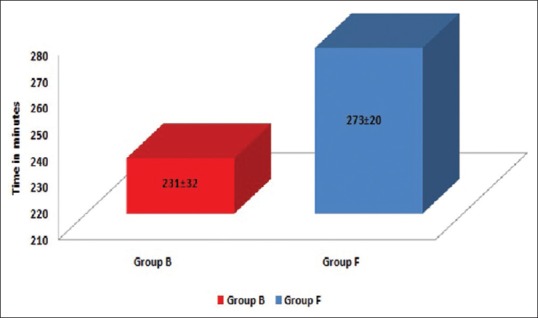
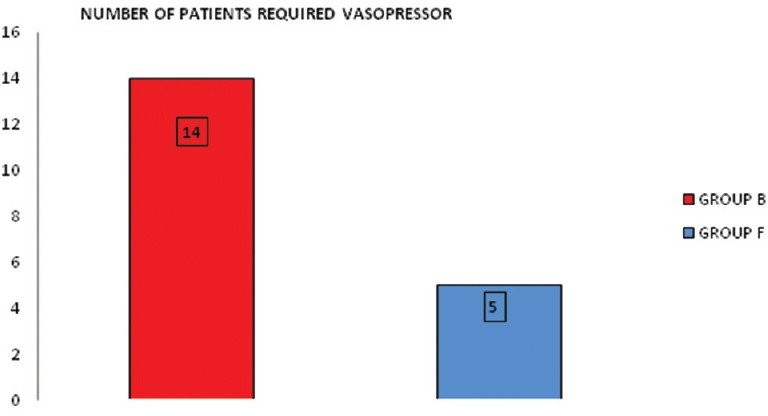
All the patients were haemodynamically stable in Group F as compared to Group B. Five patients in Group F and fourteen patients in Group B required vasopressor. Duration of sensory and motor block and duration of analgesia were longer in Group F (273.83 ± 20.62 min) compared to Group B (231.5 ± 31.87 min) < 0.05.
Fractionated dose of SA provides greater haemodynamic stability and longer duration of analgesia compared to bolus dose.
大剂量推注的脊髓麻醉(SA)起效迅速,但可能会引发低血压。当我们分次注射局麻药物且有时间间隔时,可产生完善的阻滞效果,维持血流动力学稳定,还能延长镇痛时间。我们旨在比较分次给药与大剂量推注在择期下段剖宫产术(LSCS)患者中脊髓麻醉时对血流动力学稳定性和镇痛持续时间的影响。
经机构伦理委员会批准后,对60例行择期LSCS的患者进行了研究。患者分为两组。B组患者接受单次大剂量推注重比重布比卡因(0.5%)进行脊髓麻醉,F组患者采用分次给药,先给予总量三分之二的重比重布比卡因(0.5%),90秒后再给予三分之一剂量。记录并分析感觉和运动阻滞的起效及消退时间、术中血流动力学和镇痛持续时间,采用Student非配对t检验。
与B组相比,F组所有患者血流动力学均稳定。F组有5例患者和B组有14例患者需要使用血管升压药。F组的感觉和运动阻滞持续时间以及镇痛持续时间(273.83±20.62分钟)长于B组(231.5±31.87分钟)<0.05。
与大剂量推注相比,分次给药的脊髓麻醉能提供更好的血流动力学稳定性和更长的镇痛持续时间。