Walton Kerry D, Maillet Emeline L, Garcia John, Cardozo Timothy, Galatzer-Levy Isaac, Llinás Rodolfo R
Center for Neuromagnetism, Department of Neuroscience and Physiology, New York University School of Medicine, New York NY, USA.
Department of Biochemistry and Molecular Pharmacology, New York University School of Medicine, New York NY, USA.
Front Hum Neurosci. 2017 Feb 3;11:24. doi: 10.3389/fnhum.2017.00024. eCollection 2017.
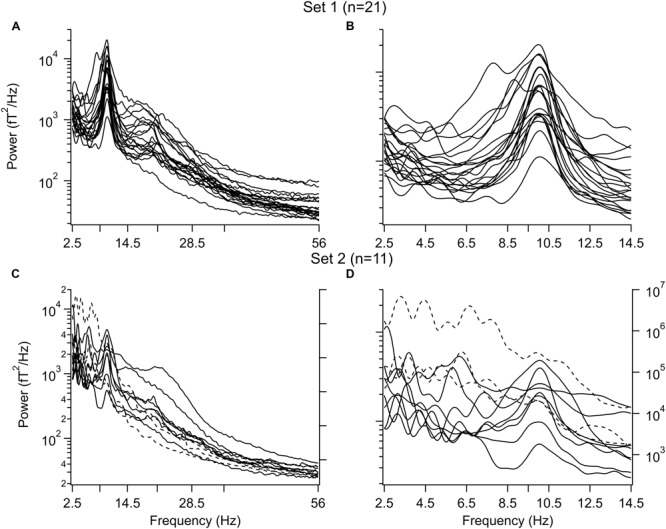
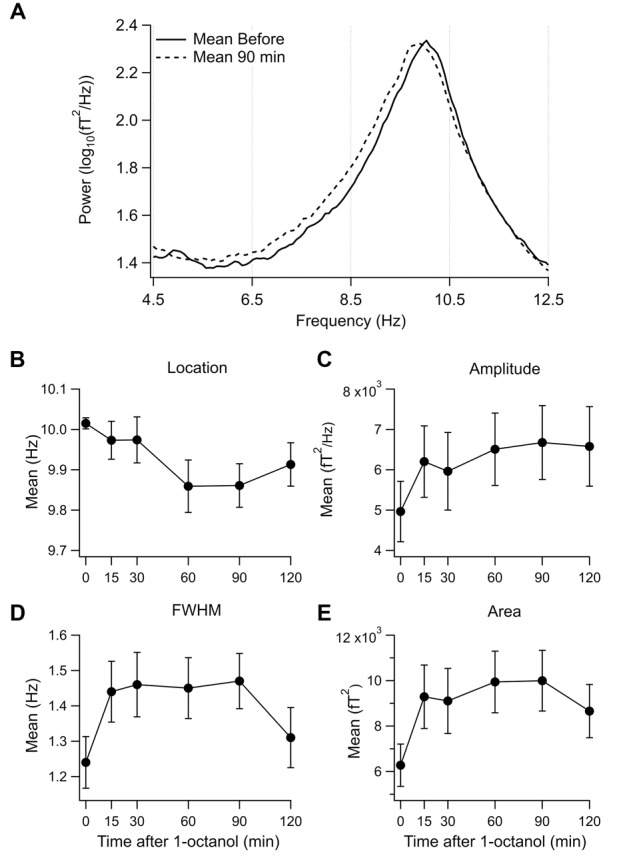
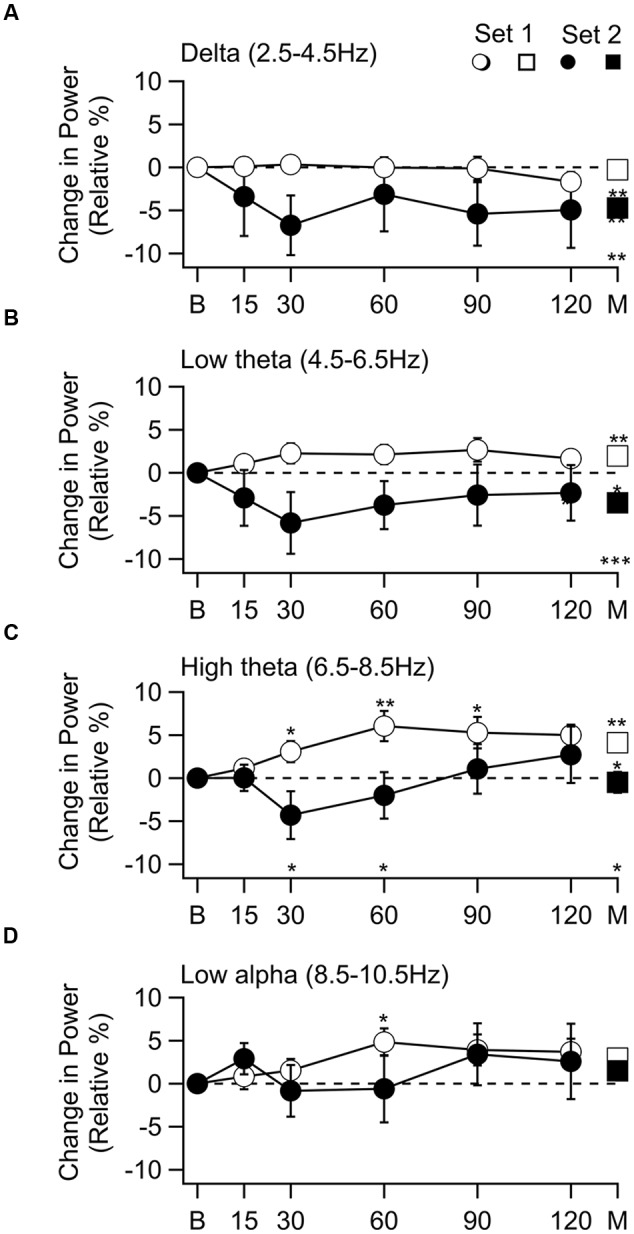
1-octanol is a therapeutic candidate for disorders involving the abnormal activation of the T-type calcium current since it blocks this current specifically. Such disorders include essential tremor and a group of neurological and psychiatric disorders resulting from thalamocortical dysrhythmia (TCD). For example, clinically, the observable phenotype in essential tremor is the tremor itself. The differential diagnostic of TCD is not based only on clinical signs and symptoms. Rather, TCD incorporates an electromagnetic biomarker, the presence of abnormal thalamocortical low frequency brain oscillations. The effect of 1-octanol on brain activity has not been tested. As a preliminary step to such a TCD study, we examined the short-term effects of a single dose of 1-octanol on resting brain activity in 32 healthy adults using magnetoencephalograpy. Visual inspection of baseline power spectra revealed that the subjects fell into those with strong low frequency activity (set 2, = 11) and those without such activity, but dominated by an alpha peak (set 1, = 22). Cross-validated linear discriminant analysis, using mean spectral density (MSD) in nine frequency bands as predictors, found overall that 82.5% of the subjects were classified as determined by visual inspection. The effect of 1-octanol on the MSD in narrow frequency bands differed between the two subject groups. In set 1 subjects the MSD increased in the 4.5-6.5Hz and 6.5-8.5 Hz bands. This was consistent with a widening of the alpha peak toward lower frequencies. In the set two subjects the MSD decrease in the 2.5-4.5 Hz and 4.5-6.5 Hz bands. This decreased power is consistent with the blocking effect of 1-octanol on T-type calcium channels. The subjects reported no adverse effects of the 1-octanol. Since stronger low frequency activity is characteristic of patients with TCD, 1-octanol and other T-type calcium channel blockers are good candidates for treatment of this group of disorders following a placebo-controlled study.
1-辛醇是一种治疗涉及T型钙电流异常激活疾病的候选药物,因为它能特异性阻断该电流。此类疾病包括特发性震颤以及一组由丘脑皮质节律紊乱(TCD)导致的神经和精神疾病。例如,临床上,特发性震颤中可观察到的表型就是震颤本身。TCD的鉴别诊断并非仅基于临床体征和症状。相反,TCD包含一种电磁生物标志物,即异常的丘脑皮质低频脑振荡的存在。1-辛醇对脑活动的影响尚未进行测试。作为此类TCD研究的初步步骤,我们使用脑磁图检查了单剂量1-辛醇对32名健康成年人静息脑活动的短期影响。对基线功率谱的目视检查显示,受试者分为低频活动较强的一组(第2组,n = 11)和无此类活动但以α波峰为主的一组(第1组,n = 22)。使用九个频段的平均谱密度(MSD)作为预测指标的交叉验证线性判别分析总体发现,82.5%的受试者分类与目视检查结果一致。1-辛醇对窄频段MSD的影响在两组受试者中有所不同。在第1组受试者中,4.5 - 6.5Hz和6.5 - 8.5Hz频段的MSD增加。这与α波峰向低频方向展宽一致。在第2组受试者中,2.5 - 4.5Hz和4.5 - 6.5Hz频段的MSD降低。这种功率降低与1-辛醇对T型钙通道的阻断作用一致。受试者报告1-辛醇无不良反应。由于更强的低频活动是TCD患者的特征,在进行安慰剂对照研究后,1-辛醇和其他T型钙通道阻滞剂是治疗这组疾病的良好候选药物。