Flury Pascale, Vesga Pilar, Péchy-Tarr Maria, Aellen Nora, Dennert Francesca, Hofer Nicolas, Kupferschmied Karent P, Kupferschmied Peter, Metla Zane, Ma Zongwang, Siegfried Sandra, de Weert Sandra, Bloemberg Guido, Höfte Monica, Keel Christoph J, Maurhofer Monika
Plant Pathology, Institute of Integrative Biology, ETH Zürich Zürich, Switzerland.
Department of Fundamental Microbiology, University of Lausanne Lausanne, Switzerland.
Front Microbiol. 2017 Feb 3;8:100. doi: 10.3389/fmicb.2017.00100. eCollection 2017.
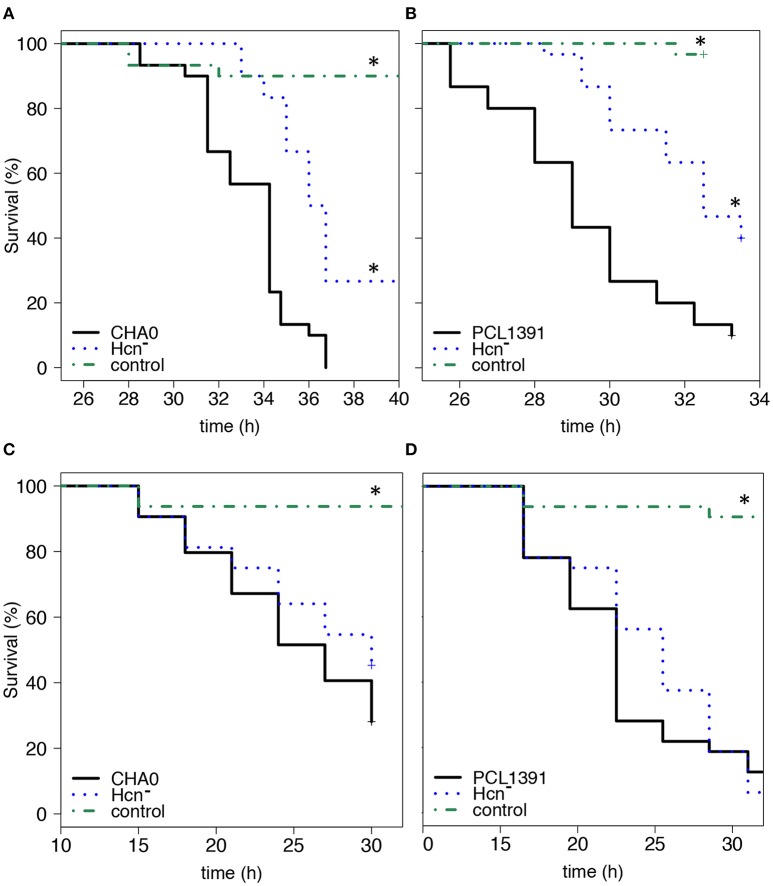
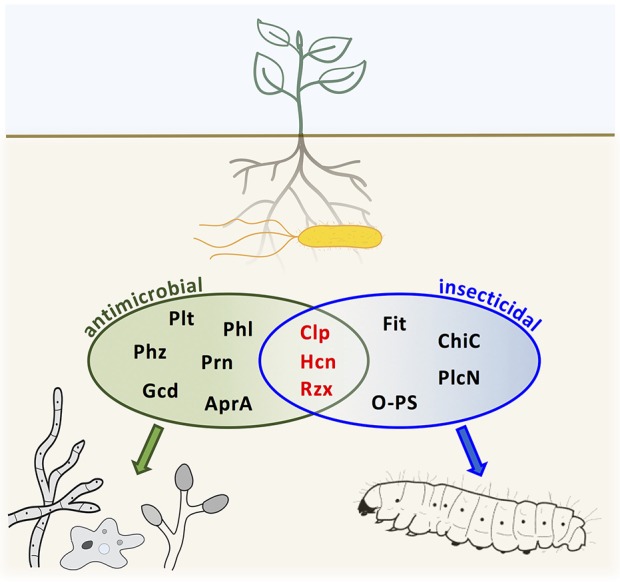
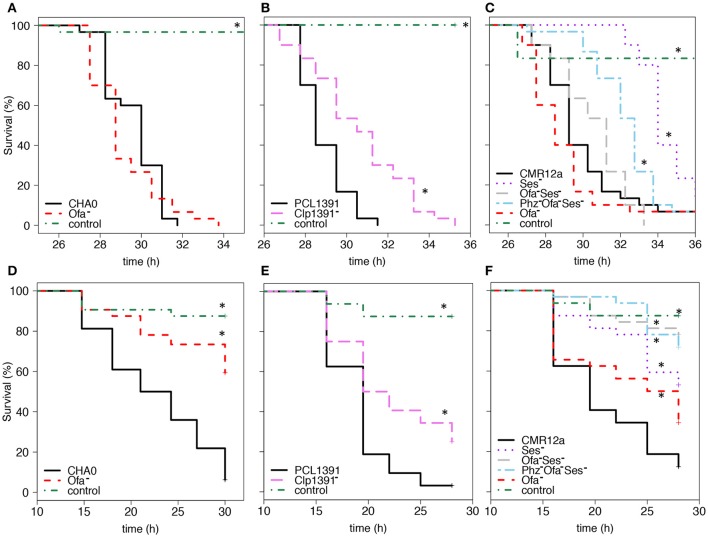
Particular groups of plant-beneficial fluorescent pseudomonads are not only root colonizers that provide plant disease suppression, but in addition are able to infect and kill insect larvae. The mechanisms by which the bacteria manage to infest this alternative host, to overcome its immune system, and to ultimately kill the insect are still largely unknown. However, the investigation of the few virulence factors discovered so far, points to a highly multifactorial nature of insecticidal activity. Antimicrobial compounds produced by fluorescent pseudomonads are effective weapons against a vast diversity of organisms such as fungi, oomycetes, nematodes, and protozoa. Here, we investigated whether these compounds also contribute to insecticidal activity. We tested mutants of the highly insecticidal strains CHA0, PCL1391, and sp. CMR12a, defective for individual or multiple antimicrobial compounds, for injectable and oral activity against lepidopteran insect larvae. Moreover, we studied expression of biosynthesis genes for these antimicrobial compounds for the first time in insects. Our survey revealed that hydrogen cyanide and different types of cyclic lipopeptides contribute to insecticidal activity. Hydrogen cyanide was essential to full virulence of CHA0 and PCL1391 directly injected into the hemolymph. The cyclic lipopeptide orfamide produced by CHA0 and CMR12a was mainly important in oral infections. Mutants of CMR12a and PCL1391 impaired in the production of the cyclic lipopeptides sessilin and clp1391, respectively, showed reduced virulence in injection and feeding experiments. Although virulence of mutants lacking one or several of the other antimicrobial compounds, i.e., 2,4-diacetylphloroglucinol, phenazines, pyrrolnitrin, or pyoluteorin, was not reduced, these metabolites might still play a role in an insect background since all investigated biosynthetic genes for antimicrobial compounds of strain CHA0 were expressed at some point during insect infection. In summary, our study identified new factors contributing to insecticidal activity and extends the diverse functions of antimicrobial compounds produced by fluorescent pseudomonads from the plant environment to the insect host.
特定的对植物有益的荧光假单胞菌群不仅是能够抑制植物病害的根系定殖菌,而且还能够感染并杀死昆虫幼虫。这些细菌侵染这种替代宿主、克服其免疫系统并最终杀死昆虫的机制在很大程度上仍不为人所知。然而,对目前已发现的少数毒力因子的研究表明,杀虫活性具有高度多因素性质。荧光假单胞菌产生的抗菌化合物是对抗多种生物(如真菌、卵菌、线虫和原生动物)的有效武器。在此,我们研究了这些化合物是否也有助于杀虫活性。我们测试了高杀虫菌株CHA0、PCL1391和菌株CMR12a中针对单个或多种抗菌化合物有缺陷的突变体对鳞翅目昆虫幼虫的注射和口服活性。此外,我们首次研究了这些抗菌化合物的生物合成基因在昆虫中的表达。我们的研究表明,氰化氢和不同类型的环脂肽有助于杀虫活性。氰化氢对于直接注入血淋巴中的CHA0和PCL1391的完全毒力至关重要。CHA0和CMR12a产生的环脂肽orfamide在口服感染中主要起重要作用。分别在环脂肽sessilin和clp1391产生方面受损的CMR12a和PCL1391突变体在注射和喂食实验中显示出毒力降低。虽然缺乏一种或几种其他抗菌化合物(即2,4 - 二乙酰基间苯三酚、吩嗪、吡咯菌素或绿脓菌素)的突变体的毒力没有降低,但这些代谢产物在昆虫环境中可能仍然起作用,因为菌株CHA0的所有研究抗菌化合物生物合成基因在昆虫感染的某个阶段都有表达。总之,我们的研究确定了有助于杀虫活性的新因素,并将荧光假单胞菌在植物环境中产生的抗菌化合物的多种功能扩展到了昆虫宿主。