Ihara Hideyuki, Hori Tomoyuki, Aoyagi Tomo, Takasaki Mitsuru, Katayama Yoko
United Graduate School of Agricultural Science, Tokyo University of Agriculture and Technology Fuchu, Japan.
Environmental Management Research Institute, National Institute of Advanced Industrial Science and Technology Tsukuba, Japan.
Front Microbiol. 2017 Feb 3;8:152. doi: 10.3389/fmicb.2017.00152. eCollection 2017.
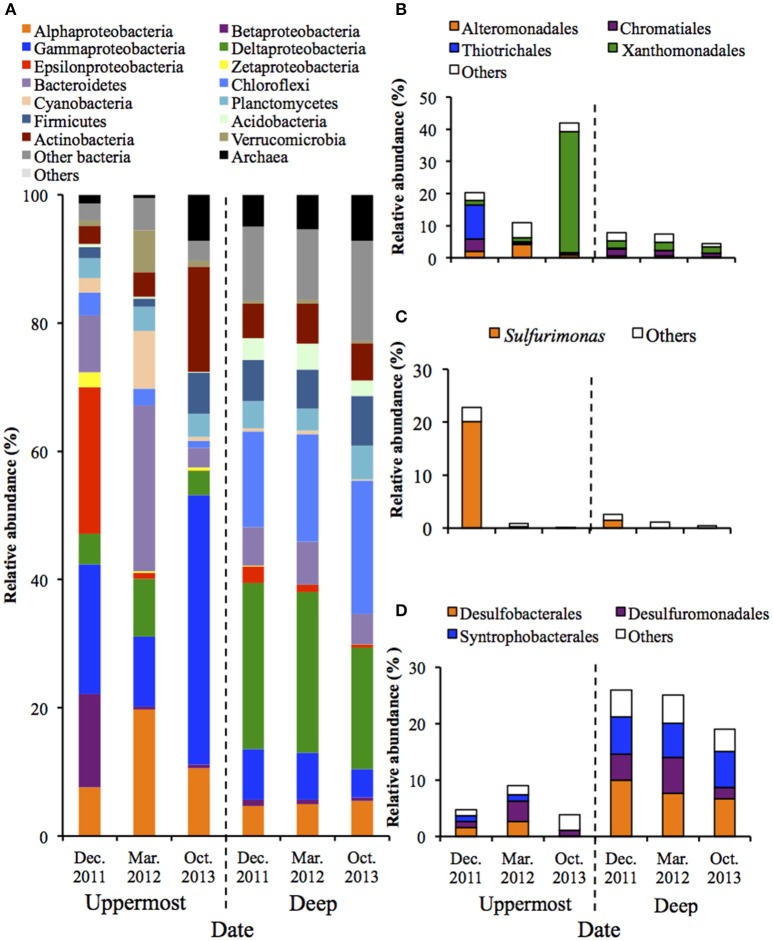
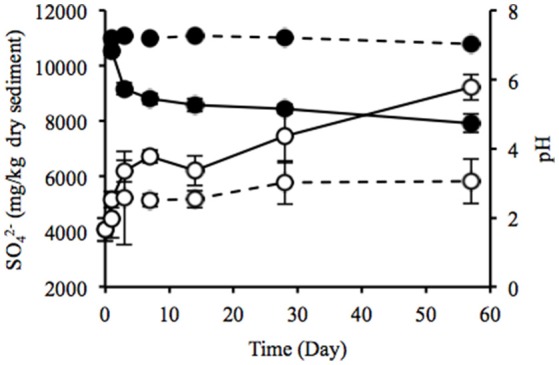
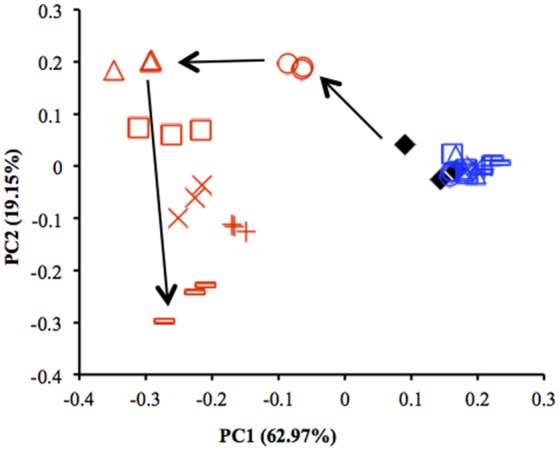
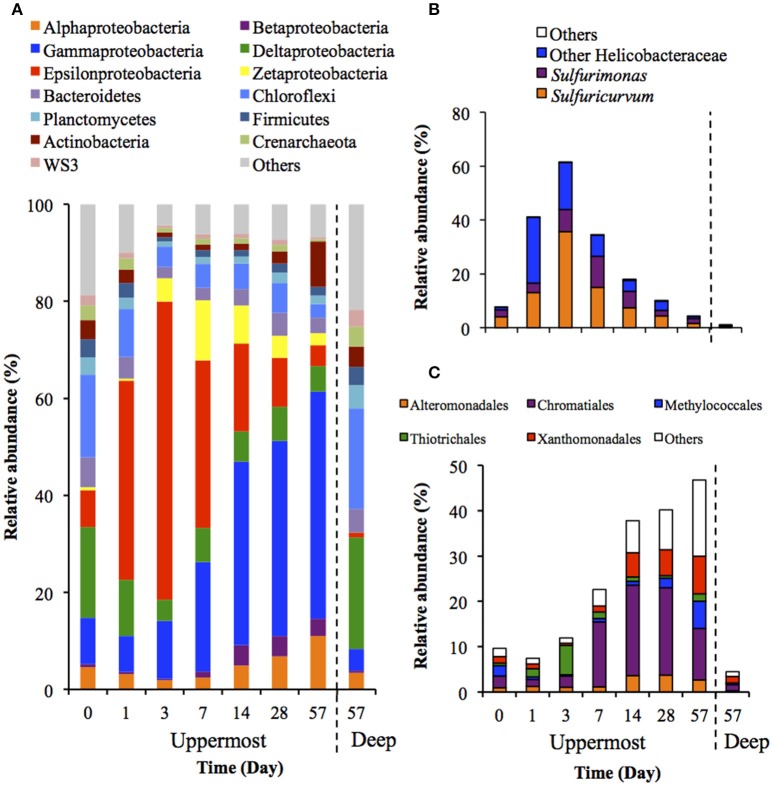
A large amount of marine sediment was launched on land by the Great East Japan earthquake. Here, we employed both on-site and laboratory studies on the launched marine sediment to investigate the succession of microbial communities and its effects on geochemical properties of the sediment. Twenty-two-month on-site survey showed that microbial communities at the uppermost layer (0-2 mm depth) of the sediment changed significantly with time, whereas those at the deeper layer (20-40 mm depth) remained nearly unchanged and kept anaerobic microbial communities. Nine months after the incidence, various sulfur-oxidizing bacteria (SOB) prevailed in the uppermost layer, in which afterwards diverse chemoorganotrophic bacteria predominated. Geochemical analyses indicated that the concentration of metals other than Fe was lower in the uppermost layer than that in the deeper layer. Laboratory study was carried out by incubating the sediment for 57 days, and clearly indicated the dynamic transition of microbial communities in the uppermost layer exposed to atmosphere. SOB affiliated in the class Epsilonproteobacteria rapidly proliferated and dominated at the uppermost layer during the first 3 days, after that Fe(II)-oxidizing bacteria and chemoorganotrophic bacteria were sequentially dominant. Furthermore, the concentration of sulfate ion increased and the pH decreased. Consequently, SOB may have influenced the mobilization of heavy metals in the sediment by metal-bound sulfide oxidation and/or sediment acidification. These results demonstrate that SOB initiated the dynamic shift from the anaerobic to aerobic microbial communities, thereby playing a critical role in element cycling in the marine sediment.
东日本大地震使大量海洋沉积物被冲到陆地上。在此,我们对冲到陆地上的海洋沉积物进行了现场和实验室研究,以调查微生物群落的演替及其对沉积物地球化学性质的影响。为期22个月的现场调查表明,沉积物最上层(0 - 2毫米深度)的微生物群落随时间发生了显著变化,而较深层(20 - 40毫米深度)的微生物群落几乎保持不变,维持着厌氧微生物群落。事件发生九个月后,各种硫氧化细菌(SOB)在最上层占主导地位,之后各种化能有机营养细菌占优势。地球化学分析表明,最上层除铁以外的金属浓度低于较深层。通过将沉积物培养57天进行了实验室研究,清楚地表明了暴露于大气中的最上层微生物群落的动态转变。属于Epsilonproteobacteria纲的SOB在前三天在最上层迅速增殖并占主导地位,之后铁(II)氧化细菌和化能有机营养细菌依次占主导地位。此外,硫酸根离子浓度增加,pH值下降。因此,SOB可能通过金属结合硫化物氧化和/或沉积物酸化影响了沉积物中重金属的迁移。这些结果表明,SOB引发了从厌氧微生物群落到需氧微生物群落的动态转变,从而在海洋沉积物的元素循环中发挥了关键作用。