Lu Hong, Lei Xiaohong, Liu Jerry, Klaassen Curtis
Hong Lu, Xiaohong Lei, Department of Pharmacology, SUNY Upstate Medical University, Syracuse, NY 13210, United States.
World J Hepatol. 2017 Feb 8;9(4):191-208. doi: 10.4254/wjh.v9.i4.191.
To uncover the role of hepatocyte nuclear factor 4 alpha (HNF4α) in regulating hepatic expression of microRNAs.
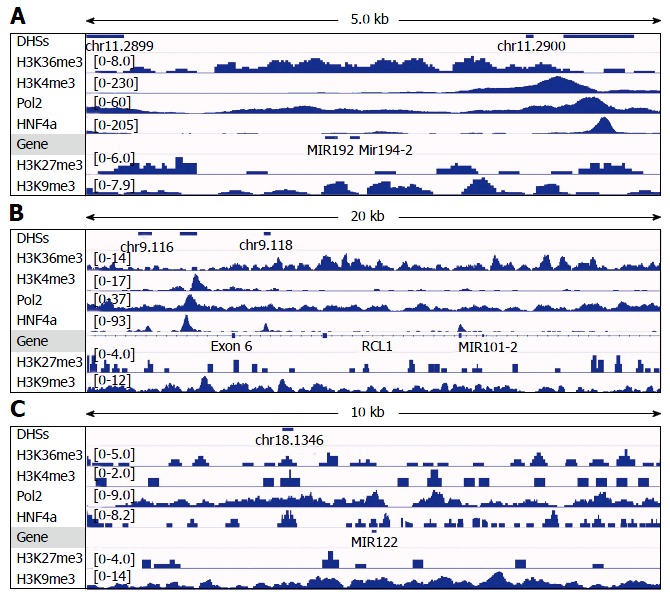
Microarray and real-time PCR were used to determine hepatic expression of microRNAs in young-adult mice lacking α expression in liver (-LivKO). Integrative genomics viewer software was used to analyze the public chromatin immunoprecipitation-sequencing datasets for DNA-binding of HNF4α, RNA polymerase-II, and histone modifications to loci of microRNAs in mouse liver and human hepatoma cells. Dual-luciferase reporter assay was conducted to determine effects of HNF4α on the promoters of mouse and human microRNAs as well as effects of microRNAs on the untranslated regions (3'UTR) of two genes in human hepatoma cells.
Microarray data indicated that most microRNAs remained unaltered by deficiency in -LivKO mice. However, certain liver-predominant microRNAs were down-regulated similarly in young-adult male and female -LivKO mice. The down-regulation of miR-101, miR-192, miR-193a, miR-194, miR-215, miR-802, and miR-122 as well as induction of miR-34 and miR-29 in male -LivKO mice were confirmed by real-time PCR. Analysis of public chromatin immunoprecipitation-sequencing data indicates that HNF4α directly binds to the promoters of miR-101, miR-122, miR-194-2/miR-192 and miR-193, which is associated with histone marks of active transcription. Luciferase reporter assay showed that HNF4α markedly activated the promoters of mouse and human miR-101b/miR-101-2 and the miR-194/miR-192 cluster. Additionally, miR-192 and miR-194 significantly decreased activities of luciferase reporters for the 3'UTR of histone H3F3 and chromodomain helicase DNA binding protein 1 (CHD1), respectively, suggesting that miR-192 and miR-194 might be important in chromosome remodeling through directly targeting H3F3 and CHD1.
HNF4α is essential for hepatic basal expression of a group of liver-enriched microRNAs, including miR-101, miR-192, miR-193a, miR-194 and miR-802, through which HNF4α may play a major role in the post-transcriptional regulation of gene expression and maintenance of the epigenome in liver.
揭示肝细胞核因子4α(HNF4α)在调节肝脏中微小RNA表达方面的作用。
利用基因芯片和实时定量PCR技术测定肝脏中缺乏α表达的年轻成年小鼠(-LivKO)肝脏中微小RNA的表达。使用综合基因组浏览器软件分析公开的染色质免疫沉淀测序数据集,以研究HNF4α、RNA聚合酶II和组蛋白修饰与小鼠肝脏和人肝癌细胞中微小RNA基因座的DNA结合情况。进行双荧光素酶报告基因检测,以确定HNF4α对小鼠和人微小RNA启动子的影响,以及微小RNA对人肝癌细胞中两个基因的非翻译区(3'UTR)的影响。
基因芯片数据表明,大多数微小RNA在-LivKO小鼠中不受α缺乏的影响。然而,某些肝脏特异性微小RNA在年轻成年雄性和雌性-LivKO小鼠中均有类似程度的下调。实时定量PCR证实了雄性-LivKO小鼠中miR-101、miR-192、miR-193a、miR-194、miR-215、miR-802和miR-122的下调以及miR-34和miR-29的上调。对公开的染色质免疫沉淀测序数据的分析表明,HNF4α直接结合到miR-101、miR-122、miR-194-2/miR-192和miR-193的启动子上,这与活跃转录的组蛋白标记相关。荧光素酶报告基因检测表明,HNF4α显著激活小鼠和人miR-101b/miR-101-2以及miR-194/miR-192簇的启动子。此外,miR-192和miR-194显著降低了组蛋白H3F3和染色质结构域解旋酶DNA结合蛋白1(CHD1)的3'UTR的荧光素酶报告基因活性,这表明miR-192和miR-194可能通过直接靶向H3F3和CHD1在染色体重塑中发挥重要作用。
HNF4α对于一组肝脏富集微小RNA(包括miR-101、miR-192、miR-193a、miR-194和miR-802)的肝脏基础表达至关重要,通过这些微小RNA,HNF4α可能在基因表达的转录后调控和肝脏表观基因组的维持中发挥主要作用。