Zhang Zhushan, Huang Tai-Qin, Nepliouev Igor, Zhang Hengtao, Barnett Adam S, Rosenberg Paul B, Ou Sai-Hong I, Stiber Jonathan A
Department of Medicine, Duke University Medical Center, Durham, NC USA 27710.
Department of Medicine, University of California Irvine School of Medicine, Orange, CA 92868.
Cardiooncology. 2017;3. doi: 10.1186/s40959-017-0020-z. Epub 2017 Jan 19.
Sinus bradycardia is frequently observed in patients treated with crizotinib, a receptor tyrosine kinase inhibitor used for the treatment of anaplastic lymphoma kinase (ALK)-rearranged non-small cell lung cancer (NSCLC). We investigated whether crizotinib could influence heart rate (HR) through direct cardiac effects.
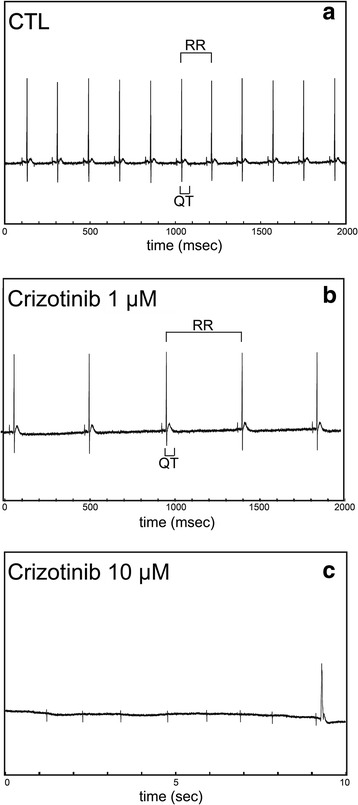
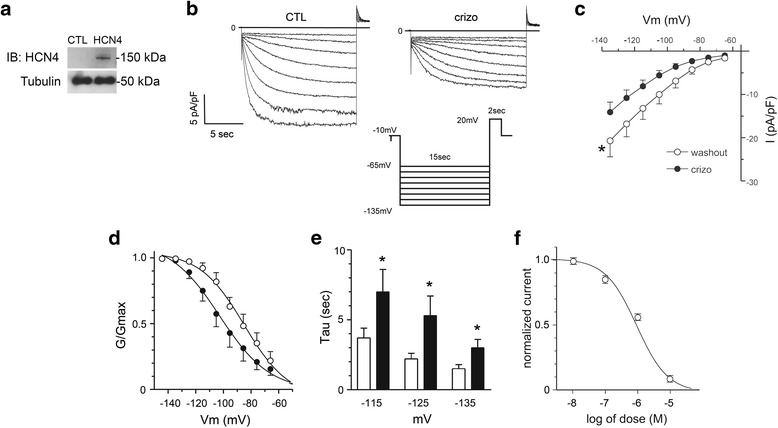
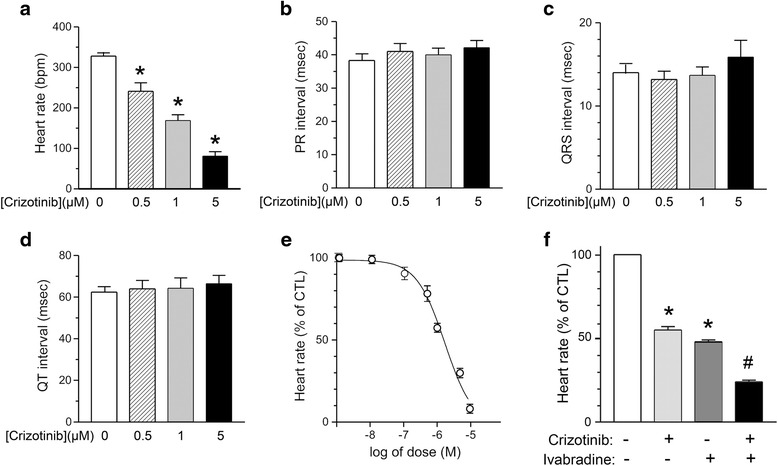
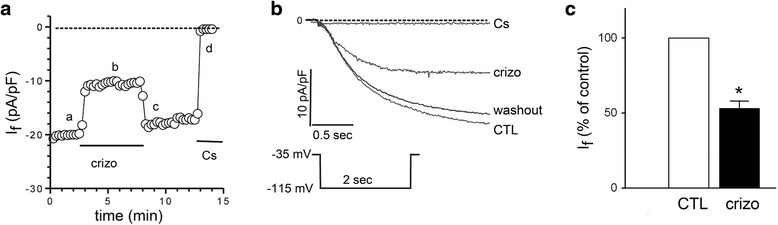
The direct effect of crizotinib on HR was studied using ECG analysis of Langendorff-perfused mouse hearts. The whole-cell patch clamp technique was used to measure the effects of crizotinib on the hyperpolarization-activated funny current, I, in mouse sinoatrial node cells (SANCs) and hyperpolarization-activated cyclic nucleotide-gated channel 4 (HCN4) activity in HEK-293 cells stably expressing human HCN4.
Crizotinib resulted in a dose-dependent reduction in HR in isolated intact mouse hearts with a half maximal inhibitory concentration (IC50) of 1.7 ± 0.4 μmol/L. Because ECG analysis revealed that crizotinib (0-5 μmol/L) resulted in significant reductions in HR in isolated mouse hearts without changes in PR, QRS, or QT intervals, we performed whole-cell patch clamp recordings of SANCs which showed that crizotinib inhibited I which regulates cardiac pacemaker activity. Crizotinib resulted in diminished current density of HCN4, the major molecular determinant of I, with an IC50 of 1.4 ± 0.3 μmol/L. Crizotinib also slowed HCN4 activation and shifted the activation curve to the left towards more hyperpolarized potentials.
Our results suggest that crizotinib's effects on HCN4 channels play a significant role in mediating its observed effects on HR.
克唑替尼是一种用于治疗间变性淋巴瘤激酶(ALK)重排的非小细胞肺癌(NSCLC)的受体酪氨酸激酶抑制剂,在接受该药物治疗的患者中经常观察到窦性心动过缓。我们研究了克唑替尼是否可通过直接的心脏效应影响心率(HR)。
使用Langendorff灌注的小鼠心脏进行心电图分析,研究克唑替尼对HR的直接作用。采用全细胞膜片钳技术,测量克唑替尼对小鼠窦房结细胞(SANC)中超极化激活的“funny”电流(I)以及对稳定表达人超极化激活环核苷酸门控通道4(HCN4)的HEK-293细胞中HCN4活性的影响。
克唑替尼导致离体完整小鼠心脏的心率呈剂量依赖性降低,半数最大抑制浓度(IC50)为1.7±0.4μmol/L。由于心电图分析显示,克唑替尼(0 - 5μmol/L)可使离体小鼠心脏的心率显著降低,而PR、QRS或QT间期无变化,因此我们对SANC进行了全细胞膜片钳记录,结果显示克唑替尼抑制了调节心脏起搏活动的I电流。克唑替尼使I电流的主要分子决定因素HCN4的电流密度降低,IC50为1.4±0.3μmol/L。克唑替尼还减缓了HCN4的激活,并使激活曲线向左移向更超极化的电位。
我们的结果表明,克唑替尼对HCN4通道的作用在介导其对心率的观察效应中起重要作用。