Yazdanpanah Mahdi, Hadji Hosseinlou Mansour
Transportation Engineering, K. N. Toosi University of Technology, Tehran 1996715433, Iran.
Department of Civil Engineering, K. N. Toosi University of Technology, Tehran 1996715433, Iran.
Behav Sci (Basel). 2017 Feb 17;7(1):8. doi: 10.3390/bs7010008.
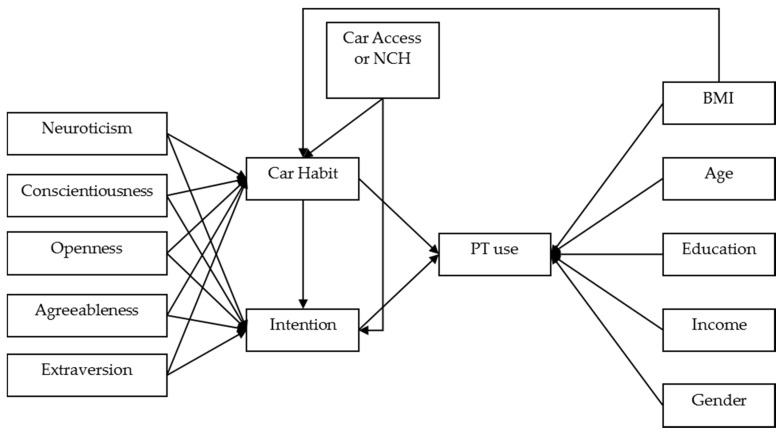
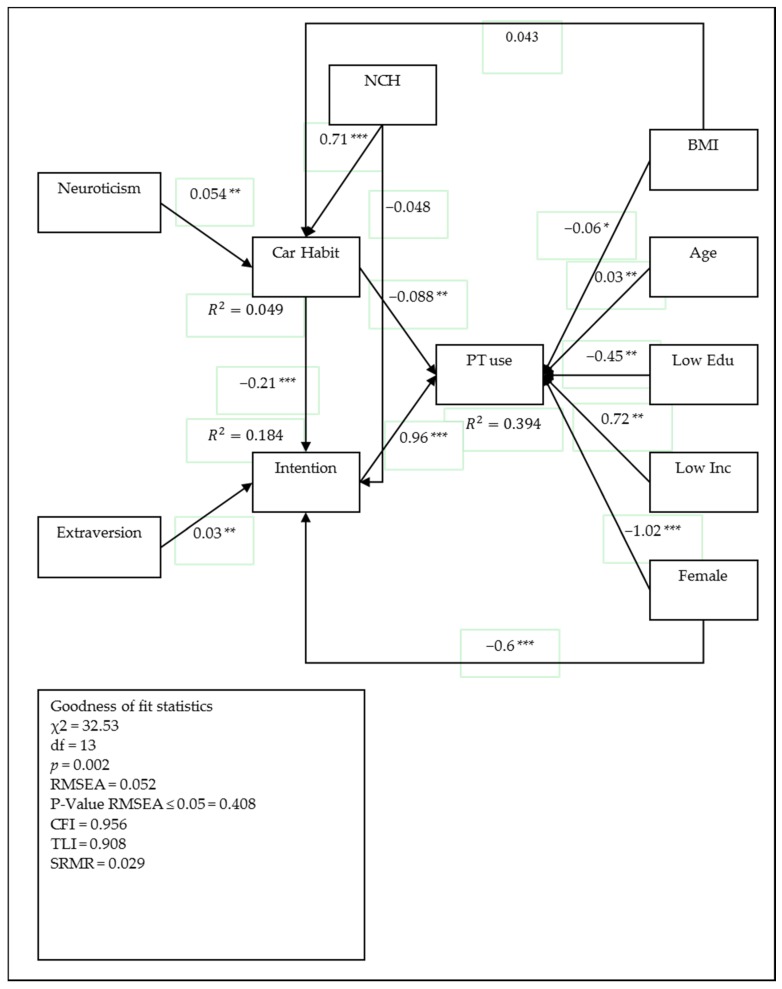
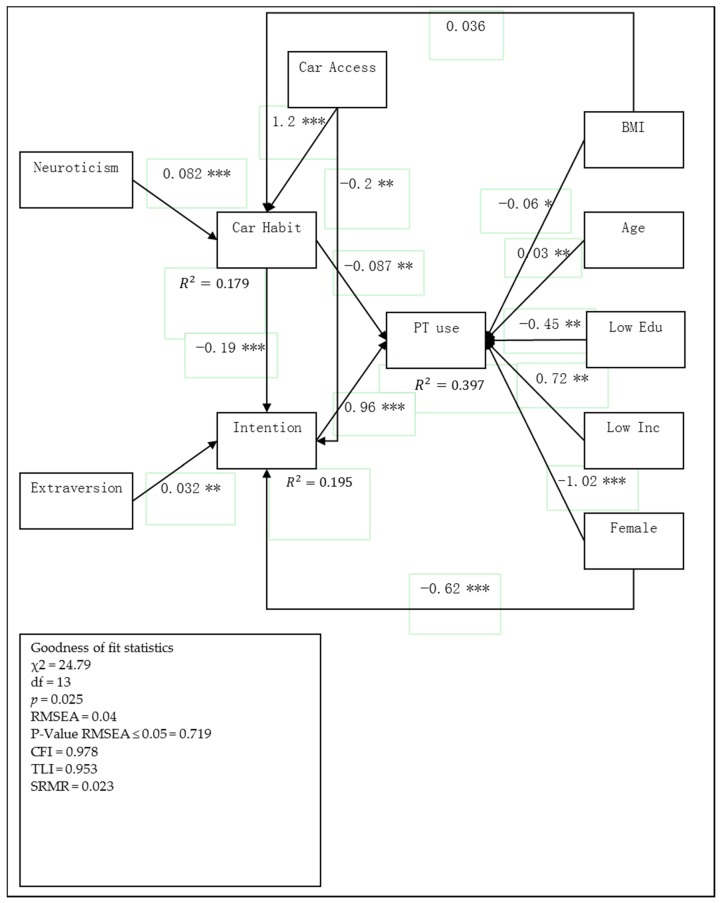
A complex set of factors may affect transportation mode choice. While earlier studies have often considered objective factors in determining preferences of public transport use as a sustainable transportation, subjective factors such as personality traits are underexplored. Therefore, this study aimed to investigate the influence of personality traits on the number of future public transport use. Additionally, "car habit" and "intention toward using public modes" were considered to be important. For this purpose, a case study from departure passengers at Imam Khomeini International Airport (IKIA, Tehran, Iran) was conducted between January and February 2015 at IKIA. Results of structural equation modeling (SEM) shows that only neuroticism and extraversion personality traits were significant in determining future public transportation mode choice. However, the model indicates that these traits indirectly influence intention and car habit. Neuroticism was found to have a total effect of -0.022 on future public transport use, which represents a negative association with public transport use, while extraversion positively influenced future public transport use with a total effect of 0.031. Moreover, the results found interestingly that car access had a better fit to the data than the number of cars in household (NCH); both had significant positive effect on car habit, but only car access had a significant influence on intention. Furthermore, the effect of socio-demographic variables such as age, gender, educational level, income level, and body mass index (BMI) were determined to be significant in identifying choice of future transport mode to airports, which is explained in the discussion section of this paper.
一系列复杂的因素可能会影响交通方式的选择。虽然早期的研究通常在确定作为可持续交通方式的公共交通使用偏好时考虑客观因素,但诸如人格特质等主观因素却未得到充分探索。因此,本研究旨在调查人格特质对未来公共交通使用次数的影响。此外,“汽车使用习惯”和“使用公共交通方式的意愿”也被认为很重要。为此,2015年1月至2月在伊朗德黑兰伊玛目霍梅尼国际机场(IKIA)对出发乘客进行了一项案例研究。结构方程模型(SEM)的结果表明,只有神经质和外向型人格特质在决定未来公共交通方式选择方面具有显著性。然而,该模型表明这些特质会间接影响意愿和汽车使用习惯。研究发现,神经质对未来公共交通使用的总效应为-0.022,这表明与公共交通使用呈负相关,而外向性对未来公共交通使用有正向影响,总效应为0.031。此外,研究结果有趣地发现,汽车拥有情况比家庭汽车数量(NCH)更符合数据;两者对汽车使用习惯都有显著的正向影响,但只有汽车拥有情况对意愿有显著影响。此外,年龄、性别、教育水平、收入水平和体重指数(BMI)等社会人口统计学变量在确定前往机场的未来交通方式选择方面的影响被确定为显著,本文的讨论部分对此进行了解释。