Department of Dermatology, Zealand University Hospital, Roskilde, Denmark.
Health Sciences Faculty, University of Copenhagen, Copenhagen, Denmark.
BMJ Open. 2017 Feb 20;7(2):e014733. doi: 10.1136/bmjopen-2016-014733.
Randomised controlled trials (RCTs) should have well-defined primary and secondary outcomes to answer questions generated by the main hypotheses. However, for the chronic, inflammatory skin disease hidradenitis suppurativa (HS), the reported outcome measures are numerous and diverse. A recent systematic review found a total of 30 outcome measure instruments in 12 RCTs. This use of a broad range of outcome measures can increase difficulties in interpretation and comparison of results and may potentially obstruct appropriate evidence synthesis by causing reporting bias. One strategy for dealing with these problems is to develop a core outcome set (COS). A COS is a list of outcomes that are meant as mandatory and should be measured and reported in all clinical trials. The aim of this study is to develop a COS for the management of HS.
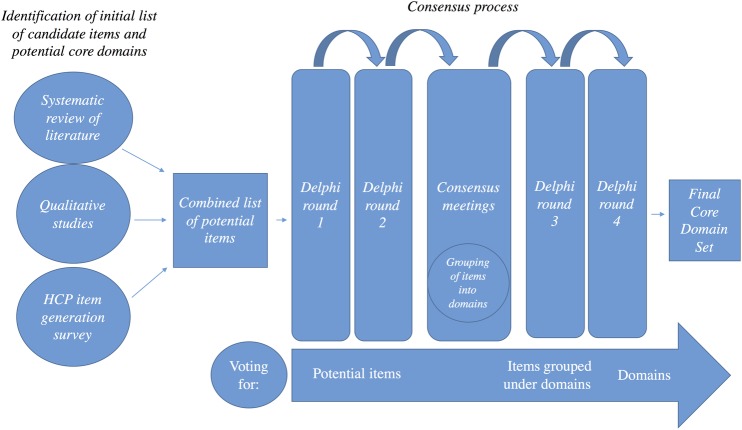
An international steering group of researchers, clinicians and a patient research partner will guide the COS development. 6 stakeholder groups are involved: patients, dermatologists, surgeons, nurses, industry representatives and drug regulatory authorities. A 1:1 ratio of patients:healthcare professionals is aimed for. The initial list of candidate items will be obtained by combining three data sets: (1) a systematic review of the literature, (2) US and Danish qualitative interview studies involving patients with HS and (3) an online healthcare professional (HCP) item generation survey. To reach consensus on the COS, 4 anonymous online Delphi rounds are then planned together with 2 face-to-face consensus meetings (1 in Europe and 1 in the USA) to ensure global representation.
The study will be performed according to the Helsinki declaration. All results from the study, including inconclusive or negative results, will be published in peer-reviewed indexed journals. The study will involve different stakeholder groups to ensure that the developed COS will be suitable and well accepted.
随机对照试验(RCT)应具有明确的主要和次要结局,以回答主要假设所产生的问题。然而,对于慢性炎症性皮肤病化脓性汗腺炎(HS),报告的结局指标众多且多样。最近的一项系统评价在 12 项 RCT 中发现了总共 30 种结局测量工具。这种广泛使用各种结局指标的方法可能会增加解释和比较结果的难度,并可能通过引起报告偏倚而阻碍适当的证据综合。一种解决这些问题的策略是制定核心结局集(COS)。COS 是一系列结局指标的列表,这些结局指标是强制性的,应在所有临床试验中进行测量和报告。本研究旨在制定 HS 管理的 COS。
一个由研究人员、临床医生和患者研究伙伴组成的国际指导小组将指导 COS 的开发。涉及 6 个利益相关者群体:患者、皮肤科医生、外科医生、护士、行业代表和药物监管机构。目标是患者与医疗保健专业人员的比例为 1:1。候选项目的初始清单将通过结合三个数据集获得:(1)文献系统评价,(2)涉及 HS 患者的美国和丹麦定性访谈研究,(3)在线医疗保健专业人员(HCP)项目生成调查。然后计划进行 4 轮匿名在线 Delphi 轮次以及 2 次面对面共识会议(1 次在欧洲,1 次在美国),以确保全球代表性,从而就 COS 达成共识。
该研究将根据赫尔辛基宣言进行。研究的所有结果,包括不确定或负面结果,都将在同行评议索引期刊上发表。该研究将涉及不同的利益相关者群体,以确保开发的 COS 是合适且被广泛接受的。