Elinder Fredrik, Liin Sara I
Department of Clinical and Experimental Medicine, Linköping University Linköping, Sweden.
Front Physiol. 2017 Feb 6;8:43. doi: 10.3389/fphys.2017.00043. eCollection 2017.
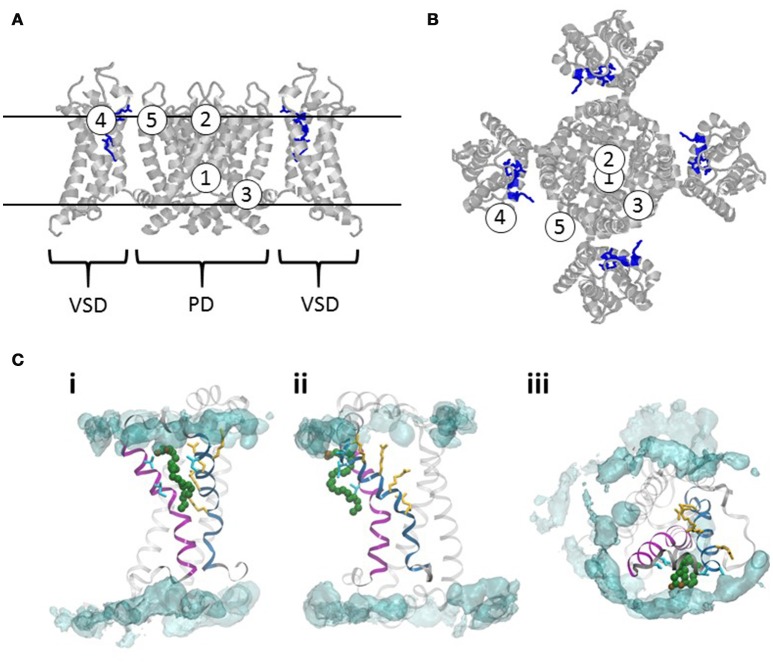
Polyunsaturated fatty acids (PUFAs) act on most ion channels, thereby having significant physiological and pharmacological effects. In this review we summarize data from numerous PUFAs on voltage-gated ion channels containing one or several voltage-sensor domains, such as voltage-gated sodium (Na), potassium (K), calcium (Ca), and proton (H) channels, as well as calcium-activated potassium (K), and transient receptor potential (TRP) channels. Some effects of fatty acids appear to be channel specific, whereas others seem to be more general. Common features for the fatty acids to act on the ion channels are at least two double bonds in geometry and a charged carboxyl group. In total we identify and label five different sites for the PUFAs. : The intracellular cavity. Binding of PUFA reduces the current, sometimes as a time-dependent block, inducing an apparent inactivation. : The extracellular entrance to the pore. Binding leads to a block of the channel. : The intracellular gate. Binding to this site can bend the gate open and increase the current. : The interface between the extracellular leaflet of the lipid bilayer and the voltage-sensor domain. Binding to this site leads to an opening of the channel via an electrostatic attraction between the negatively charged PUFA and the positively charged voltage sensor. : The interface between the extracellular leaflet of the lipid bilayer and the pore domain. Binding to this site affects slow inactivation. This mapping of functional PUFA sites can form the basis for physiological and pharmacological modifications of voltage-gated ion channels.
多不饱和脂肪酸(PUFAs)作用于大多数离子通道,从而产生显著的生理和药理作用。在本综述中,我们总结了大量关于PUFAs对包含一个或多个电压传感器结构域的电压门控离子通道的数据,如电压门控钠(Na)、钾(K)、钙(Ca)和质子(H)通道,以及钙激活钾(K)和瞬时受体电位(TRP)通道。脂肪酸的一些作用似乎具有通道特异性,而其他作用似乎更具普遍性。脂肪酸作用于离子通道的共同特征是在几何结构上至少有两个双键和一个带电荷的羧基。我们总共确定并标记了PUFAs的五个不同作用位点:细胞内腔。PUFA的结合会降低电流,有时表现为时间依赖性阻断,诱导明显的失活。:孔道的细胞外入口。结合会导致通道阻断。:细胞内门控。与该位点结合可使门控弯曲打开并增加电流。:脂质双分子层细胞外小叶与电压传感器结构域之间的界面。与该位点结合会通过带负电荷的PUFA与带正电荷的电压传感器之间的静电吸引导致通道开放。:脂质双分子层细胞外小叶与孔道结构域之间的界面。与该位点结合会影响缓慢失活。这种功能性PUFA位点的定位可为电压门控离子通道的生理和药理修饰奠定基础。