Cai Zhencun, Li Lianyong, Zhang Lijun, Ji Shijun, Zhao Qun
Department of Paediatric Orthopaedics, Shengjing Hospital of China Medical University, Shenyang, Liaoning Province, China.
J Int Med Res. 2017 Feb;45(1):272-281. doi: 10.1177/0300060516675110. Epub 2016 Dec 20.
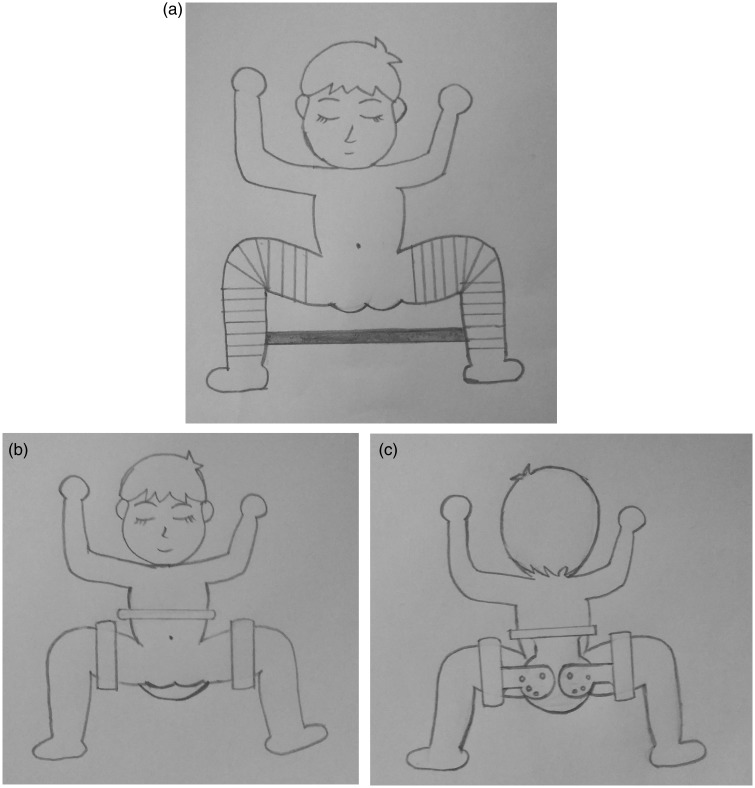
Objective To evaluate the effect of dynamic long leg casting in paediatric patients with developmental dysplasia of hip (DDH) diagnosed at 12-18 months. Methods The adductor tenotomy, closed reduction, and dynamic long leg casting method was adopted to treat paediatric patients with DDH. The hips were divided into four groups according to the Tonnis radiographic dislocation classification. Groups were also classified according to the baseline acetabular index (AI): 30°-35°, 36°-40°, and > 40°. The outcomes of the reductions were evaluated according to McKay's hip function criteria and Severin's radiological criteria. Results A total of 246 patients (339 hips) had complete follow-up data. After 3 months of orthosis fixation, the results were satisfactory in 264 hips (77.88%). Hip function was rated as 'excellent' or 'good' in 43 of 51 (84.31%) Tonnis type 1 hips, 125 of 155 (80.65%) type 2 hips, 70 of 90 (77.78%) type 3 hips, and 34 of 43 (79.07%) type 4 hips. The higher the baseline AI, the lower the rates of 'excellent' and 'good' hip function. Favourable radiological results (Severin types I and II) were found in 266 of 339 (78.47) hips. Conclusions Dynamic long leg casting is an effective method for treating patients with DDH aged 12-18 months at diagnosis.
目的 评估动态长腿石膏固定法对12至18个月大诊断为发育性髋关节发育不良(DDH)的儿科患者的疗效。方法 采用内收肌切断、闭合复位及动态长腿石膏固定法治疗儿科DDH患者。根据托尼斯(Tonnis)X线脱位分类将髋关节分为四组。还根据基线髋臼指数(AI)进行分组:30°-35°、36°-40°和>40°。根据麦凯(McKay)髋关节功能标准和塞韦林(Severin)放射学标准评估复位结果。结果 共有246例患者(339髋)有完整的随访数据。矫形器固定3个月后,264髋(77.88%)结果满意。51例托尼斯1型髋关节中的43例(84.31%)、155例2型髋关节中的125例(80.65%)、90例3型髋关节中的70例(77.78%)以及43例4型髋关节中的34例(79.07%)髋关节功能评定为“优”或“良”。基线AI越高,髋关节功能“优”和“良”的比例越低。339髋中的266髋(78.47%)获得了良好的放射学结果(塞韦林I型和II型)。结论 动态长腿石膏固定法是治疗诊断时年龄为12至18个月的DDH患者的有效方法。