• 文献检索
  • 文档翻译
  • 深度研究
  • 学术资讯
  • Suppr Zotero 插件Zotero 插件
  • 邀请有礼
  • 套餐&价格
  • 历史记录
应用&插件
Suppr Zotero 插件Zotero 插件浏览器插件Mac 客户端Windows 客户端微信小程序
定价
高级版会员购买积分包购买API积分包
服务
文献检索文档翻译深度研究API 文档MCP 服务
关于我们
关于 Suppr公司介绍联系我们用户协议隐私条款
关注我们

Suppr 超能文献

核心技术专利:CN118964589B侵权必究
粤ICP备2023148730 号-1Suppr @ 2026

文献检索

告别复杂PubMed语法,用中文像聊天一样搜索,搜遍4000万医学文献。AI智能推荐,让科研检索更轻松。

立即免费搜索

文件翻译

保留排版,准确专业,支持PDF/Word/PPT等文件格式,支持 12+语言互译。

免费翻译文档

深度研究

AI帮你快速写综述,25分钟生成高质量综述,智能提取关键信息,辅助科研写作。

立即免费体验

发育性髋关节发育不良闭合复位术的时机及其失败分析。

Timing for closed reduction procedure for developmental dysplasia of the hip and its failure analysis.

机构信息

Department of Orthopedics, National Children's Medical Center & Children's Hospital of Fudan University, 399 Wanyuan Road, Shanghai, 201102, China.

Department of Orthopedics, Shanghai Sixth People's Hospital, School of Medicine, Shanghai Jiaotong University, 600 Yishan Road, Shanghai, 200233, China.

出版信息

BMC Musculoskelet Disord. 2020 Sep 14;21(1):613. doi: 10.1186/s12891-020-03635-1.

DOI:10.1186/s12891-020-03635-1
PMID:32928170
原文链接:https://pmc.ncbi.nlm.nih.gov/articles/PMC7488999/
Abstract

BACKGROUND

It remains controversial whether the older age to perform closed reduction (CR) procedure for developmental dysplasia of the hip (DDH), the higher incidence of complications. The aim of this study is to evaluate the midterm outcome of CR for DDH among different age groups, and to analyze and identify risk factors for the failure of this procedure.

METHODS

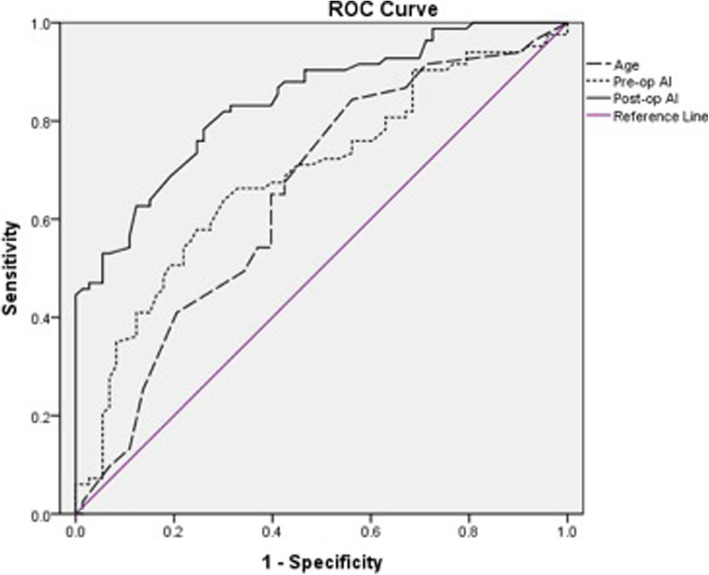
Clinical data of 107 DDH patients, who received CR, were retrospectively reviewed. Data were divided into three groups according to initial treatment age (Group I: younger than 12 months; Group II: 12 months to less or equal to18 months; Group III: older than 18 months). The presence of avascular necrosis (AVN), residual acetabular dysplasia (RAD), re-dislocation, and further surgeries (FS) were observed. The risk factors were identified for those outcomes aforementioned using univariable logistic regression models. For identified risk factor age, pre-op acetabular index (AI) and post-op AI, their prediction of CR failure were evaluated by receiver operating characteristics curve (ROC).

RESULTS

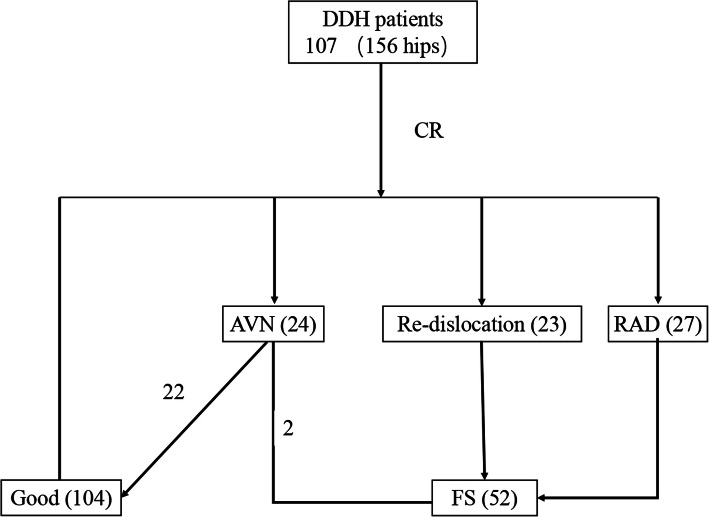
A total of 107 patients (156 hips) undergoing CR procedure were evaluated with a median age at initial reduction of 13.0 ± 5.4 months (range, 4 to 28 mo). Mean follow-up time in this study was 6.7 ± 0.8 years (range, 3-8 years). The incidence of AVN, RAD and re-dislocation was 15.4% (24/156), 17.3% (27/156) and 14.7% (23/156) respectively. For AVN, RAD and re-dislocation, the significant risk factors are pre-op IHDI IV (p = 0.033), age ≥ 18 months (p = 0.012), and pre-op IHDI IV (p = 0.004) and walking (p = 0.011), respectively. The areas under the ROC curve of each type of failures were 0.841 (post-op AI), 0.688 (pre-op AI) and 0.650 (age).

CONCLUSIONS

Severe DDH patients older than 18 months with CR procedure may result in a high risk of RAD complication. Re-dislocation is significantly associated with pre-op IHDI IV and walking. Patients, who are older than 12.5 months or have a pre-op AI of 38.7° or a post-op AI of 26.4°, are also more likely to fail of CR procedure.

摘要

背景

对于发育性髋关节发育不良(DDH),行闭合复位(CR)的年龄越大,并发症的发生率越高,这一观点仍存在争议。本研究旨在评估不同年龄段行 CR 治疗 DDH 的中期结果,并分析和确定该手术失败的风险因素。

方法

回顾性分析 107 例接受 CR 治疗的 DDH 患者的临床资料。根据初始治疗年龄将数据分为三组(I 组:<12 个月;II 组:12 个月至<18 个月;III 组:>18 个月)。观察有无股骨头缺血性坏死(AVN)、残余髋臼发育不良(RAD)、再脱位和进一步手术(FS)。使用单变量逻辑回归模型确定上述结局的风险因素。对于确定的风险因素年龄、术前髋臼指数(AI)和术后 AI,通过受试者工作特征曲线(ROC)评估其对 CR 失败的预测能力。

结果

共 107 例(156 髋)患者接受 CR 治疗,初次复位时的中位年龄为 13.0±5.4 个月(4-28 个月)。本研究的平均随访时间为 6.7±0.8 年(3-8 年)。AVN、RAD 和再脱位的发生率分别为 15.4%(24/156)、17.3%(27/156)和 14.7%(23/156)。对于 AVN、RAD 和再脱位,显著的风险因素分别为术前髋臼指数头包容指数(IHDI)IV 型(p=0.033)、年龄≥18 个月(p=0.012)和术前 IHDI IV 型(p=0.004)和行走(p=0.011)。每种类型失败的 ROC 曲线下面积分别为 0.841(术后 AI)、0.688(术前 AI)和 0.650(年龄)。

结论

对于行 CR 治疗的年龄较大的重度 DDH 患者,可能会导致 RAD 并发症的高风险。再脱位与术前 IHDI IV 型和行走显著相关。年龄大于 12.5 个月或术前 AI 为 38.7°或术后 AI 为 26.4°的患者,也更有可能出现 CR 治疗失败。
https://cdn.ncbi.nlm.nih.gov/pmc/blobs/3508/7488999/6bebe3741d3b/12891_2020_3635_Fig3_HTML.jpg
https://cdn.ncbi.nlm.nih.gov/pmc/blobs/3508/7488999/b027532a4e40/12891_2020_3635_Fig1_HTML.jpg
https://cdn.ncbi.nlm.nih.gov/pmc/blobs/3508/7488999/ed6b263b773c/12891_2020_3635_Fig2_HTML.jpg
https://cdn.ncbi.nlm.nih.gov/pmc/blobs/3508/7488999/6bebe3741d3b/12891_2020_3635_Fig3_HTML.jpg
https://cdn.ncbi.nlm.nih.gov/pmc/blobs/3508/7488999/b027532a4e40/12891_2020_3635_Fig1_HTML.jpg
https://cdn.ncbi.nlm.nih.gov/pmc/blobs/3508/7488999/ed6b263b773c/12891_2020_3635_Fig2_HTML.jpg
https://cdn.ncbi.nlm.nih.gov/pmc/blobs/3508/7488999/6bebe3741d3b/12891_2020_3635_Fig3_HTML.jpg

相似文献

1
Timing for closed reduction procedure for developmental dysplasia of the hip and its failure analysis.发育性髋关节发育不良闭合复位术的时机及其失败分析。
BMC Musculoskelet Disord. 2020 Sep 14;21(1):613. doi: 10.1186/s12891-020-03635-1.
2
Acetabular index is the best predictor of late residual acetabular dysplasia after closed reduction in developmental dysplasia of the hip.髋臼指数是发育性髋关节发育不良闭合复位后晚期残余髋臼发育不良的最佳预测指标。
Int Orthop. 2018 Mar;42(3):631-640. doi: 10.1007/s00264-017-3726-5. Epub 2017 Dec 29.
3
Intraoperative Arthrogram Predicts Residual Dysplasia after Successful Closed Reduction of DDH.术中关节造影可预测发育性髋关节发育不良成功闭合复位后的残余发育异常。
Orthop Surg. 2016 Aug;8(3):338-44. doi: 10.1111/os.12273.
4
Risk factors for avascular necrosis of the femoral head after developmental hip dislocation reduction surgery and construction of Nomogram prediction model.发育性髋关节脱位复位术后股骨头坏死的危险因素及Nomogram 预测模型的构建。
BMC Musculoskelet Disord. 2024 Jun 14;25(1):464. doi: 10.1186/s12891-024-07575-y.
5
Risk factors for re-dislocation after closed reduction in children with developmental dysplasia of the hip.发育性髋关节发育不良患儿闭合复位后再脱位的危险因素。
Zhejiang Da Xue Xue Bao Yi Xue Ban. 2022 Aug 1;51(4):454-461. doi: 10.3724/zdxbyxb-2022-0147.
6
Closed Reduction for Developmental Dysplasia of the Hip: Early-term Results From a Prospective, Multicenter Cohort.发育性髋关节发育不良的闭合复位:一项前瞻性多中心队列研究的早期结果
J Pediatr Orthop. 2019 Mar;39(3):111-118. doi: 10.1097/BPO.0000000000000895.
7
Severity of hip dysplasia as the major factor affecting outcome of closed reduction in children with hip dysplasia.髋关节发育不良的严重程度是影响儿童髋关节发育不良闭合复位效果的主要因素。
J Pediatr Orthop B. 2024 Jul 1;33(4):322-327. doi: 10.1097/BPB.0000000000001122. Epub 2023 Sep 5.
8
Magnetic resonance imaging follow-up can screen for soft tissue changes and evaluate the short-term prognosis of patients with developmental dysplasia of the hip after closed reduction.磁共振成像随访可筛查软组织变化,并评估发育性髋关节发育不良患者闭合复位后的短期预后。
BMC Pediatr. 2021 Mar 8;21(1):115. doi: 10.1186/s12887-021-02587-2.
9
Closed reduction and plaster immobilization: an alternative solution for patients with developmental dysplasia of the hip who failed Pavlik harness treatment.闭合复位和石膏固定:帕夫利克吊带治疗失败的发育性髋关节发育不良患者的另一种解决方案。
ANZ J Surg. 2023 Mar;93(3):663-668. doi: 10.1111/ans.18285. Epub 2023 Feb 2.
10
Treatment of developmental dysplasia of the hip (DDH) between the age of 18 and 24 months.18 至 24 个月龄发育性髋关节发育不良(DDH)的治疗。
Eur J Orthop Surg Traumatol. 2020 May;30(4):637-641. doi: 10.1007/s00590-019-02601-5. Epub 2019 Dec 21.

引用本文的文献

1
Comparative efficacy of closed reduction versus open reduction with pelvic osteotomy for developmental dysplasia of the hip in children aged 18-24 months: A retrospective cohort study.18至24个月儿童发育性髋关节发育不良的闭合复位与切开复位加骨盆截骨术的比较疗效:一项回顾性队列研究。
PLoS One. 2025 May 20;20(5):e0324995. doi: 10.1371/journal.pone.0324995. eCollection 2025.
2
Closed Reduction and Spica Cast Immobilization in Patients Aged 18 Months and Older With Developmental Dysplasia of the Hip.18个月及以上发育性髋关节发育不良患者的闭合复位与髋人字石膏固定
Orthop Surg. 2025 Jun;17(6):1702-1709. doi: 10.1111/os.70043. Epub 2025 Apr 22.
3

本文引用的文献

1
Effect of age on radiographic outcomes of patients aged 6-24 months with developmental dysplasia of the hip treated by closed reduction.年龄对 6-24 月龄发育性髋关节发育不良行闭合复位治疗患者的影像学结果的影响。
J Pediatr Orthop B. 2020 Sep;29(5):431-437. doi: 10.1097/BPB.0000000000000672.
2
Closed Reduction for Developmental Dysplasia of the Hip: Early-term Results From a Prospective, Multicenter Cohort.发育性髋关节发育不良的闭合复位:一项前瞻性多中心队列研究的早期结果
J Pediatr Orthop. 2019 Mar;39(3):111-118. doi: 10.1097/BPO.0000000000000895.
3
Acetabular index is the best predictor of late residual acetabular dysplasia after closed reduction in developmental dysplasia of the hip.
Rates and risk factors for failure of reduction in closed reduction in developmental dysplasia of the hip: a systematic review and meta-analysis.
发育性髋关节发育不良闭合复位失败的发生率及危险因素:一项系统评价和荟萃分析
EFORT Open Rev. 2024 Sep 2;9(9):908-922. doi: 10.1530/EOR-24-0007.
4
Protective effect of modified lange "second position" for developing avascular necrosis following closed reduction for developmental dysplasia of the hip.改良 lange“第二位置”对发育性髋关节发育不良闭合复位后发生缺血性坏死的保护作用。
Arch Orthop Trauma Surg. 2024 Aug;144(8):3337-3342. doi: 10.1007/s00402-024-05488-y. Epub 2024 Aug 6.
5
The impact of the introduction of selective screening in the UK on the epidemiology, presentation, and treatment outcomes of developmental dysplasia of the hip.英国引入选择性筛查对髋关节发育不良的流行病学、临床表现及治疗结果的影响。
Bone Jt Open. 2023 Aug 23;4(8):635-642. doi: 10.1302/2633-1462.48.BJO-2022-0158.R1.
6
Impact of Failed Pavlik Harness Treatment on the Outcomes Following Closed or Open Reduction in Developmental Dysplasia of the Hip.帕夫利克吊带治疗失败对发育性髋关节发育不良闭合或切开复位术后结局的影响。
Indian J Orthop. 2022 Jun 25;56(9):1634-1639. doi: 10.1007/s43465-022-00680-x. eCollection 2022 Sep.
7
Narrative Review of Complications Following DDH Treatment.发育性髋关节发育不良治疗后并发症的叙述性综述
Indian J Orthop. 2021 Oct 23;55(6):1490-1502. doi: 10.1007/s43465-021-00550-y. eCollection 2020 Dec.
8
Short-term outcomes of treatment in children presenting with DDH in walking age - An analysis of 84 hips.学步期儿童发育性髋关节发育不良的短期治疗结果——84例髋关节分析
J Clin Orthop Trauma. 2021 Nov 22;24:101712. doi: 10.1016/j.jcot.2021.101712. eCollection 2022 Jan.
9
The Global Research Trends and Hotspots on Developmental Dysplasia of the Hip: A Bibliometric and Visualized Study.髋关节发育不良的全球研究趋势与热点:一项文献计量学与可视化研究
Front Surg. 2021 Oct 25;8:671403. doi: 10.3389/fsurg.2021.671403. eCollection 2021.
髋臼指数是发育性髋关节发育不良闭合复位后晚期残余髋臼发育不良的最佳预测指标。
Int Orthop. 2018 Mar;42(3):631-640. doi: 10.1007/s00264-017-3726-5. Epub 2017 Dec 29.
4
Diagnosing developmental dysplasia of the hip using the Graf ultrasound method: risk and protective factor analysis in 11,820 universally screened newborns.应用 Graf 超声方法诊断发育性髋关节发育不良:11820 例普遍筛查新生儿的风险和保护因素分析。
Eur J Pediatr. 2017 Sep;176(9):1193-1200. doi: 10.1007/s00431-017-2959-z. Epub 2017 Jul 17.
5
Dynamic long leg casting fixation for treating 12- to 18-month-old infants with developmental dysplasia of the hip.动力长腿石膏固定术治疗12至18个月大发育性髋关节发育不良婴儿
J Int Med Res. 2017 Feb;45(1):272-281. doi: 10.1177/0300060516675110. Epub 2016 Dec 20.
6
Retrospective observational study comparing the international hip dysplasia institute classification with the Tonnis classification of developmental dysplasia of the hip.一项回顾性观察研究,比较国际髋关节发育不良协会分类与托尼斯髋关节发育不良分类。
Medicine (Baltimore). 2017 Jan;96(3):e5902. doi: 10.1097/MD.0000000000005902.
7
Avascular necrosis following closed reduction for treatment of developmental dysplasia of the hip: a systematic review.闭合复位治疗发育性髋关节发育不良后发生的股骨头缺血性坏死:一项系统评价
J Child Orthop. 2016 Dec;10(6):627-632. doi: 10.1007/s11832-016-0776-y. Epub 2016 Nov 3.
8
Acetabular Remodeling and Role of Osteotomy After Closed Reduction of Developmental Dysplasia of the Hip.髋臼重塑及髋关节发育不良闭合复位后截骨术的作用
J Bone Joint Surg Am. 2016 Jun 1;98(11):952-7. doi: 10.2106/JBJS.15.00992.
9
Risk factors for avascular necrosis after closed reduction for developmental dysplasia of the hip.发育性髋关节发育不良闭合复位后股骨头缺血性坏死的危险因素。
J Child Orthop. 2016 Jun;10(3):185-92. doi: 10.1007/s11832-016-0743-7. Epub 2016 May 13.
10
A New Radiographic Classification System for Developmental Hip Dysplasia is Reliable and Predictive of Successful Closed Reduction and Late Pelvic Osteotomy.一种用于发育性髋关节发育不良的新型放射学分类系统可靠且能预测闭合复位及晚期骨盆截骨术的成功。
J Pediatr Orthop. 2018 Jan;38(1):16-21. doi: 10.1097/BPO.0000000000000733.