Dobson Laura E, Musa Tarique A, Uddin Akhlaque, Fairbairn Timothy A, Bebb Owen J, Swoboda Peter P, Haaf Philip, Foley James, Garg Pankaj, Fent Graham J, Malkin Christopher J, Blackman Daniel J, Plein Sven, Greenwood John P
Multidisciplinary Cardiovascular Research Centre (MCRC) & Leeds Institute of Cardiovascular and Metabolic Medicine (LICAMM), University of Leeds, Clarendon Way, Leeds, LS2 9JT, UK.
Department of Cardiology, Leeds Teaching Hospitals NHS Trust, Leeds, LS1 3EX, UK.
J Cardiovasc Magn Reson. 2017 Feb 22;19(1):22. doi: 10.1186/s12968-017-0335-9.
Left bundle branch block (LBBB) is common following trans-catheter aortic valve replacement (TAVR) and has been linked to increased mortality, although whether this is related to less favourable cardiac reverse remodeling is unclear. The aim of the study was to investigate the impact of TAVR induced LBBB on cardiac reverse remodeling.
48 patients undergoing TAVR for severe aortic stenosis were evaluated. 24 patients with new LBBB (LBBB-T) following TAVR were matched with 24 patients with a narrow post-procedure QRS (nQRS). Patients underwent cardiovascular magnetic resonance (CMR) prior to and 6 m post-TAVR. Measured cardiac reverse remodeling parameters included left ventricular (LV) size, ejection fraction (LVEF) and global longitudinal strain (GLS). Inter- and intra-ventricular dyssynchrony were determined using time to peak radial strain derived from CMR Feature Tracking.
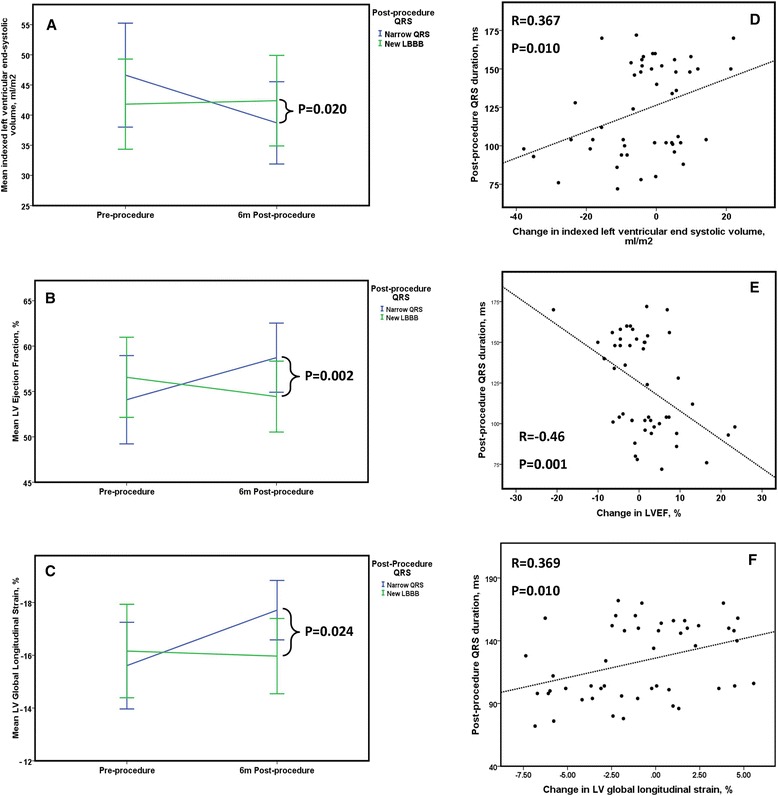
In the LBBB-T group there was an increase in QRS duration from 96 ± 14 to 151 ± 12 ms (P < 0.001) leading to inter- and intra-ventricular dyssynchrony (inter: LBBB-T 130 ± 73 vs nQRS 23 ± 86 ms, p < 0.001; intra: LBBB-T 118 ± 103 vs. nQRS 13 ± 106 ms, p = 0.001). Change in indexed LV end-systolic volume (LVESVi), LVEF and GLS was significantly different between the two groups (LVESVi: nQRS -7.9 ± 14.0 vs. LBBB-T -0.6 ± 10.2 ml/m, p = 0.02, LVEF: nQRS +4.6 ± 7.8 vs LBBB-T -2.1 ± 6.9%, p = 0.002; GLS: nQRS -2.1 ± 3.6 vs. LBBB-T +0.2 ± 3.2%, p = 0.024). There was a significant correlation between change in QRS and change in LVEF (r = -0.434, p = 0.002) and between change in QRS and change in GLS (r = 0.462, p = 0.001). Post-procedure QRS duration was an independent predictor of change in LVEF and GLS at 6 months.
TAVR-induced LBBB is associated with less favourable cardiac reverse remodeling at medium term follow up. In view of this, every effort should be made to prevent TAVR-induced LBBB, especially as TAVR is now being extended to a younger, lower risk population.
左束支传导阻滞(LBBB)在经导管主动脉瓣置换术(TAVR)后很常见,并且与死亡率增加有关,尽管这是否与不太有利的心脏逆向重构有关尚不清楚。本研究的目的是调查TAVR诱导的LBBB对心脏逆向重构的影响。
对48例因严重主动脉瓣狭窄接受TAVR的患者进行评估。24例TAVR术后出现新发LBBB(LBBB-T)的患者与24例术后QRS波狭窄(nQRS)的患者进行匹配。患者在TAVR术前和术后6个月接受心血管磁共振成像(CMR)检查。测量的心脏逆向重构参数包括左心室(LV)大小、射血分数(LVEF)和整体纵向应变(GLS)。使用CMR特征追踪得出的径向应变峰值时间来确定心室间和心室内不同步。
在LBBB-T组中,QRS波时限从96±14毫秒增加到151±12毫秒(P<0.001),导致心室间和心室内不同步(心室间:LBBB-T为130±73毫秒,nQRS为23±86毫秒,p<0.001;心室内:LBBB-T为118±103毫秒,nQRS为13±106毫秒,p=0.001)。两组之间的左心室收缩末期容积指数(LVESVi)、LVEF和GLS变化有显著差异(LVESVi:nQRS组-7.9±14.0与LBBB-T组-0.6±10.2毫升/米,p=0.02;LVEF:nQRS组+4.6±7.8与LBBB-T组-2.1±6.9%,p=0.002;GLS:nQRS组-2.1±3.6与LBBB-T组+0.2±3.2%,p=0.024)。QRS波变化与LVEF变化之间存在显著相关性(r=-0.434,p=0.002),QRS波变化与GLS变化之间也存在显著相关性(r=0.462,p=0.001)。术后QRS波时限是6个月时LVEF和GLS变化的独立预测因素。
在中期随访中,TAVR诱导的LBBB与不太有利的心脏逆向重构有关。鉴于此,应尽一切努力预防TAVR诱导的LBBB,特别是因为TAVR现在正扩展到更年轻、风险更低的人群。