Wang Bo, Yang Xing-Lou, Li Wen, Zhu Yan, Ge Xing-Yi, Zhang Li-Biao, Zhang Yun-Zhi, Bock Claus-Thomas, Shi Zheng-Li
CAS Key Laboratory of Special Pathogens and Biosafety and Center for Emerging Infectious Diseases, Wuhan Institute of Virology, Chinese Academy of Sciences, Wuhan, China.
Department of Infectious Diseases, Robert Koch Institute, Berlin, Germany.
Virol J. 2017 Feb 22;14(1):40. doi: 10.1186/s12985-017-0706-8.
In recent years, novel hepadnaviruses, hepeviruses, hepatoviruses, and hepaciviruses have been discovered in various species of bat around the world, indicating that bats may act as natural reservoirs for these hepatitis viruses. In order to further assess the distribution of hepatitis viruses in bat populations in China, we tested the presence of these hepatitis viruses in our archived bat liver samples that originated from several bat species and various geographical regions in China.
A total of 78 bat liver samples (involving two families, five genera, and 17 species of bat) were examined using nested or heminested reverse transcription PCR (RT-PCR) with degenerate primers. Full-length genomic sequences of two virus strains were sequenced followed by phylogenetic analyses.
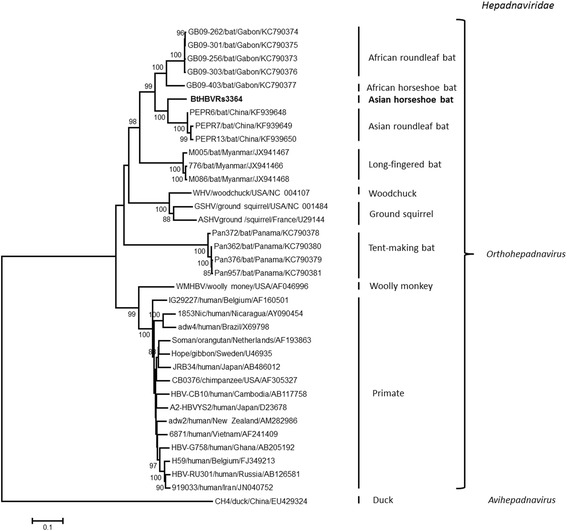
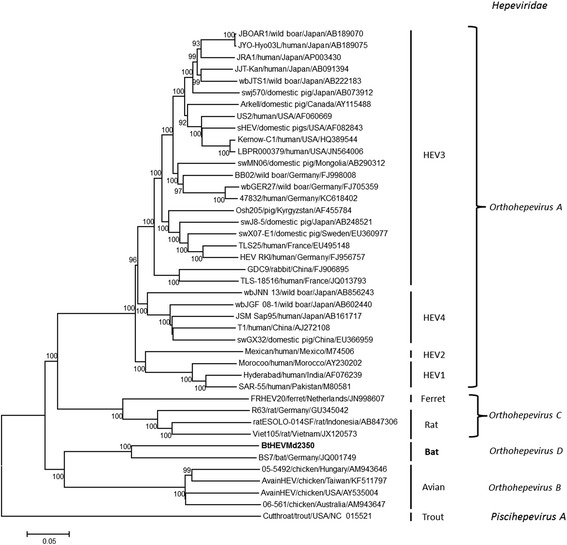
Four samples were positive for hepadnavirus, only one was positive for hepevirus, and none of the samples were positive for hepatovirus or hepacivirus. The hepadnaviruses were discovered in the horseshoe bats, Rhinolophus sinicus and Rhinolophus affinis, and the hepevirus was found in the whiskered bat Myotis davidii. The full-length genomic sequences were determined for one of the two hepadnaviruses identified in R. sinicus (designated BtHBVRs3364) and the hepevirus (designated BtHEVMd2350). A sequence identity analysis indicated that BtHBVRs3364 had the highest degree of identity with a previously reported hepadnavirus from the roundleaf bat, Hipposideros pomona, from China, and BtHEVMd2350 had the highest degree of identity with a hepevirus found in the serotine bat, Eptesicus serotinus, from Germany, but it exhibited high levels of divergence at both the nucleotide and the amino acid levels.
This is the first study to report that the Chinese horseshoe bat and the Chinese whiskered bat have been found to carry novel hepadnaviruses and a novel hepevirus, respectively. The discovery of BtHBVRs3364 further supports the significance of host switches evolution while opposing the co-evolutionary theory associated with hepadnaviruses. According to the latest criterion of the International Committee on Taxonomy of Viruses (ICTV), we hypothesize that BtHEVMd2350 represents an independent genotype within the species Orthohepevirus D of the family Hepeviridae.
近年来,在世界各地的多种蝙蝠中发现了新型嗜肝DNA病毒、戊型肝炎病毒、肝病毒和丙型肝炎病毒,这表明蝙蝠可能是这些肝炎病毒的天然宿主。为了进一步评估中国蝙蝠种群中肝炎病毒的分布情况,我们检测了来自中国多个蝙蝠物种和不同地理区域的存档蝙蝠肝脏样本中这些肝炎病毒的存在情况。
使用简并引物通过巢式或半巢式逆转录聚合酶链反应(RT-PCR)对总共78份蝙蝠肝脏样本(涉及两个科、五个属和17种蝙蝠)进行检测。对两个病毒株的全长基因组序列进行测序,随后进行系统发育分析。
4份样本对嗜肝DNA病毒呈阳性,仅1份样本对戊型肝炎病毒呈阳性,没有样本对肝病毒或丙型肝炎病毒呈阳性。在中华菊头蝠和中菊头蝠中发现了嗜肝DNA病毒,在大足鼠耳蝠中发现了戊型肝炎病毒。确定了在中华菊头蝠中鉴定出的两种嗜肝DNA病毒之一(命名为BtHBVRs3364)和戊型肝炎病毒(命名为BtHEVMd2350)的全长基因组序列。序列同一性分析表明,BtHBVRs3364与先前报道的来自中国的棕果蝠的嗜肝DNA病毒具有最高程度的同一性,而BtHEVMd2350与在德国的棕蝠中发现的戊型肝炎病毒具有最高程度的同一性,但在核苷酸和氨基酸水平上均表现出高度差异。
这是第一项报告发现中华菊头蝠和大足鼠耳蝠分别携带新型嗜肝DNA病毒和新型戊型肝炎病毒的研究。BtHBVRs3364的发现进一步支持了宿主转换进化的重要性,同时反对与嗜肝DNA病毒相关的共同进化理论。根据国际病毒分类委员会(ICTV)的最新标准,我们假设BtHEVMd2350代表戊型肝炎病毒科正戊型肝炎病毒属D种内的一个独立基因型。