Warlop Thibault, Detrembleur Christine, Buxes Lopez Maïté, Stoquart Gaëtan, Lejeune Thierry, Jeanjean Anne
Physical and Rehabilitation Medicine Department, Cliniques universitaires Saint-Luc, Avenue Hippocrate n°10, 1200, Brussels, Belgium.
Institut de Recherche Expérimentale et Clinique, Neuro Musculo Skeletal Lab (IREC/NMSK), Université catholique de Louvain, Brussels, Belgium.
J Neuroeng Rehabil. 2017 Feb 21;14(1):17. doi: 10.1186/s12984-017-0226-1.
Gait disorders of Parkinson's disease (PD) are characterized by the breakdown of the temporal organization of stride duration variability that was tightly associated to dynamic instability in PD. Activating the upper body during walking, Nordic Walking (NW) may be used as an external cueing to improve spatiotemporal parameters of gait, such as stride length or gait variability, in PD. The aim of this study was to evaluate the beneficial effects of NW on temporal organization of gait variability and spatiotemporal gait variables in PD.
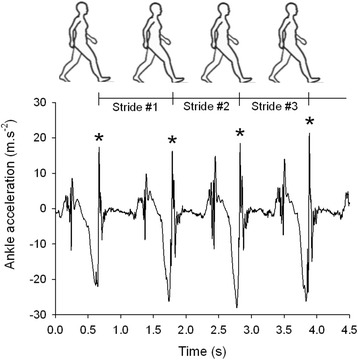
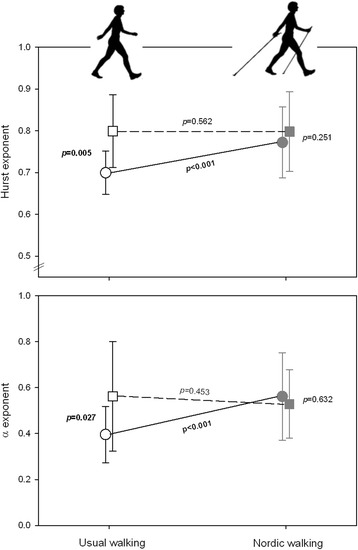
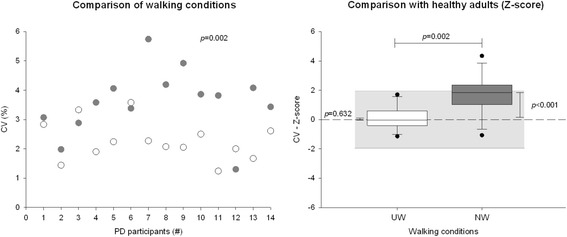
Fourteen mild to moderate PD participants and ten age-matched healthy subjects performed 2 × 12 min overground walking sessions (with and without pole in a randomized order) at a comfortable speed. Gait speed, cadence, step length and temporal organization (i.e. long-range autocorrelations; LRA) of stride duration variability were studied on 512 consecutive gait cycles using a unidimensional accelerometer placed on the malleola of the most affected side in PD patients and of the dominant side in healthy controls. The presence of LRA was determined using the Rescaled Range Analysis (Hurst exponent) and the Power Spectral Density (α exponent). To assess NW and disease influences on gait, paired t-tests, Z-score and a two-way (pathological condition x walking condition) ANOVA repeated measure were used.
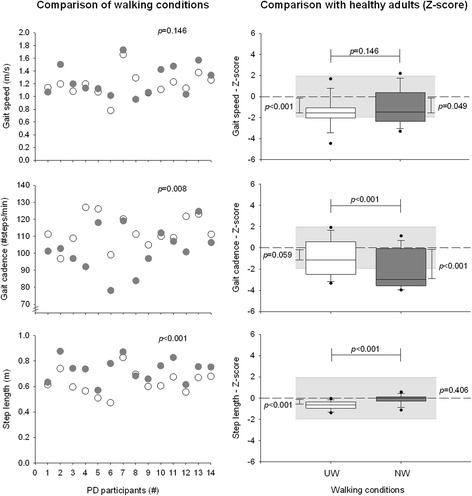
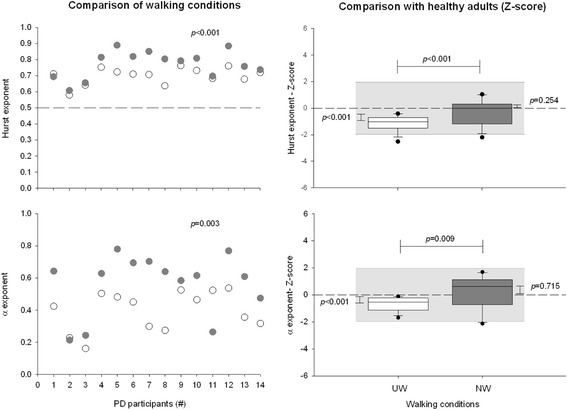
Leading to significant improvement of LRA, NW enhances step length and reduces gait cadence without any change in gait speed in PD. Interestingly, LRA and step length collected from the NW session are similar to that of the healthy population.
This cross-sectional controlled study demonstrates that NW may constitute a powerful way to struggle against the randomness of PD gait and the typical gait hypokinesia. Involving a voluntary intersegmental coordination, such improvement could also be due to the upper body rhythmic movements acting as rhythmical external cue to bypass their defective basal ganglia circuitries.
ETHICS COMMITTEE'S REFERENCE NUMBER: B403201318916 TRIAL REGISTRATION: NCT02419768.
帕金森病(PD)的步态障碍表现为步幅持续时间变异性的时间组织紊乱,这与PD中的动态不稳定性密切相关。在行走过程中激活上半身,北欧式健走(NW)可作为一种外部提示,以改善PD患者的步态时空参数,如步长或步态变异性。本研究的目的是评估NW对PD患者步态变异性的时间组织和时空步态变量的有益影响。
14名轻度至中度PD参与者和10名年龄匹配的健康受试者以舒适的速度进行了2×12分钟的地面行走试验(随机顺序进行有杆和无杆行走)。使用放置在PD患者受影响最严重一侧的内踝以及健康对照者优势侧的一维加速度计,对512个连续步态周期的步态速度、步频、步长和步幅持续时间变异性的时间组织(即长程自相关;LRA)进行了研究。使用重标极差分析(赫斯特指数)和功率谱密度(α指数)确定LRA的存在。为了评估NW和疾病对步态的影响,使用了配对t检验、Z分数和双向(病理状况x行走状况)方差分析重复测量。
NW导致LRA显著改善,增加了PD患者的步长并降低了步频,而步态速度没有任何变化。有趣的是,从NW试验中收集的LRA和步长与健康人群相似。
这项横断面对照研究表明,NW可能是对抗PD步态随机性和典型步态运动减少的有效方法。这种改善可能还归因于上半身的节律性运动作为节律性外部提示,绕过了其有缺陷的基底神经节回路,涉及到自愿的节段间协调。
B403201318916 试验注册:NCT02419768。