Jones Gerrad D, Droz Boris, Greve Peter, Gottschalk Pia, Poffet Deyan, McGrath Steve P, Seneviratne Sonia I, Smith Pete, Winkel Lenny H E
Eawag, Swiss Federal Institute of Aquatic Science and Technology, 8600 Duebendorf, Switzerland.
Institute for Atmospheric and Climate Science, ETH Zurich, 8092 Zurich, Switzerland.
Proc Natl Acad Sci U S A. 2017 Mar 14;114(11):2848-2853. doi: 10.1073/pnas.1611576114. Epub 2017 Feb 21.
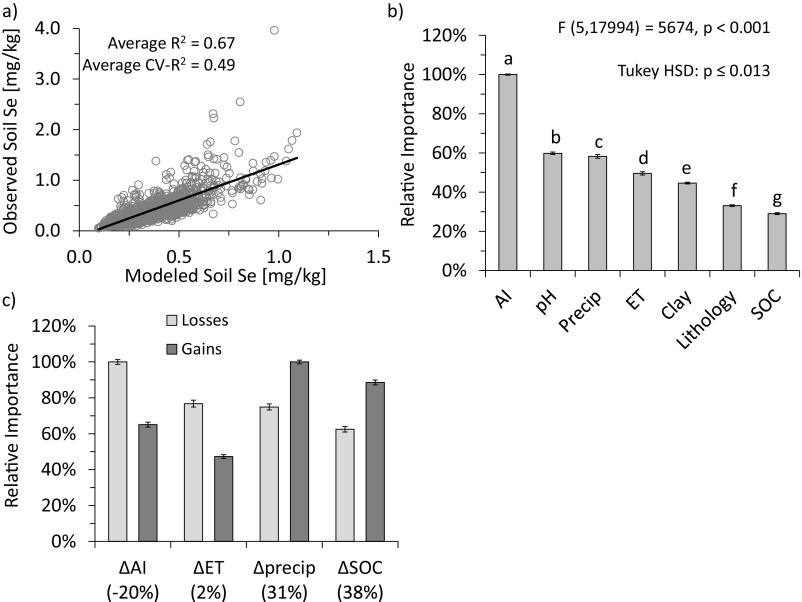
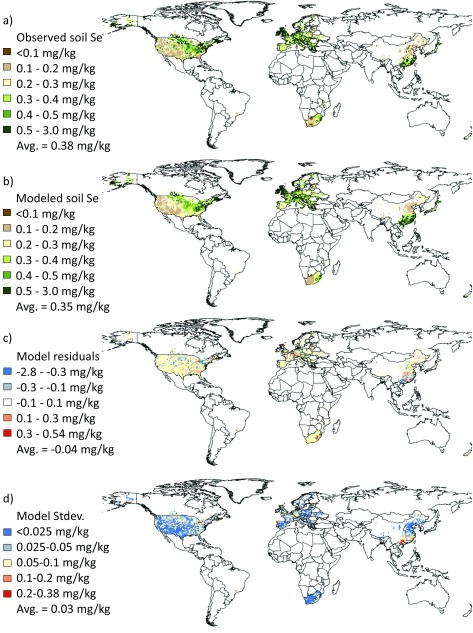
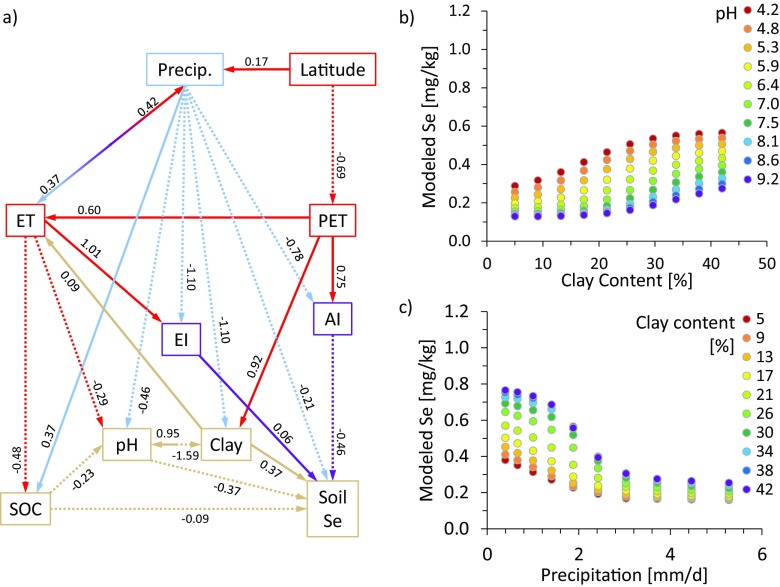
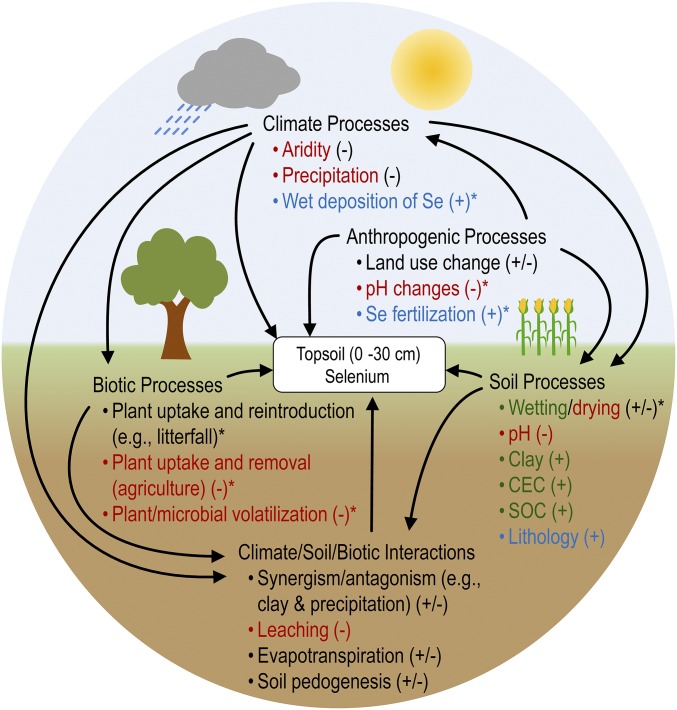
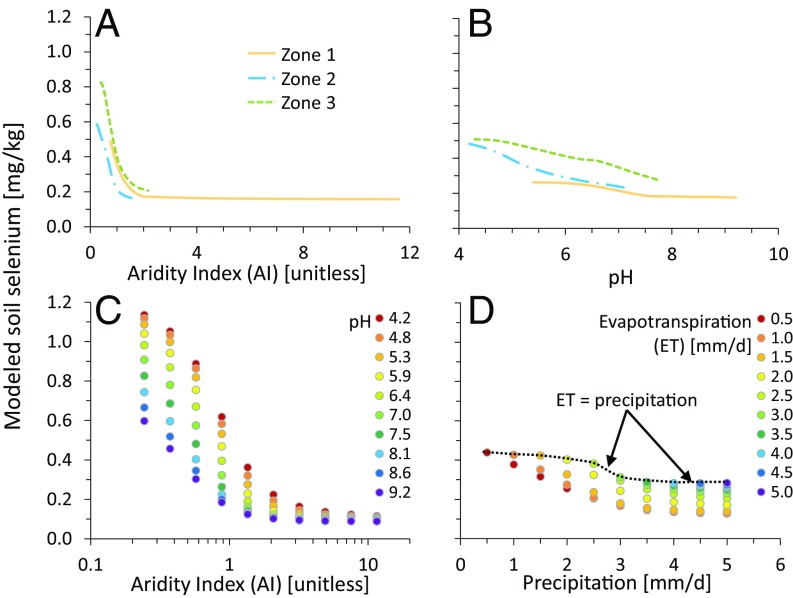
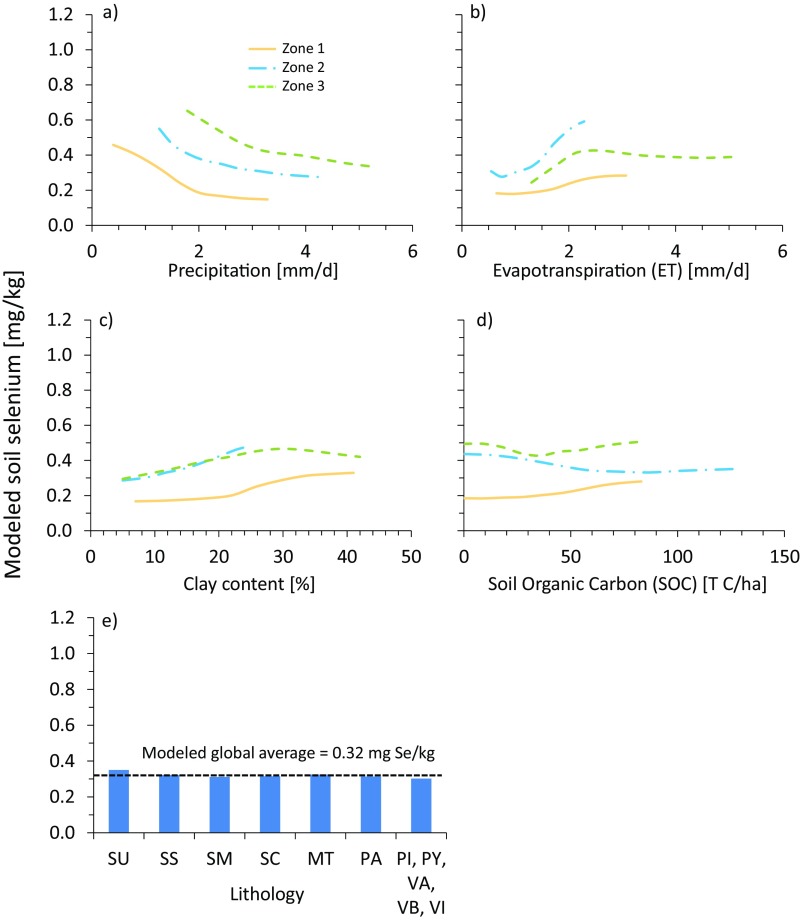
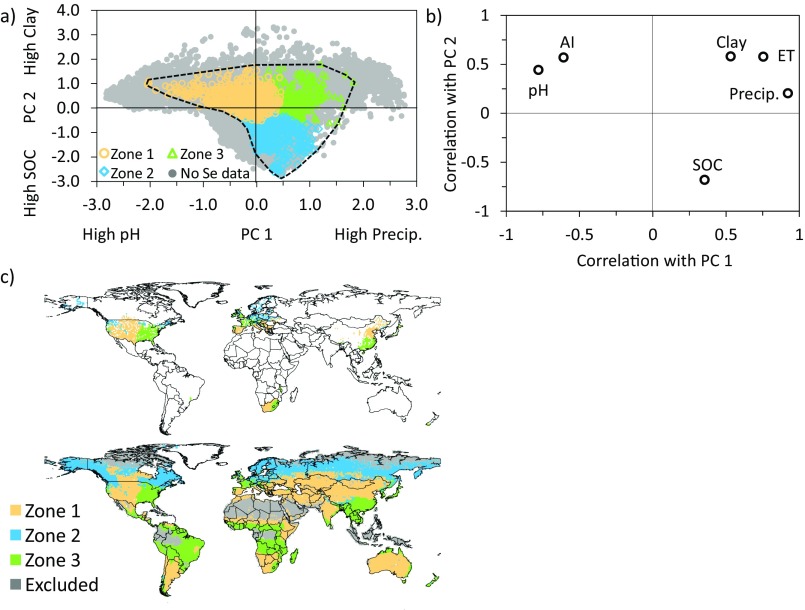
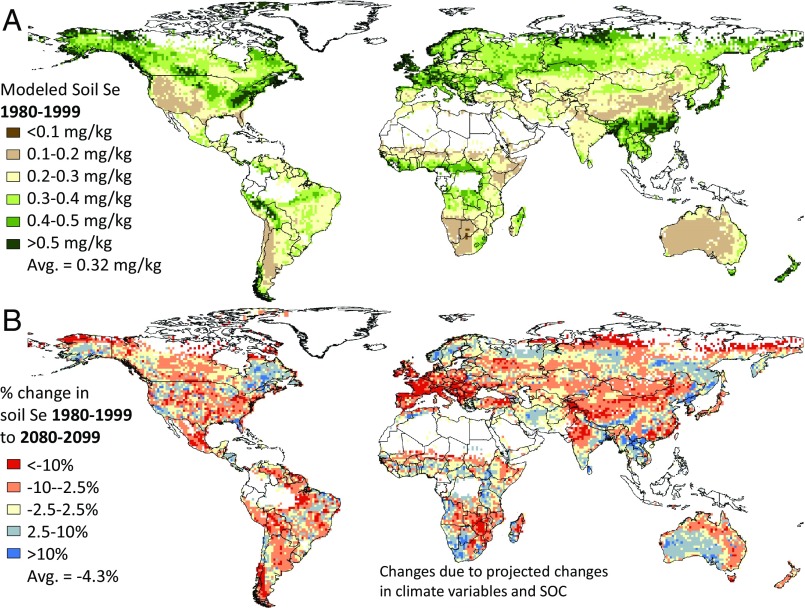
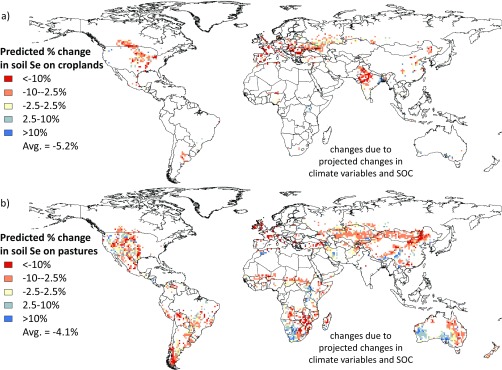
Deficiencies of micronutrients, including essential trace elements, affect up to 3 billion people worldwide. The dietary availability of trace elements is determined largely by their soil concentrations. Until now, the mechanisms governing soil concentrations have been evaluated in small-scale studies, which identify soil physicochemical properties as governing variables. However, global concentrations of trace elements and the factors controlling their distributions are virtually unknown. We used 33,241 soil data points to model recent (1980-1999) global distributions of Selenium (Se), an essential trace element that is required for humans. Worldwide, up to one in seven people have been estimated to have low dietary Se intake. Contrary to small-scale studies, soil Se concentrations were dominated by climate-soil interactions. Using moderate climate-change scenarios for 2080-2099, we predicted that changes in climate and soil organic carbon content will lead to overall decreased soil Se concentrations, particularly in agricultural areas; these decreases could increase the prevalence of Se deficiency. The importance of climate-soil interactions to Se distributions suggests that other trace elements with similar retention mechanisms will be similarly affected by climate change.
包括必需微量元素在内的微量营养素缺乏影响着全球多达30亿人。微量元素在饮食中的可利用性很大程度上取决于其在土壤中的浓度。到目前为止,控制土壤浓度的机制仅在小规模研究中进行过评估,这些研究将土壤物理化学性质确定为控制变量。然而,微量元素的全球浓度及其分布的控制因素实际上仍不清楚。我们使用了33241个土壤数据点来模拟近期(1980 - 1999年)全球硒(Se)的分布,硒是人体必需的微量元素。据估计,全球多达七分之一的人饮食中硒摄入量较低。与小规模研究相反,土壤硒浓度主要受气候 - 土壤相互作用的影响。利用2080 - 2099年的适度气候变化情景,我们预测气候和土壤有机碳含量的变化将导致土壤硒浓度总体下降,特别是在农业地区;这些下降可能会增加硒缺乏的发生率。气候 - 土壤相互作用对硒分布的重要性表明,其他具有类似保留机制的微量元素也将受到气候变化的类似影响。