Li Hongqiao, Mori Tetsuya, Moriyama Rintaro, Fujita Moeka, Hatanaka Genki, Shiotsuka Naoki, Hosomi Ryota, Maruyama-Nakashita Akiko
Department of Bioscience and Biotechnology, Faculty of Agriculture, Kyushu University, 744, Motooka, Nishi-ku, Fukuoka 819-0395, Japan.
RIKEN Center for Sustainable Resource Science, Yokohama 230-0045, Japan.
Plants (Basel). 2025 Jan 22;14(3):322. doi: 10.3390/plants14030322.
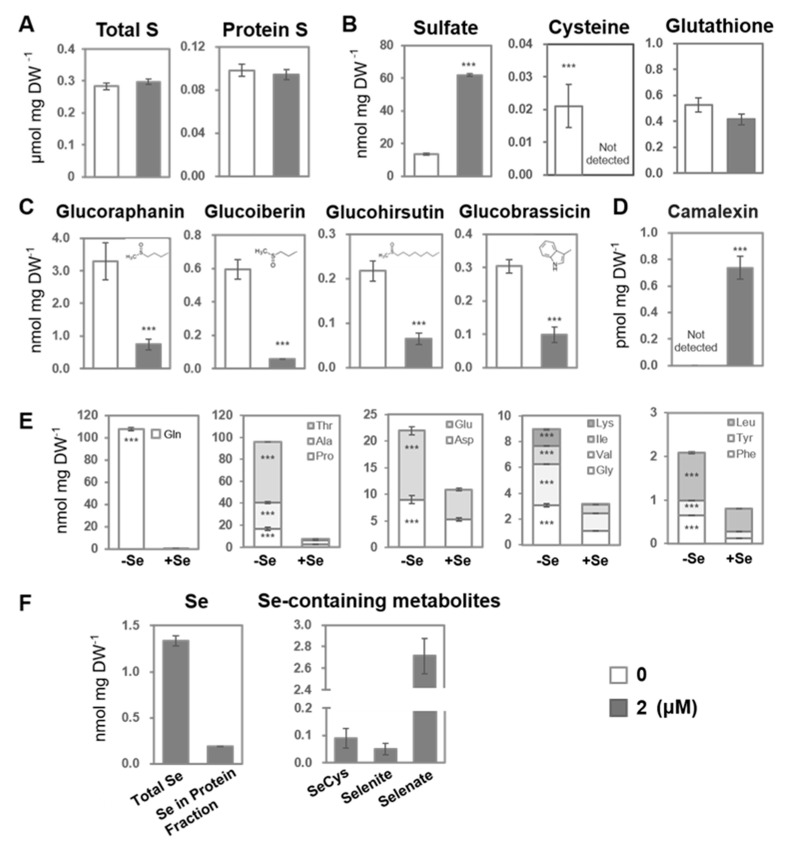
Selenate, the most common form of selenium (Se) in soil environments, is beneficial for higher plants. Selenate is similar to sulfate in terms of the structure and the manner of assimilation by plants, which involves the reduction of selenate to selenide and the replacement of an S moiety in the organic compounds such as amino acids. The nonspecific incorporation of seleno-amino acids into proteins induce Se toxicity in plants. Selenate alters the plant metabolism, particularly the S metabolism, which is comparable to the responses to S deficiency (-S). However, previous analyses involved high concentrations of selenate, and the effects of lower selenate doses have not been elucidated. In this study, we analyzed the metabolic changes induced by selenate treatment through a non-targeted metabolome analysis and found that 2 µM of selenate decreased the S assimilates and amino acids, and increased the flavonoids, while the glutathione levels were maintained. The results suggest that the decrease in amino acid levels, which is not detected under -S, along with the disruptions in S assimilation, amino acid biosynthesis pathways, and the energy metabolism, present the primary metabolic influences of selenate. These results suggest that selenate targets the energy metabolism and S assimilation first, and induces oxidative stress mitigation, represented by flavonoid accumulation, as a key adaptive response, providing a novel, possible mechanism in plant stress adaptation.
硒酸盐是土壤环境中最常见的硒(Se)形态,对高等植物有益。硒酸盐在结构和植物同化方式上与硫酸盐相似,植物对其同化过程包括将硒酸盐还原为硒化物,并在氨基酸等有机化合物中取代硫部分。硒代氨基酸非特异性地掺入蛋白质会在植物中诱导硒毒性。硒酸盐会改变植物代谢,尤其是硫代谢,这与对缺硫(-S)的反应类似。然而,以往的分析涉及高浓度的硒酸盐,较低剂量硒酸盐的影响尚未阐明。在本研究中,我们通过非靶向代谢组分析来分析硒酸盐处理诱导的代谢变化,发现2 μM的硒酸盐会降低硫同化产物和氨基酸含量,增加黄酮类化合物含量,同时谷胱甘肽水平保持不变。结果表明,在缺硫条件下未检测到的氨基酸水平下降,以及硫同化、氨基酸生物合成途径和能量代谢的紊乱,是硒酸盐的主要代谢影响。这些结果表明,硒酸盐首先靶向能量代谢和硫同化,并诱导以黄酮类化合物积累为代表的氧化应激缓解作为关键的适应性反应,为植物应激适应提供了一种新的可能机制。