Zhou Zhenming, Fang Lei, Meng Qingxiang, Li Shengli, Chai Shatuo, Liu Shujie, Schonewille Jan Thomas
State Key Laboratory of Animal Nutrition, College of Animal Science and Technology, China Agricultural University Beijing, China.
Qinghai Academy of Animal and Veterinary Sciences, Qinghai University Xining, China.
Front Microbiol. 2017 Feb 7;8:179. doi: 10.3389/fmicb.2017.00179. eCollection 2017.
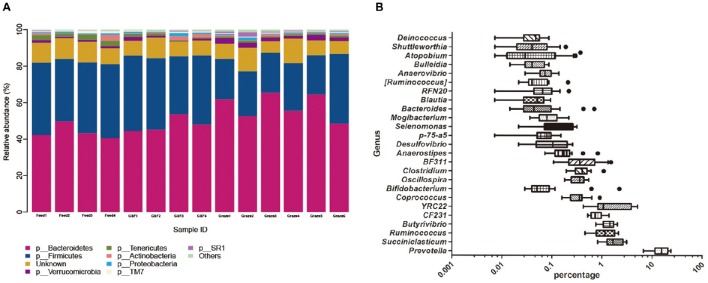
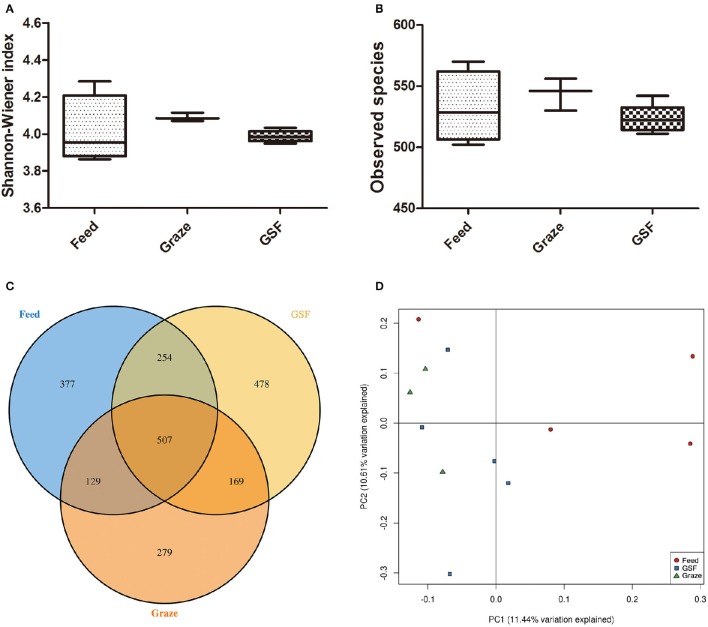
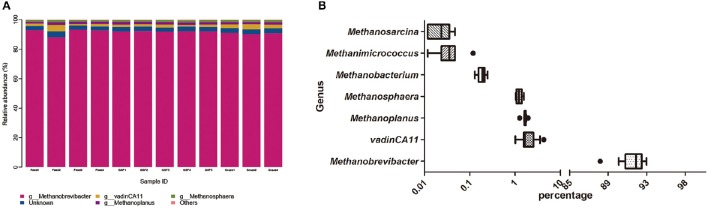
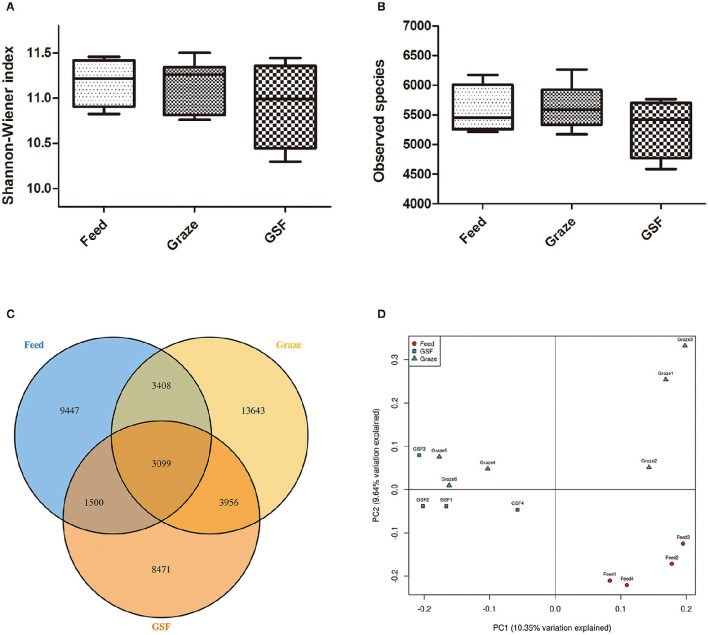
The aim of this study was to determine the microbial community composition in the rumen of yaks under different feeding regimes. Microbial communities were assessed by sequencing bacterial and archaeal 16S ribosomal RNA gene fragments obtained from yaks () from Qinghai-Tibetan Plateau, China. Samples were obtained from 14 animals allocated to either pasture grazing (Graze), a grazing and supplementary feeding regime (GSF), or an indoor feeding regime (Feed). The predominant bacterial phyla across feeding regimes were (51.06%) and (32.73%). At genus level, 25 genera were shared across all samples. The relative abundance of in the graze and GSF regime group were significantly higher than that in the feed regime group. Meanwhile, the relative abundance of was lower in the graze group than the feed and GSF regime groups. The most abundant archaeal phylum was , which accounted for 99.67% of the sequences. Ten genera were detected across feeding regimes, seven genera were shared by all samples, and the most abundant was genus (91.60%). The relative abundance of the most detected genera were similar across feeding regime groups. Our results suggest that the ruminal bacterial community structure differs across yak feeding regimes while the archaeal community structures are largely similar.
本研究的目的是确定不同饲养方式下牦牛瘤胃中的微生物群落组成。通过对从中国青藏高原的牦牛获取的细菌和古菌16S核糖体RNA基因片段进行测序,评估微生物群落。样本取自14头动物,它们被分配到三种饲养方式中:纯放牧(Graze)、放牧加补饲(GSF)或舍饲(Feed)。所有饲养方式中主要的细菌门类是厚壁菌门(51.06%)和拟杆菌门(32.73%)。在属水平上,所有样本共有25个属。在放牧和放牧加补饲组中普雷沃氏菌属的相对丰度显著高于舍饲组。同时,放牧组中丁酸弧菌属的相对丰度低于舍饲组和放牧加补饲组。最丰富的古菌门类是广古菌门,占序列的99.67%。在所有饲养方式中检测到10个属,所有样本共有7个属,最丰富的是甲烷杆菌属(91.60%)。在不同饲养方式组中,大多数检测到的属的相对丰度相似。我们的结果表明,牦牛不同饲养方式下瘤胃细菌群落结构不同,而古菌群落结构基本相似。