Department of Biology, University of Crete, 71409 Heraklion, Greece.
Institute for Biodiversity and Ecosystem Dynamics (IBED), University of Amsterdam (UvA), Science Park 904, 1098 XH Amsterdam, The Netherlands.
Sci Rep. 2017 Feb 22;7:42633. doi: 10.1038/srep42633.
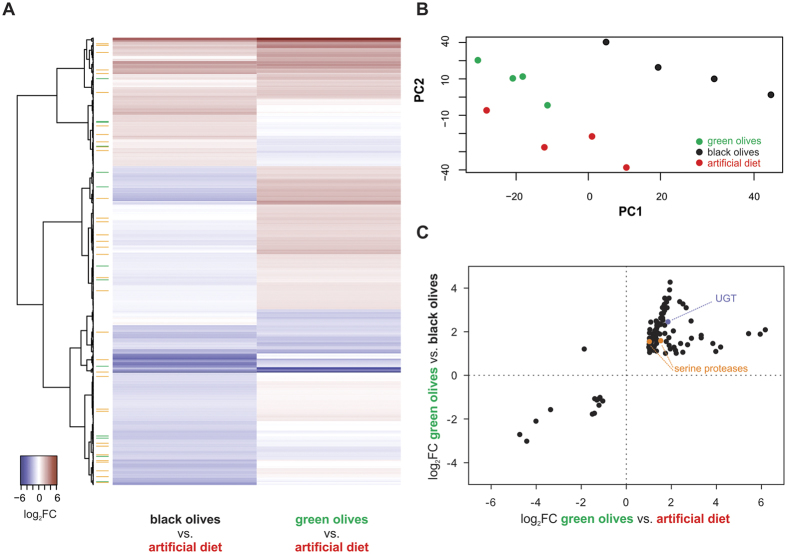
The olive fruit fly, Bactrocera oleae, is the most destructive pest of olive orchards worldwide. The monophagous larva has the unique capability of feeding on olive mesocarp, coping with high levels of phenolic compounds and utilizing non-hydrolyzed proteins present, particularly in the unripe, green olives. On the molecular level, the interaction between B. oleae and olives has not been investigated as yet. Nevertheless, it has been associated with the gut obligate symbiotic bacterium Candidatus Erwinia dacicola. Here, we used a B.oleae microarray to analyze the gene expression of larvae during their development in artificial diet, unripe (green) and ripe (black) olives. The expression profiles of Ca. E. dacicola were analyzed in parallel, using the Illumina platform. Several genes were found overexpressed in the olive fly larvae when feeding in green olives. Among these, a number of genes encoding detoxification and digestive enzymes, indicating a potential association with the ability of B. oleae to cope with green olives. In addition, a number of biological processes seem to be activated in Ca. E. dacicola during the development of larvae in olives, with the most notable being the activation of amino-acid metabolism.
油橄榄果蝇,Bactrocera oleae,是全球橄榄果园中最具破坏性的害虫。这种单食性幼虫具有独特的能力,可以以橄榄中果皮为食,应对高水平的酚类化合物,并利用存在的未水解蛋白质,特别是在未成熟的绿色橄榄中。在分子水平上,B. oleae 与橄榄之间的相互作用尚未被研究。然而,它与肠道专性共生菌 Candidatus Erwinia dacicola 有关。在这里,我们使用 B.oleae 微阵列分析了幼虫在人工饮食、未成熟(绿色)和成熟(黑色)橄榄中发育过程中的基因表达。同时,使用 Illumina 平台分析了 Ca. E. dacicola 的表达谱。在幼虫以绿色橄榄为食时,发现了几个基因过度表达。其中,许多基因编码解毒和消化酶,表明与 B. oleae 应对绿色橄榄的能力有潜在关联。此外,在幼虫在橄榄中发育期间,Ca. E. dacicola 中的许多生物过程似乎被激活,最显著的是氨基酸代谢的激活。