Santos Viviane Martins, Formiga Cibelle Kayenne Martins Roberto, de Mello Paulo Roberto Bezerra, Leone Cléa Rodrigues
Universidade Federal do Mato Grosso, Hospital Universitário Júlio Müller, Cuiabá/MT, Brazil.
Universidade Estadual de Goiás, Faculdade de Educação Física e Fisioterapia, Goiania/GO, Brazil.
Clinics (Sao Paulo). 2017 Jan 1;72(1):17-22. doi: 10.6061/clinics/2017(01)04.
: To analyze the motor development of late preterm newborn infants (LPI) from birth to term-corrected age using the Test of Infant Motor Performance (TIMP) and to compare the obtained results with those of term infants at birth.
: Prospective cohort study, 29 late preterm newborn infants were evaluated by the TIMP at birth and every two weeks until term-corrected age. The TIMP was administered to 88 term infants at birth.
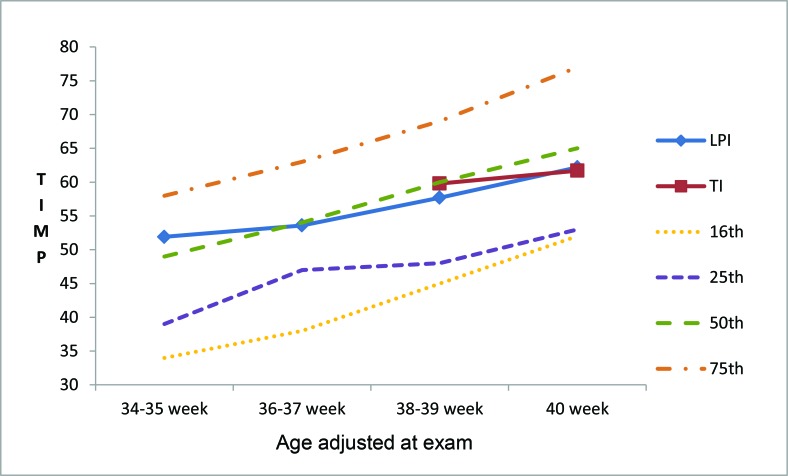
: The mean TIMP score of late preterm newborn infants was 51.9±5.8 at 34-35 weeks and 62.6±5.2 at 40 weeks. There was a significant increase at 38-39 weeks in the LPI group (p<0.05). There were no significant differences in the motor evaluations between term infants at birth and LPI at the equivalent age.
: The LPI presented a gradual progression of motor development until the term-corrected age, but differences with term infants at birth were not detected.
使用婴儿运动表现测试(TIMP)分析晚期早产儿(LPI)从出生到足月校正年龄的运动发育情况,并将所得结果与足月儿出生时的结果进行比较。
前瞻性队列研究,29例晚期早产儿在出生时及每两周进行一次TIMP评估,直至足月校正年龄。88例足月儿在出生时接受TIMP评估。
晚期早产儿在34 - 35周时TIMP平均得分为51.9±5.8,在40周时为62.6±5.2。LPI组在38 - 39周时有显著增加(p<0.05)。足月儿出生时与同等年龄的LPI在运动评估方面无显著差异。
LPI在足月校正年龄前运动发育呈逐渐进展,但未发现与足月儿出生时的差异。