Coutier-Marie Laurianne, Ioan Iulia, Bonabel Claude, Demoulin Bruno, Leblanc Anne-Laure, Debitu Ludivine, Schweitzer Cyril, Marchal François, Demoulin-Alexikova Silvia
EA 3450DevAH - Laboratoire de Physiologie, Faculté de Médicine, Université de LorraineVandœuvre-lès-Nancy, France; Service d'Explorations Fonctionnelles Pédiatriques, Hôpital d'EnfantsVandœuvre-lès-Nancy, France; Service de Pneumologie, Hôpital Femme-Mère-Enfant, Hospices Civils de LyonLyon, France.
EA 3450DevAH - Laboratoire de Physiologie, Faculté de Médicine, Université de LorraineVandœuvre-lès-Nancy, France; Service d'Explorations Fonctionnelles Pédiatriques, Hôpital d'EnfantsVandœuvre-lès-Nancy, France.
Front Physiol. 2017 Feb 8;8:64. doi: 10.3389/fphys.2017.00064. eCollection 2017.
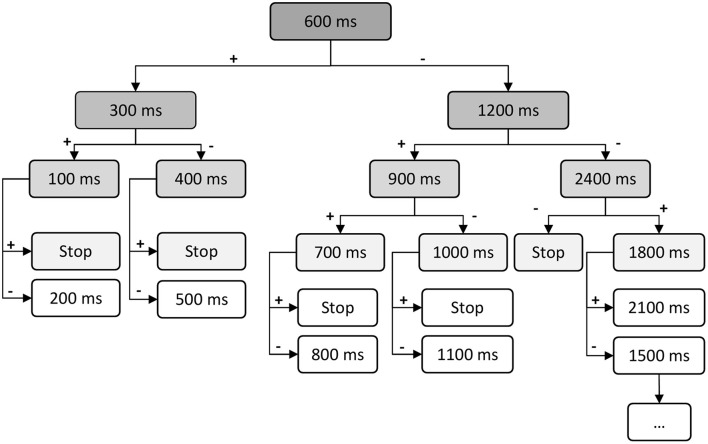
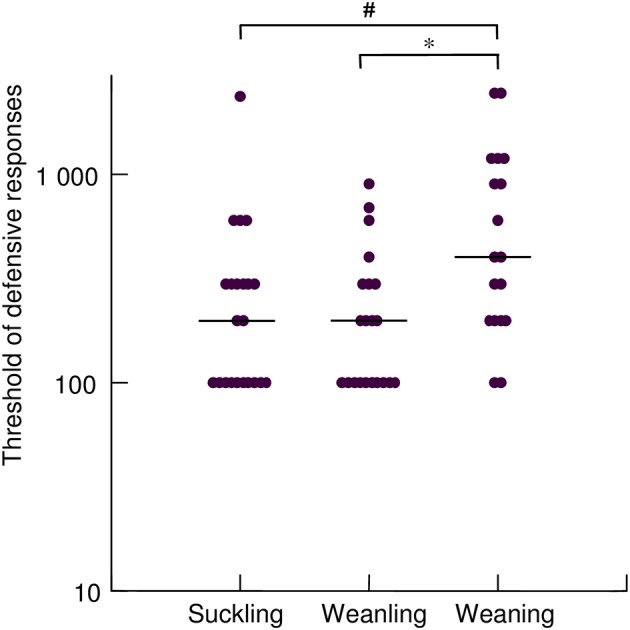
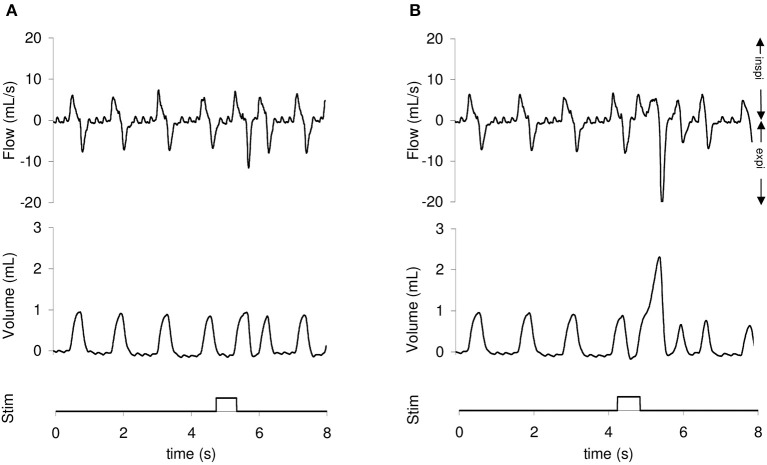
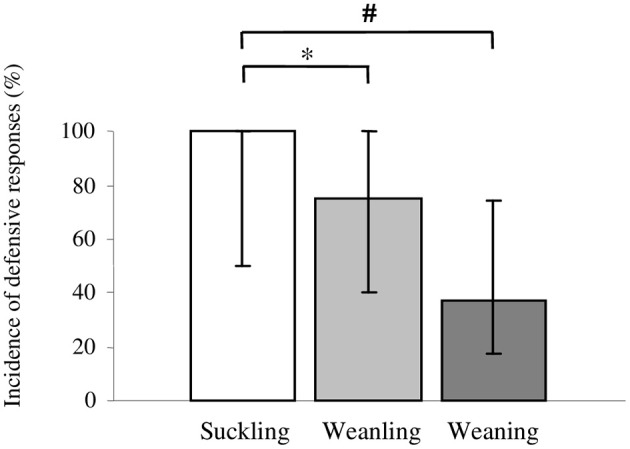
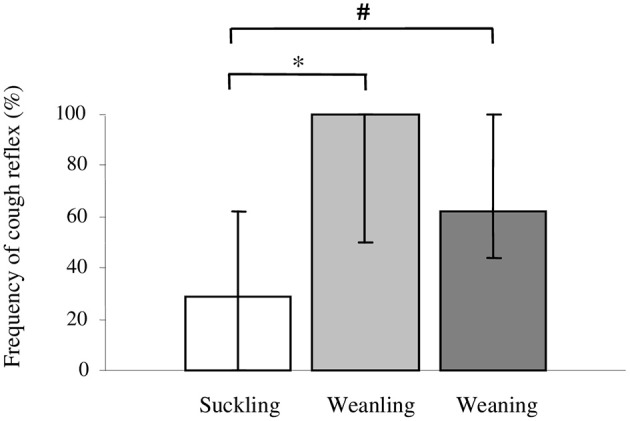
Cough and expiration reflex are major lower airway defense mechanisms that have not been studied throughout development in relation with the feeding behavior. To describe airway defense reflexes evoked by mechanical stimulation of the trachea in developing rabbit pups. Sixty one pups were allocated to 3 groups according to their feeding behavior: suckling ( = 22), weanling ( = 21) and weaning ( = 18) group. The incidence and sensitivity of defense reflexes triggered by mechanical tracheal stimulation were studied in anesthetized and tracheotomized animals. Data are expressed as median (25th to 75th percentile). The overall incidence of defensive responses (cough and/or expiration reflex) was found to be significantly higher in suckling [100% (50-100%); = 0.01] and weanling [75% (40-100%); = 0.05] animals when compared to weaning ones [37.5% (0-75%)]. However, cough motor pattern accounted for only 29% (0-62%) of all defensive responses in suckling rabbits and its frequency was significantly lower in this group when compared with weanling [100%(50-100%); = 0.006] or weaning group [62%(50-100%), = 0.05]. In other word the expiration reflex was the dominant response in suckling animals. Incidence and motor pattern of defensive responses were found to be linked to the pup feeding behavior and the expiration reflex was the major response triggered in suckling pups. The results suggest that this reflex is especially fitted to occur during the coordinated swallowing - breathing fast activities of sucking.
咳嗽和呼气反射是主要的下呼吸道防御机制,在整个发育过程中尚未与进食行为相关联进行研究。为了描述发育中的兔幼崽气管机械刺激诱发的气道防御反射。根据进食行为将61只幼崽分为3组:哺乳组(n = 22)、断奶前组(n = 21)和断奶组(n = 18)。在麻醉和气管切开的动物中研究了气管机械刺激引发的防御反射的发生率和敏感性。数据以中位数(第25至75百分位数)表示。与断奶组[37.5%(0 - 75%)]相比,发现哺乳组[100%(50 - 100%);P = 0.01]和断奶前组[75%(40 - 100%);P = 0.05]动物的防御反应(咳嗽和/或呼气反射)总体发生率显著更高。然而,咳嗽运动模式在哺乳兔的所有防御反应中仅占29%(0 - 62%),与断奶前组[100%(50 - 100%);P = 0.006]或断奶组[62%(50 - 100%),P = 0.05]相比,该组的频率显著更低。换句话说,呼气反射是哺乳动物的主要反应。发现防御反应的发生率和运动模式与幼崽的进食行为有关,并且呼气反射是哺乳幼崽引发的主要反应。结果表明,这种反射特别适合在吸吮时协调的吞咽 - 快速呼吸活动期间发生。