Wei Chuguang, Han Jin, Zhang Yuqing, Hannak Walter, Liu Zhengkui
Key Laboratory of Mental Health, Institute of Psychology, Chinese Academy of Sciences, Beijing, China; University of Chinese Academy of Sciences, Beijing, China; The Core Facility of Institute of Psychology, Chinese Academy of Sciences, Beijing, China.
China Meteorological Administration Training Centre , Beijing , China.
Front Public Health. 2017 Feb 8;5:3. doi: 10.3389/fpubh.2017.00003. eCollection 2017.
Post-traumatic stress disorder (PTSD) and post-traumatic growth (PTG) are two different outcomes that may occur after experiencing traumatic events. Meanwhile, the traumatic exposure level and emotion response played an important role in the process. The present study first evaluated the relationship between PTSD, PTG, and traumatic exposure level and then compared the characteristics of emotional response through response time of the affective priming paradigm.
For the purpose of evaluating the relationship between PTSD, PTG, and trauma exposure level, a sample of 2,395 participants completed measures of posttraumatic stress disorder Checklist-Civilian Version (PCL-C), Post-traumatic Growth Inventory (PTGI) and a trauma exposure-related survey, and Pearson's correlation analysis for the scales were conducted. In order to compare the characteristics of emotional response between PTSD and PTG, we randomly selected 90 participants and divided them into groups of PTSD, PTG, and control according the scores of PCL-C and PTGI, then the 90 participants were asked to do the affective priming task and the response time was recorded, at last analysis of variance was employed to analyze the data.
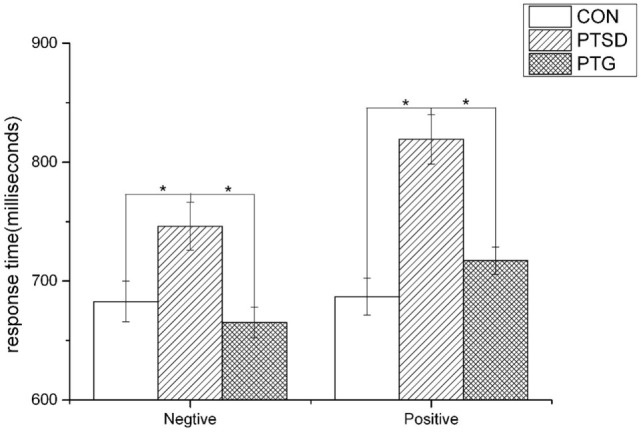
The results indicated that PTSD was not correlated with PTG. It was positively correlated with the traumatic exposure level, but PTG was not observed in this phenomenon. Finally, the data of response time showed that PTSD required more time to do the priming task and PTG demonstrated no difference compared to the control group.
Combined with previous research findings, the relationship between PTSD and PTG may depend on the type and severity of the trauma, the exposure level, and other such parameters. In terms of positive outcome of trauma PTG displayed no changes of emotional performance from the perspective of behavior. The preliminary results suggested that PTG was more related to a self-reported or self-experienced state.
创伤后应激障碍(PTSD)和创伤后成长(PTG)是经历创伤性事件后可能出现的两种不同结果。同时,创伤暴露水平和情绪反应在此过程中起着重要作用。本研究首先评估PTSD、PTG与创伤暴露水平之间的关系,然后通过情感启动范式的反应时间比较情绪反应特征。
为评估PTSD、PTG与创伤暴露水平之间的关系,2395名参与者完成了创伤后应激障碍检查表-平民版(PCL-C)、创伤后成长量表(PTGI)及一项与创伤暴露相关的调查,并对各量表进行了Pearson相关分析。为比较PTSD和PTG之间的情绪反应特征,我们随机选取90名参与者,根据PCL-C和PTGI得分将他们分为PTSD组、PTG组和对照组,然后让这90名参与者完成情感启动任务并记录反应时间,最后采用方差分析对数据进行分析。
结果表明,PTSD与PTG不相关。它与创伤暴露水平呈正相关,但PTG未出现此现象。最后,反应时间数据显示,PTSD完成启动任务需要更多时间,而PTG与对照组相比无差异。
结合以往研究结果,PTSD与PTG之间的关系可能取决于创伤的类型和严重程度、暴露水平等参数。就创伤的积极结果而言,从行为角度看,PTG的情绪表现没有变化。初步结果表明,PTG更与自我报告或自我体验的状态相关。