Ye Qing, Qi Fan, Bian Li, Zhang Shao-Hua, Wang Tao, Jiang Ze-Fei
Department of Breast Cancer, Affiliated Hospital of Academy of Military Medical Sciences, Beijing 100071, China.
Department of Respiration, Tianjin Haihe Hospital, Tianjin 300350, China.
Chin Med J (Engl). 2017 Mar 5;130(5):522-529. doi: 10.4103/0366-6999.200542.
The addition of anti-human epidermal growth factor receptor 2 (HER2)-targeted drugs, such as trastuzumab, lapatinib, and trastuzumab emtansine (T-DM1), to chemotherapy significantly improved prognosis of HER2-positive breast cancer patients. However, it was confused that metastatic patients vary in the response of targeted drug. Therefore, methods of accurately predicting drug response were really needed. To overcome the spatial and temporal limitations of biopsies, we aimed to develop a more sensitive and less invasive method of detecting mutations associated with anti-HER2 therapeutic response through circulating-free DNA (cfDNA).
From March 6, 2014 to December 10, 2014, 24 plasma samples from 20 patients with HER2-positive metastatic breast cancer who received systemic therapy were eligible. We used a panel for detection of hot-spot mutations from 50 oncogenes and tumor suppressor genes, and then used targeted next-generation sequencing (NGS) to identify somatic mutation of these samples in those 50 genes. Samples taken before their first trastuzumab administration and subsequently proven with clinical benefit were grouped into sensitive group. The others were collected after disease progression of the trastuzumab-based therapy and were grouped into the resistant group.
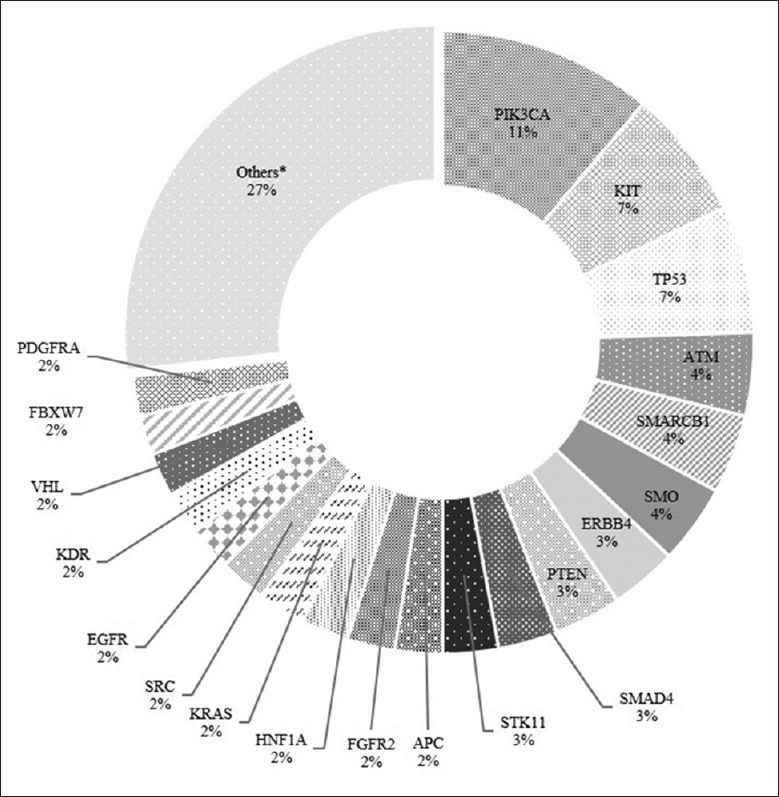
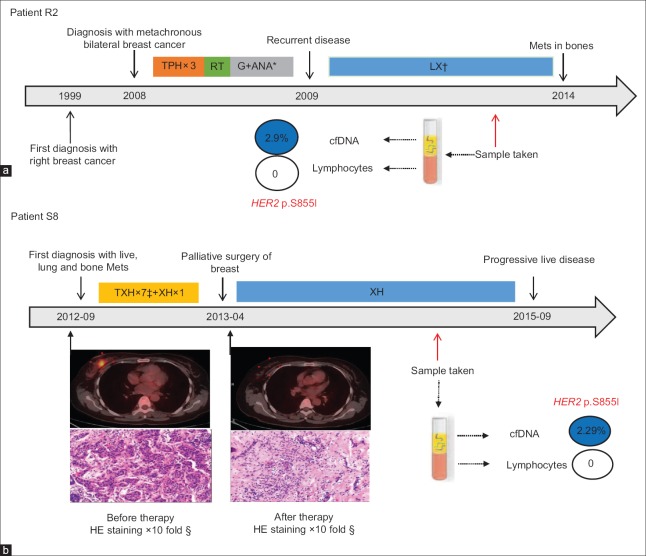
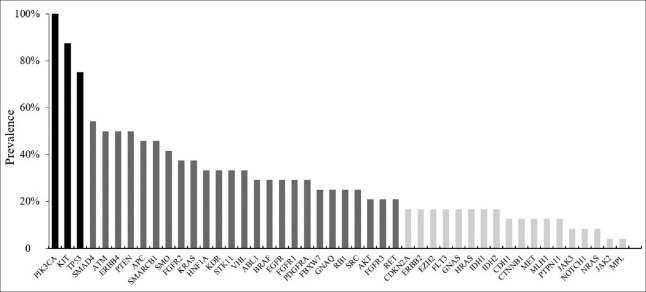
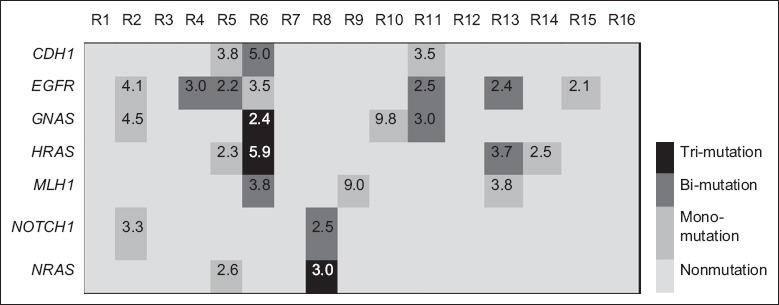
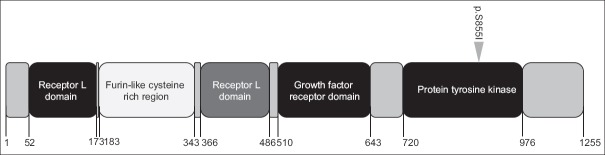
A total of 486 single-nucleotide variants from 46 genes were detected. Of these 46 genes, phosphatidylinositol 4,5-bisphosphate 3-kinase catalytic subunit alpha (PIK3CA), proto-oncogene c-Kit (KIT), and tumor protein p53 (TP53) were the most common mutated genes. Seven genes, including epidermal growth factor receptor (EGFR), G protein subunit alpha S (GNAS), HRas proto-oncogene (HRAS), mutL homolog 1 (MLH1), cadherin 1 (CDH1), neuroblastoma RAS viral oncogene homolog (NRAS), and NOTCH1, that only occurred m utations in the resistant group were associated with the resistance of targeted therapy. In addition, we detected a HER2 S855I mutation in two patients who had persistent benefits from anti-HER2 therapy.
Targeted NGS of cfDNA has potential clinical utility to detect biomarkers from HER2-targeted therapies.
将抗人表皮生长因子受体2(HER2)靶向药物,如曲妥珠单抗、拉帕替尼和曲妥珠单抗 emtansine(T-DM1),添加到化疗中可显著改善HER2阳性乳腺癌患者的预后。然而,转移性患者对靶向药物的反应各不相同,这令人困惑。因此,确实需要准确预测药物反应的方法。为了克服活检的时空限制,我们旨在开发一种更敏感、侵入性更小的方法,通过游离循环DNA(cfDNA)检测与抗HER2治疗反应相关的突变。
2014年3月6日至2014年12月10日,20例接受全身治疗的HER2阳性转移性乳腺癌患者的24份血浆样本符合条件。我们使用一个检测板检测50个癌基因和肿瘤抑制基因的热点突变,然后使用靶向二代测序(NGS)来识别这些样本在这50个基因中的体细胞突变。在首次给予曲妥珠单抗之前采集且随后经临床证实有获益的样本被归入敏感组。其他样本在基于曲妥珠单抗的治疗疾病进展后采集,并被归入耐药组。
共检测到来自46个基因的486个单核苷酸变异。在这46个基因中,磷脂酰肌醇-4,5-二磷酸3-激酶催化亚基α(PIK3CA)、原癌基因c-Kit(KIT)和肿瘤蛋白p53(TP53)是最常见的突变基因。7个基因,包括表皮生长因子受体(EGFR)、G蛋白亚基αS(GNAS)、原癌基因HRas(HRAS)、错配修复蛋白1(MLH1)、钙黏蛋白1(CDH1)、神经母细胞瘤RAS病毒癌基因同源物(NRAS)和Notch1,仅在耐药组中发生突变,与靶向治疗耐药相关。此外,我们在两名从抗HER2治疗中持续获益的患者中检测到HER2 S855I突变。
cfDNA的靶向NGS在检测HER2靶向治疗的生物标志物方面具有潜在的临床应用价值。