Schwaederle Maria, Husain Hatim, Fanta Paul T, Piccioni David E, Kesari Santosh, Schwab Richard B, Banks Kimberly C, Lanman Richard B, Talasaz AmirAli, Parker Barbara A, Kurzrock Razelle
Center for Personalized Cancer Therapy and Division of Hematology and Oncology, UCSD Moores Cancer Center, La Jolla, CA, USA.
Guardant Health, Inc., Redwood City, CA, USA.
Oncotarget. 2016 Mar 1;7(9):9707-17. doi: 10.18632/oncotarget.7110.
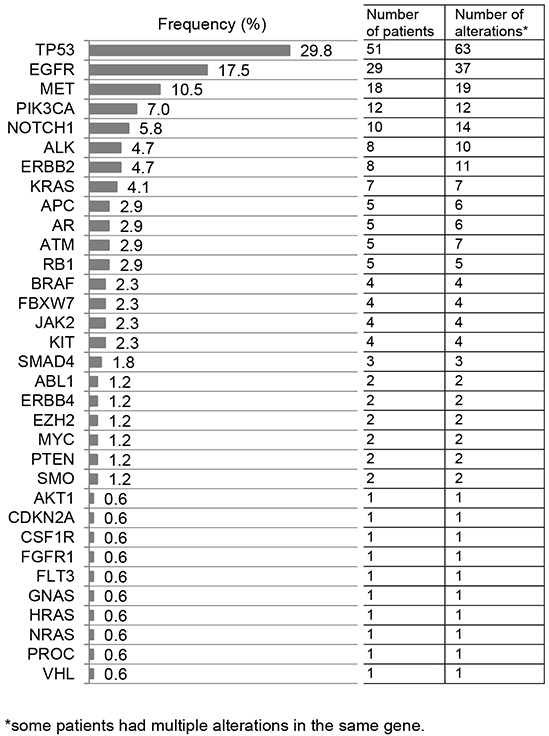
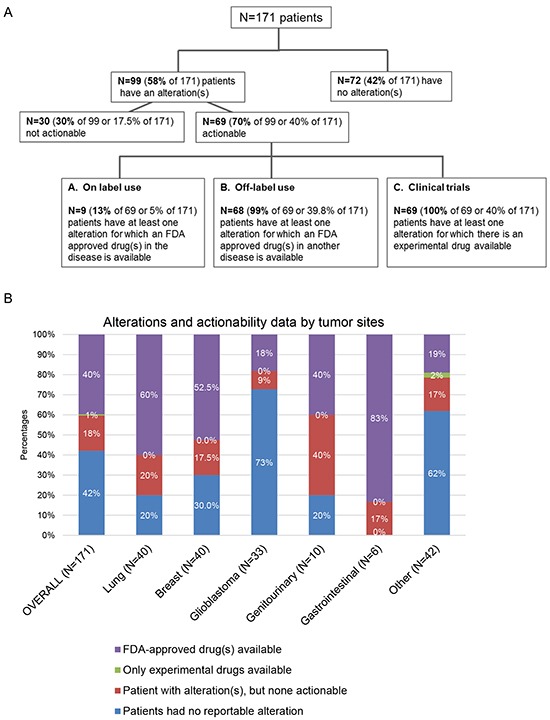
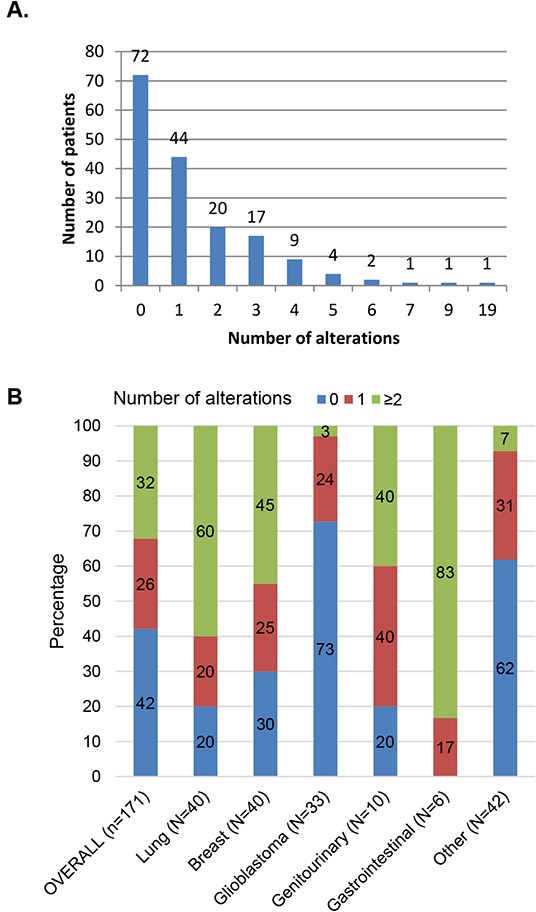
Analysis of cell-free DNA using next-generation sequencing (NGS) is a powerful tool for the detection/monitoring of alterations present in circulating tumor DNA (ctDNA). Plasma extracted from 171 patients with a variety of cancers was analyzed for ctDNA (54 genes and copy number variants (CNVs) in three genes (EGFR, ERBB2 and MET)). The most represented cancers were lung (23%), breast (23%), and glioblastoma (19%). Ninety-nine patients (58%) had at least one detectable alteration. The most frequent alterations were TP53 (29.8%), followed by EGFR (17.5%), MET (10.5%), PIK3CA (7%), and NOTCH1 (5.8%). In contrast, of 222 healthy volunteers, only one had an aberration (TP53). Ninety patients with non-brain tumors had a discernible aberration (65% of 138 patients; in 70% of non-brain tumor patients with an alteration, the anomaly was potentially actionable). Interestingly, nine of 33 patients (27%) with glioblastoma had an alteration (6/33 (18%) potentially actionable). Overall, sixty-nine patients had potentially actionable alterations (40% of total; 69.7% of patients (69/99) with alterations); 68 patients (40% of total; 69% of patients with alterations), by a Food and Drug Administration (FDA) approved drug. In summary, 65% of diverse cancers (as well as 27% of glioblastomas) had detectable ctDNA aberration(s), with the majority theoretically actionable by an approved agent.
使用下一代测序(NGS)分析游离DNA是检测/监测循环肿瘤DNA(ctDNA)中存在的改变的有力工具。对从171例患有各种癌症的患者中提取的血浆进行ctDNA分析(54个基因以及三个基因(EGFR、ERBB2和MET)中的拷贝数变异(CNV))。最常见的癌症类型为肺癌(23%)、乳腺癌(23%)和胶质母细胞瘤(19%)。99例患者(58%)至少有一处可检测到的改变。最常见的改变是TP53(29.8%),其次是EGFR(17.5%)、MET(10.5%)、PIK3CA(7%)和NOTCH1(5.8%)。相比之下,在222名健康志愿者中,只有一人存在异常(TP53)。90例非脑肿瘤患者有可识别的异常(138例患者中的65%;在70%有改变的非脑肿瘤患者中,该异常可能是可采取行动的)。有趣的是,33例胶质母细胞瘤患者中有9例(27%)有改变(6/33(18%)可能是可采取行动的)。总体而言,69例患者有潜在可采取行动的改变(占总数的40%;有改变的患者中的69.7%(69/99));68例患者(占总数的40%;有改变的患者中的69%),有美国食品药品监督管理局(FDA)批准的药物。总之,65%的多种癌症(以及27%的胶质母细胞瘤)有可检测到的ctDNA异常,理论上大多数可通过批准的药物进行处理。