Center for Microbiome Informatics and Therapeutics, Massachusetts Institute of Technology, Cambridge, Massachusetts 02139, USA.
Department of Biological Engineering, Massachusetts Institute of Technology, Cambridge, Massachusetts 02139, USA.
Nat Commun. 2017 Feb 23;8:14319. doi: 10.1038/ncomms14319.
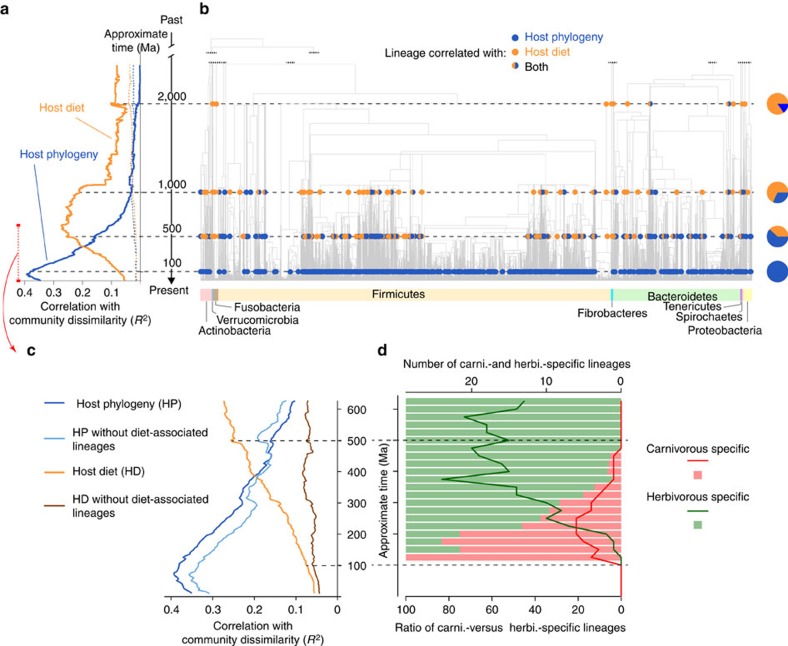
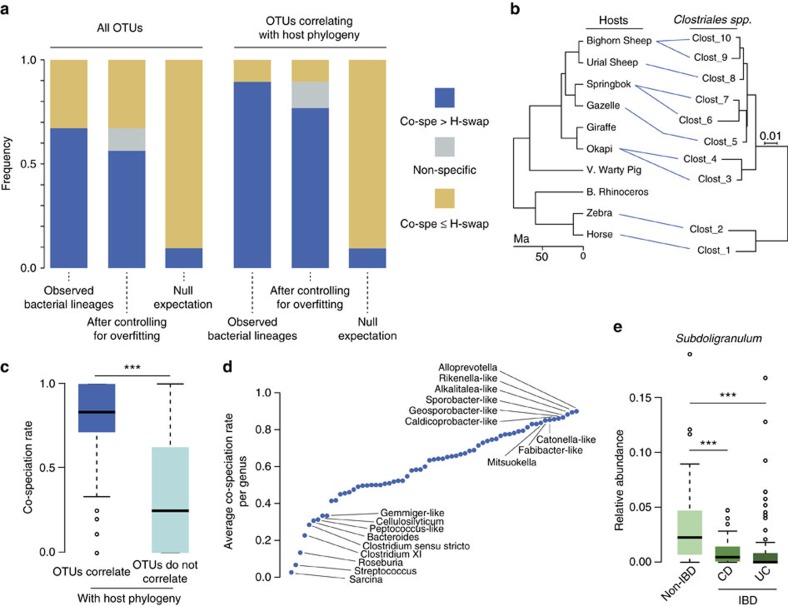
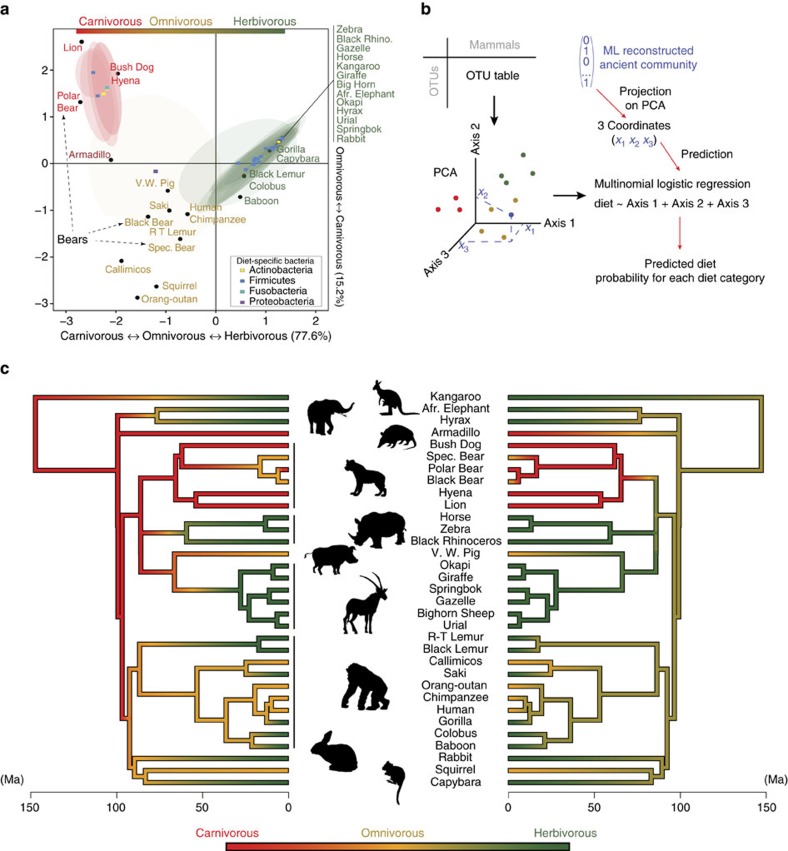
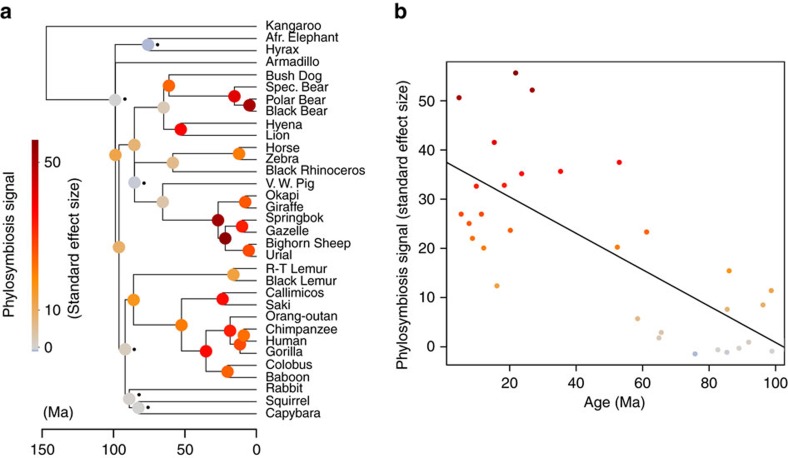
Whether mammal-microbiome interactions are persistent and specific over evolutionary time is controversial. Here we show that host phylogeny and major dietary shifts have affected the distribution of different gut bacterial lineages and did so on vastly different bacterial phylogenetic resolutions. Diet mostly influences the acquisition of ancient and large microbial lineages. Conversely, correlation with host phylogeny is mostly seen among more recently diverged bacterial lineages, consistent with processes operating at similar timescales to host evolution. Considering microbiomes at appropriate phylogenetic scales allows us to model their evolution along the mammalian tree and to infer ancient diets from the predicted microbiomes of mammalian ancestors. Phylogenetic analyses support co-speciation as having a significant role in the evolution of mammalian gut microbiome compositions. Highly co-speciating bacterial genera are also associated with immune diseases in humans, laying a path for future studies that probe these co-speciating bacteria for signs of co-evolution.
哺乳动物-微生物组的相互作用是否在进化过程中具有持久性和特异性是有争议的。在这里,我们表明,宿主进化史和主要的饮食变化影响了不同肠道细菌谱系的分布,而且这种影响在细菌系统发育的分辨率上有很大的不同。饮食主要影响古代和大型微生物谱系的获得。相反,与宿主进化史的相关性主要见于最近分化的细菌谱系,这与宿主进化相似时间尺度上的过程一致。在适当的系统发育尺度上考虑微生物组,使我们能够沿着哺乳动物树来模拟它们的进化,并从哺乳动物祖先的预测微生物组中推断出古代的饮食。系统发育分析支持共进化在哺乳动物肠道微生物组组成的进化中起着重要作用。高度共进化的细菌属也与人类的免疫疾病有关,为未来的研究铺平了道路,这些研究将探索这些共进化细菌的共同进化迹象。