Center for Food Safety, Department of Food Science, University of Arkansas, Fayetteville, AR 72704 USA.
Department of Poultry Science, University of Arkansas, Fayetteville, AR 72701 USA.
Sci Rep. 2017 Feb 23;7:43354. doi: 10.1038/srep43354.
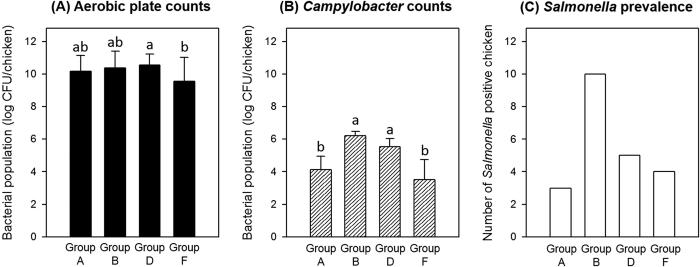
The purpose of this study was to 1) identify microbial compositional changes on chicken carcasses during processing, 2) determine the antimicrobial efficacy of peracetic acid (PAA) and Amplon (blend of sulfuric acid and sodium sulfate) at a poultry processing pilot plant scale, and 3) compare microbial communities between chicken carcass rinsates and recovered bacteria from media. Birds were collected from each processing step and rinsates were applied to estimate aerobic plate count (APC) and Campylobacter as well as Salmonella prevalence. Microbiome sequencing was utilized to identify microbial population changes over processing and antimicrobial treatments. Only the PAA treatment exhibited significant reduction of APC at the post chilling step while both Amplon and PAA yielded detectable Campylobacter reductions at all steps. Based on microbiome sequencing, Firmicutes were the predominant bacterial group at the phyla level with over 50% frequency in all steps while the relative abundance of Proteobacteria decreased as processing progressed. Overall microbiota between rinsate and APC plate microbial populations revealed generally similar patterns at the phyla level but they were different at the genus level. Both antimicrobials appeared to be effective on reducing problematic bacteria and microbiome can be utilized to identify optimal indicator microorganisms for enhancing product quality.
1)鉴定鸡肉在加工过程中的微生物组成变化,2)在禽类加工中试工厂规模下确定过氧乙酸(PAA)和 Amplon(硫酸和硫酸钠混合物)的抗菌效果,3)比较鸡体冲洗物和从培养基中回收的细菌之间的微生物群落。从每个加工步骤收集鸟类,并用冲洗物进行估计需氧平板计数(APC)和空肠弯曲菌以及沙门氏菌的流行率。利用微生物组测序来识别加工和抗菌处理过程中的微生物种群变化。只有 PAA 处理在冷却后步骤表现出对 APC 的显著减少,而 Amplon 和 PAA 在所有步骤均产生可检测的空肠弯曲菌减少。基于微生物组测序,厚壁菌门是在门水平上的主要细菌群体,在所有步骤中的频率均超过 50%,而随着加工的进行,变形菌门的相对丰度降低。冲洗物和 APC 平板微生物种群之间的总体微生物群落揭示了在门水平上通常相似的模式,但在属水平上却不同。这两种抗菌剂似乎都能有效减少有问题的细菌,并且微生物组可用于鉴定增强产品质量的最佳指示微生物。