D'Urban Jackson Josephine, Dos Remedios Natalie, Maher Kathryn H, Zefania Sama, Haig Susan, Oyler-McCance Sara, Blomqvist Donald, Burke Terry, Bruford Michael W, Székely Tamás, Küpper Clemens
Milner Centre for Evolution, Department of Biology and Biochemistry, University of Bath, Bath, BA2 7AY, United Kingdom.
Organisms and Environment Division, Cardiff School of Biosciences, Cardiff University, Cardiff, CF10 3AX, United Kingdom.
Evolution. 2017 May;71(5):1313-1326. doi: 10.1111/evo.13212. Epub 2017 Apr 10.
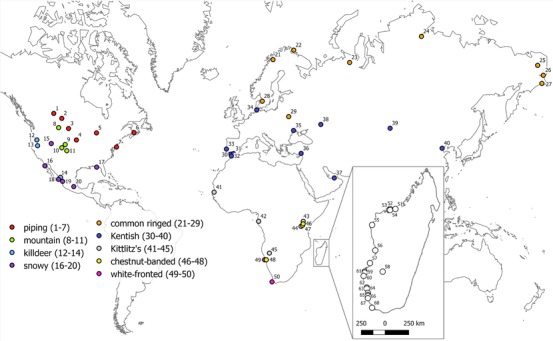
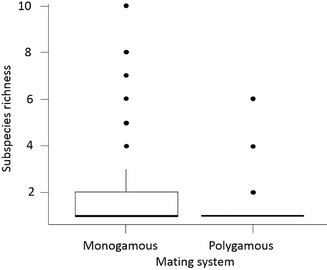
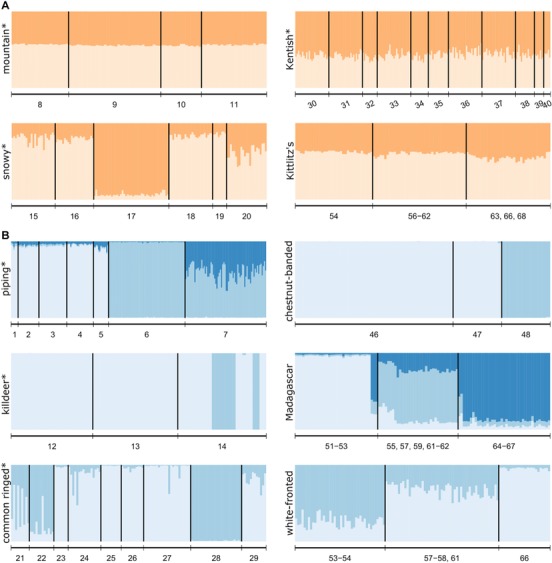
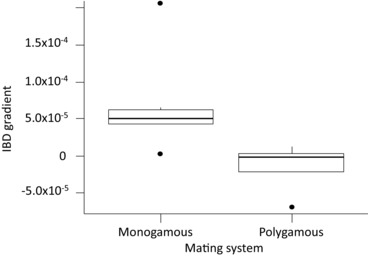
Sexual selection may act as a promotor of speciation since divergent mate choice and competition for mates can rapidly lead to reproductive isolation. Alternatively, sexual selection may also retard speciation since polygamous individuals can access additional mates by increased breeding dispersal. High breeding dispersal should hence increase gene flow and reduce diversification in polygamous species. Here, we test how polygamy predicts diversification in shorebirds using genetic differentiation and subspecies richness as proxies for population divergence. Examining microsatellite data from 79 populations in 10 plover species (Genus: Charadrius) we found that polygamous species display significantly less genetic structure and weaker isolation-by-distance effects than monogamous species. Consistent with this result, a comparative analysis including 136 shorebird species showed significantly fewer subspecies for polygamous than for monogamous species. By contrast, migratory behavior neither predicted genetic differentiation nor subspecies richness. Taken together, our results suggest that dispersal associated with polygamy may facilitate gene flow and limit population divergence. Therefore, intense sexual selection, as occurs in polygamous species, may act as a brake rather than an engine of speciation in shorebirds. We discuss alternative explanations for these results and call for further studies to understand the relationships between sexual selection, dispersal, and diversification.
性选择可能充当物种形成的促进因素,因为不同的配偶选择和对配偶的竞争会迅速导致生殖隔离。另外,性选择也可能阻碍物种形成,因为一夫多妻制的个体可以通过增加繁殖扩散来获得更多配偶。因此,高繁殖扩散应会增加一夫多妻制物种的基因流动并减少其多样化。在此,我们以遗传分化和亚种丰富度作为种群分化的指标,来测试一夫多妻制如何预测滨鸟的多样化。通过检查10种鸻属(属名:Charadrius)79个种群的微卫星数据,我们发现一夫多妻制物种的遗传结构明显少于一夫一妻制物种,且距离隔离效应较弱。与这一结果一致,一项涵盖136种滨鸟的比较分析表明,一夫多妻制物种的亚种数量明显少于一夫一妻制物种。相比之下,迁徙行为既不能预测遗传分化,也不能预测亚种丰富度。综合来看,我们的结果表明,与一夫多妻制相关的扩散可能促进基因流动并限制种群分化。因此,在一夫多妻制物种中出现的强烈性选择,可能在滨鸟物种形成过程中起到阻碍而非推动作用。我们讨论了这些结果的其他解释,并呼吁进行进一步研究以了解性选择、扩散和多样化之间的关系。