Sun Xudong, Wang Chongde, Xiang Nan, Li Xiong, Yang Shihai, Du JianCan, Yang Yongping, Yang Yunqiang
Key Laboratory for Plant Diversity and Biogeography of East Asia, Kunming Institute of Botany, Chinese Academy of Sciences, Kunming, China.
Plant Germplasm and Genomics Center, The Germplasm Bank of Wild Species, Kunming Institute of Botany, Chinese Academy of Sciences, Kunming, China.
Plant Biotechnol J. 2017 Oct;15(10):1284-1294. doi: 10.1111/pbi.12715. Epub 2017 Apr 27.
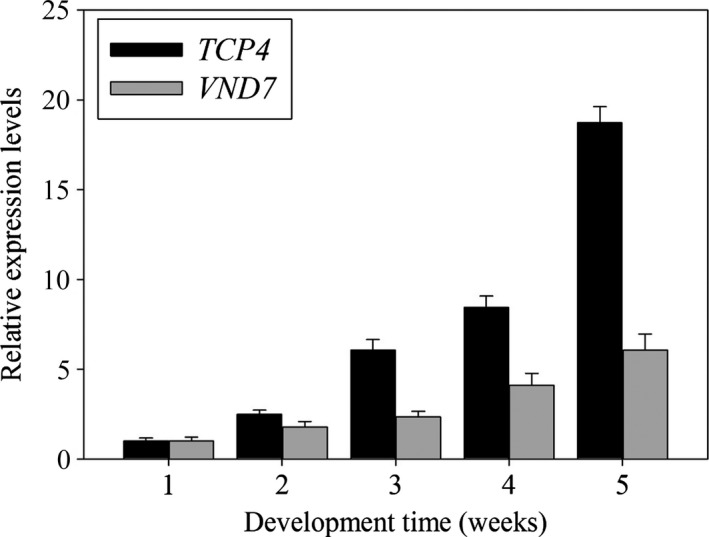
The overexpression of miR319 in plants results in delayed senescence, and high levels of miR319-targeted TCP4 transcription factor cause premature onset of this process. However, the underlying mechanisms of this pathway remain elusive. Here, we found that miR319 overexpression results in a decrease in TCP4 abundance and secondary cell wall formation in the stem. Conversely, constitutive expression of miR319-resistant TCP4 promotes secondary cell wall formation, indicating that miR319-mediated TCP4 controls secondary cell wall formation during development. Further analysis revealed that TCP4 might directly bind the promoter of VND7 to activate its expression, which triggers the expression of a VND7 transcriptional network associated with secondary cell wall biosynthesis and programmed cell death and accelerates vessel formation. In addition, the development process gradually increased TCP4 expression. These results suggest that miR319 and its target TCP4 can act as switches that turn on secondary cell wall synthesis and programmed cell death.
植物中miR319的过表达会导致衰老延迟,而高水平的miR319靶向TCP4转录因子会导致这一过程过早开始。然而,该途径的潜在机制仍然不清楚。在这里,我们发现miR319过表达导致TCP4丰度降低以及茎中次生细胞壁的形成减少。相反,抗miR319的TCP4的组成型表达促进次生细胞壁的形成,表明miR319介导的TCP4在发育过程中控制次生细胞壁的形成。进一步分析表明,TCP4可能直接结合VND7的启动子以激活其表达,从而触发与次生细胞壁生物合成和程序性细胞死亡相关的VND7转录网络的表达,并加速导管形成。此外,发育过程中TCP4的表达逐渐增加。这些结果表明,miR319及其靶标TCP4可以作为开启次生细胞壁合成和程序性细胞死亡的开关。