Zengin-Toktas Yildiz, Woolley Sarah Cushing
Department of Biology, McGill University, Montreal, Québec, Canada.
PLoS One. 2017 Feb 24;12(2):e0172944. doi: 10.1371/journal.pone.0172944. eCollection 2017.
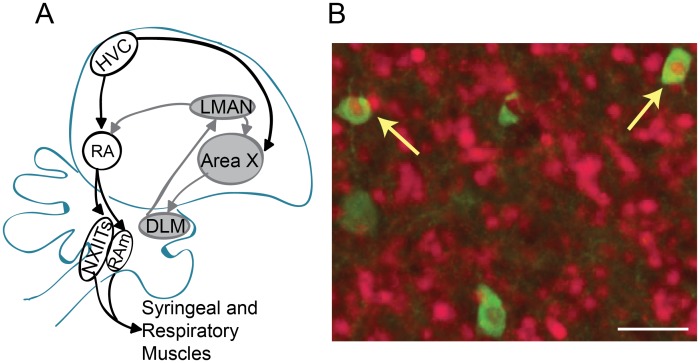
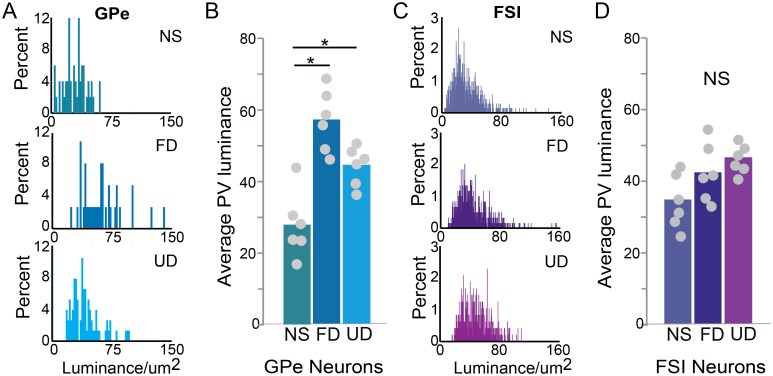
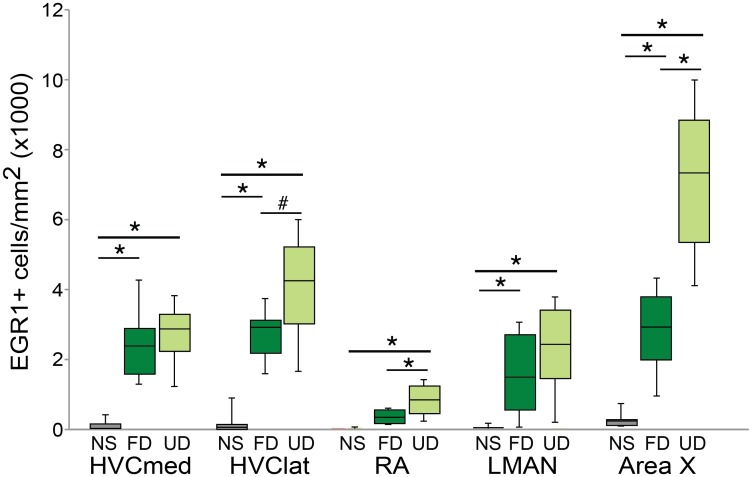
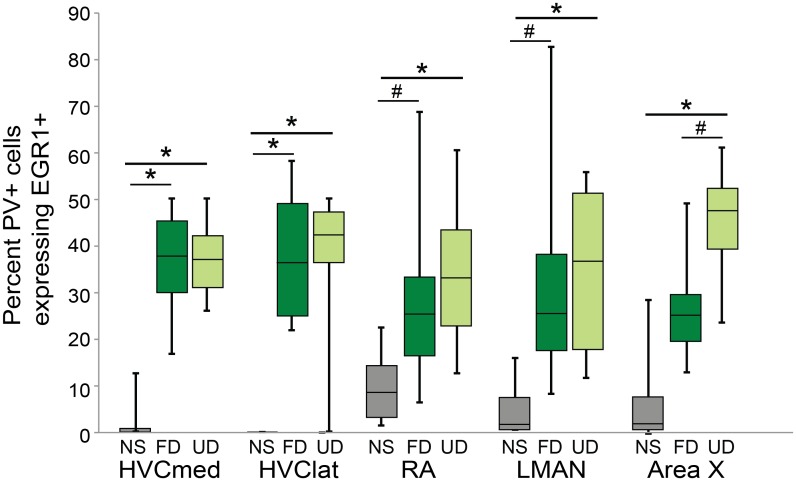
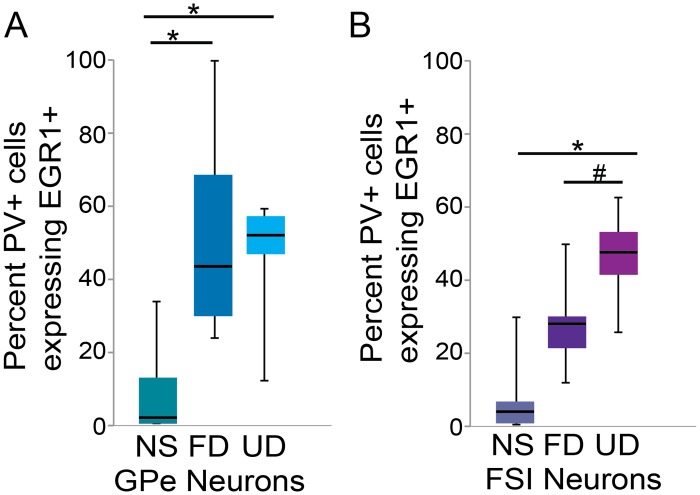
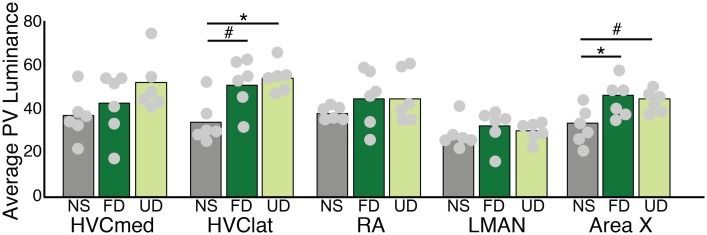
Across species, the performance of vocal signals can be modulated by the social environment. Zebra finches, for example, adjust their song performance when singing to females ('female-directed' or FD song) compared to when singing in isolation ('undirected' or UD song). These changes are salient, as females prefer the FD song over the UD song. Despite the importance of these performance changes, the neural mechanisms underlying this social modulation remain poorly understood. Previous work in finches has established that expression of the immediate early gene EGR1 is increased during singing and modulated by social context within the vocal control circuitry. Here, we examined whether particular neural subpopulations within those vocal control regions exhibit similar modulations of EGR1 expression. We compared EGR1 expression in neurons expressing parvalbumin (PV), a calcium buffer that modulates network plasticity and homeostasis, among males that performed FD song, males that produced UD song, or males that did not sing. We found that, overall, singing but not social context significantly affected EGR1 expression in PV neurons throughout the vocal control nuclei. We observed differences in EGR1 expression between two classes of PV interneurons in the basal ganglia nucleus Area X. Additionally, we found that singing altered the amount of PV expression in neurons in HVC and Area X and that distinct PV interneuron types in Area X exhibited different patterns of modulation by singing. These data indicate that throughout the vocal control circuitry the singing-related regulation of EGR1 expression in PV neurons may be less influenced by social context than in other neuron types and raise the possibility of cell-type specific differences in plasticity and calcium buffering.
在不同物种中,发声信号的表现可受到社会环境的调节。例如,与单独歌唱(“无指向性”或UD歌声)相比,斑胸草雀在向雌鸟歌唱时(“指向雌鸟”或FD歌声)会调整其歌声表现。这些变化很显著,因为雌鸟更喜欢FD歌声而非UD歌声。尽管这些表现变化很重要,但这种社会调节背后的神经机制仍知之甚少。之前对雀类的研究已证实,即刻早期基因EGR1在歌唱过程中表达增加,并在发声控制回路中受到社会环境的调节。在这里,我们研究了那些发声控制区域内特定的神经亚群是否表现出类似的EGR1表达调节。我们比较了在进行FD歌声的雄鸟、发出UD歌声的雄鸟或不唱歌的雄鸟中,表达小白蛋白(PV)的神经元中的EGR1表达,PV是一种调节网络可塑性和稳态的钙缓冲蛋白。我们发现,总体而言,歌唱而非社会环境显著影响了整个发声控制核团中PV神经元的EGR1表达。我们观察到基底神经节核团X区中两类PV中间神经元的EGR1表达存在差异。此外,我们发现歌唱改变了HVC和X区神经元中PV的表达量,并且X区不同的PV中间神经元类型表现出不同的歌唱调节模式。这些数据表明,在整个发声控制回路中,PV神经元中与歌唱相关的EGR1表达调节可能比其他神经元类型受社会环境的影响更小,并增加了可塑性和钙缓冲存在细胞类型特异性差异的可能性。