Qin Lei, Chen Stephanie, Flood Emuella, Shaunik Alka, Romero Beverly, de la Cruz Marie, Alvarez Cynthia, Grandy Susan
AstraZeneca, Gaithersburg, MD, USA.
ICON plc, Clinical Outcomes Assessment, Gaithersburg, MD, USA.
Diabetes Ther. 2017 Apr;8(2):335-353. doi: 10.1007/s13300-017-0237-8. Epub 2017 Feb 24.
This study assessed the relative importance of treatment-related attributes in influencing patient preferences for glucagon-like peptide-1 receptor agonists (GLP-1RAs) among injection-experienced type 2 diabetes mellitus (T2DM) patients in Germany and the United Kingdom.
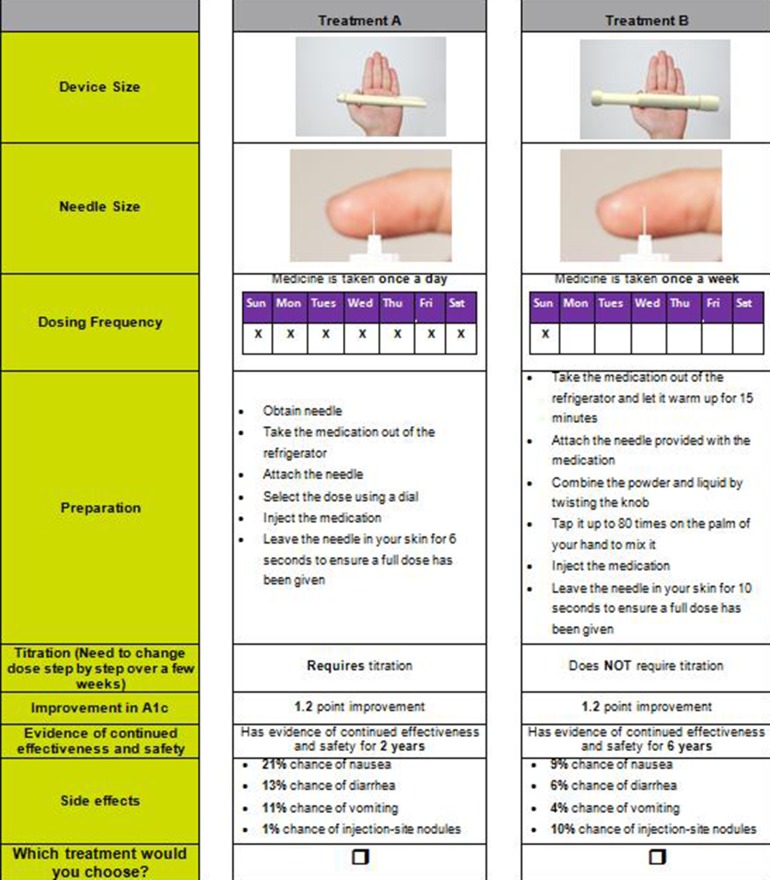
T2DM patients experienced with injecting once-weekly (QW) exenatide or once-daily (QD) liraglutide completed an online discrete-choice experiment (DCE) survey. Patients chose between hypothetical blinded treatment profiles reflecting attributes of GLP-1RAs. The DCE survey included eight attributes: efficacy, side effects, device size, needle size, titration, injection preparation, long-term efficacy/safety, and dosing frequency. Odds ratios (ORs) and 95% confidence intervals (CIs) were calculated using a conditional logit model indicating the likelihood of choosing a treatment with a given attribute level versus a reference attribute level.
510 GLP-1RA injection-experienced patients completed the survey; 45.3% respondents were being treated with exenatide QW and 54.7% respondents were being treated with liraglutide QD. In terms of GLP-1RA attributes, patients indicated a preference for a treatment with greater efficacy (i.e., a 1.5-point improvement in HbA1c) (OR 2.58; 95% CI 2.37, 2.80; p < 0.001), fewer side effects (OR 2.67; 95% CI 2.52, 2.82; p < 0.001), once-weekly rather than once-daily administration (OR 2.26; 95% CI 2.13, 2.39; p < 0.001), and the preparation required for a multi-use pen (OR 1.71; 95% CI 1.55, 1.88; p < 0.001). Needle size, device size, and titration were not significant drivers of patient preference.
Among GLP-1RA injection-experienced patients, key drivers of treatment preference for a hypothetical GLP-RA profile were side effects, efficacy, dosing frequency, and required preparation. Understanding patient preferences is important for optimizing treatment decision-making and improving treatment adherence.
AstraZeneca.
本研究评估了在德国和英国有注射经验的2型糖尿病(T2DM)患者中,与治疗相关的属性对其选择胰高血糖素样肽-1受体激动剂(GLP-1RAs)偏好的相对重要性。
有每周一次(QW)注射艾塞那肽或每日一次(QD)注射利拉鲁肽经验的T2DM患者完成了一项在线离散选择实验(DCE)调查。患者在反映GLP-1RAs属性的假设性盲法治疗方案之间进行选择。DCE调查包括八个属性:疗效、副作用、器械尺寸、针头尺寸、滴定、注射准备、长期疗效/安全性和给药频率。使用条件logit模型计算优势比(OR)和95%置信区间(CI),该模型表明选择具有给定属性水平的治疗方案相对于参考属性水平的可能性。
510名有GLP-1RA注射经验的患者完成了调查;45.3%的受访者正在接受QW艾塞那肽治疗,54.7%的受访者正在接受QD利拉鲁肽治疗。就GLP-1RA属性而言,患者表示更倾向于选择疗效更佳(即糖化血红蛋白改善1.5个百分点)的治疗方案(OR 2.58;95%CI 2.37,2.80;p<0.001)、副作用更少的治疗方案(OR 2.67;95%CI 2.52,2.82;p<0.001)、每周一次而非每日一次给药的治疗方案(OR 2.26;95%CI 2.13,2.39;p<0.001)以及多剂量笔所需的准备方案(OR 1.71;95%CI 1.55, 1.88;p<0.001)。针头尺寸、器械尺寸和滴定不是患者偏好的显著驱动因素。
在有GLP-1RA注射经验的患者中,对假设的GLP-RA方案治疗偏好的关键驱动因素是副作用、疗效、给药频率和所需准备。了解患者偏好对于优化治疗决策和提高治疗依从性很重要。
阿斯利康公司。