Reis-Teixeira Fernanda Barbosa Dos, Alves Virgínia Farias, de Martinis Elaine Cristina Pereira
Universidade de São Paulo, Faculdade de Ciências Farmacêuticas de Ribeirão Preto, São Paulo, SP, Brazil.
Universidade Federal de Goiás, Faculdade de Farmácia, Goiás, GO, Brazil.
Braz J Microbiol. 2017 Jul-Sep;48(3):587-591. doi: 10.1016/j.bjm.2017.01.004. Epub 2017 Feb 9.
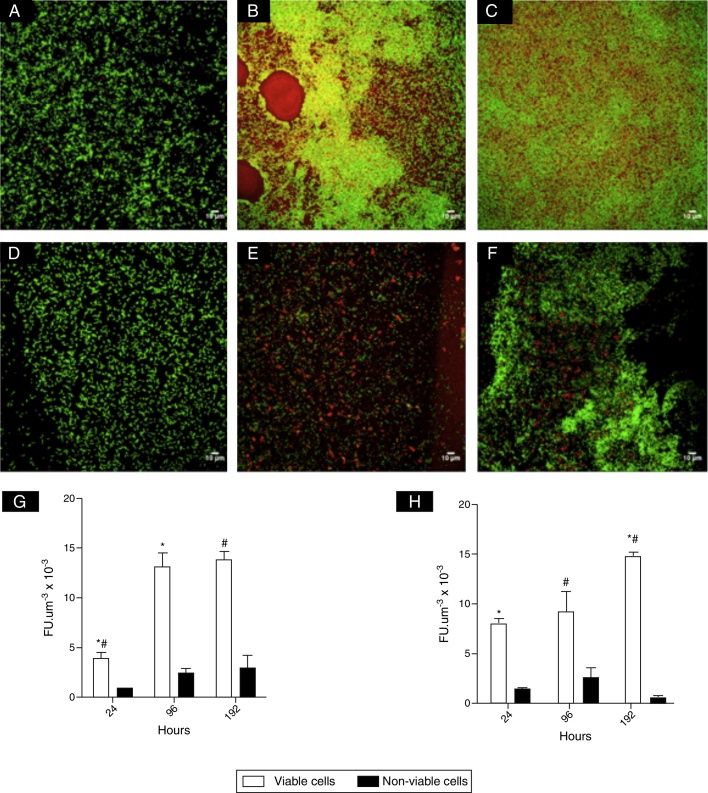
The pathogenic bacterium Listeria monocytogenes can persist in food processing plants for many years, even when appropriate hygienic measures are in place, with potential for contaminating ready-to-eat products and, its ability to form biofilms on abiotic surfaces certainly contributes for the environmental persistence. In this research, L. monocytogenes was grown in biofilms up 8 days attached to stainless steel and glass surfaces, contributing for advancing the knowledge on architecture of mature biofilms, since many literature studies carried out on this topic considered only early stages of cell adhesion. In this study, biofilm populations of two strains of L. monocytogenes (serotypes 1/2a and 4b) on stainless steel coupons and glass were examined using regular fluorescence microscopy, confocal laser scanning microscopy and classic culture method. The biofilms formed were not very dense and microscopic observations revealed uneven biofilm structures, with presence of exopolymeric matrix surrounding single cells, small aggregates and microcolonies, in a honeycomb-like arrangement. Moreover, planktonic population of L. monocytogenes (present in broth media covering the abiotic surface) remained stable throughout the incubation time, which indicates an efficient dispersal mechanism, since the culture medium was replaced daily. In conclusion, even if these strains of L. monocytogenes were not able to form thick multilayer biofilms, it was noticeable their high persistence on abiotic surfaces, reinforcing the need to focus on measures to avoid biofilm formation, instead of trying to eradicate mature biofilms.
致病性细菌单核细胞增生李斯特菌能够在食品加工厂中持续存在多年,即便采取了适当的卫生措施也是如此。它有可能污染即食产品,而且其在非生物表面形成生物膜的能力无疑有助于其在环境中持续存在。在本研究中,单核细胞增生李斯特菌在附着于不锈钢和玻璃表面的生物膜中生长长达8天,这有助于增进对成熟生物膜结构的了解,因为许多关于该主题的文献研究仅考虑了细胞黏附的早期阶段。在这项研究中,使用常规荧光显微镜、共聚焦激光扫描显微镜和经典培养方法,对不锈钢试片和玻璃上两株单核细胞增生李斯特菌(血清型1/2a和4b)的生物膜群体进行了检测。形成的生物膜并不十分致密,显微镜观察显示生物膜结构不均匀,单个细胞、小聚集体和微菌落周围存在胞外基质,呈蜂窝状排列。此外,单核细胞增生李斯特菌的浮游群体(存在于覆盖非生物表面的肉汤培养基中)在整个培养期间保持稳定,这表明存在一种有效的扩散机制,因为培养基每天都更换。总之,即使这些单核细胞增生李斯特菌菌株无法形成厚厚的多层生物膜,但它们在非生物表面的高持久性仍很明显,这强化了需要专注于避免生物膜形成的措施,而不是试图根除成熟生物膜。