Kim Juhui, Ro Eunyoung, Yoon Kisun
Department of Food and Nutrition, 1 Hoeki-dong, Dongdaemun-gu, Kyung Hee University, Seoul 130-701, Korea.
Foods. 2013 Aug 2;2(3):364-373. doi: 10.3390/foods2030364.
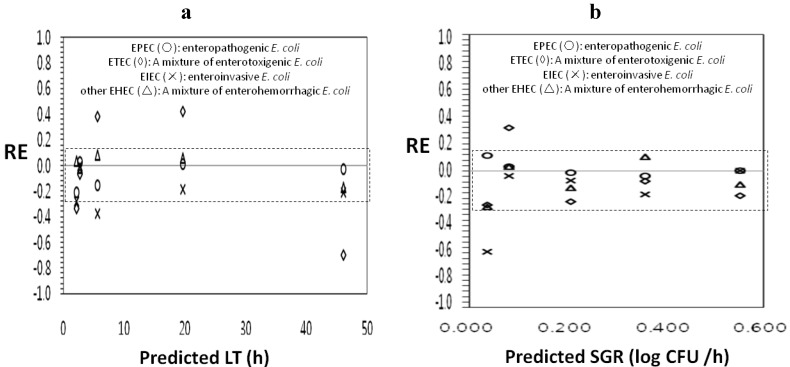
Growth kinetics for O157:H7 in perilla leaves were compared to those of pathogenic strains, including enteropathogenic (EPEC), enterotoxigenic (ETEC), enteroinvasive (EIEC) and other enterohemorrhagic (EHEC) at 13, 17, 24, 30 and 36 °C. Models for lag time (LT), specific growth rate (SGR) and maximum population density (MPD) as a function of temperature were developed. The performance of the models was quantified using the ratio method and an acceptable prediction zone method. Significant differences in SGR and LT among the strains were observed at all temperatures. Overall, the shortest LT was observed with O157:H7, followed by EPEC, other EHEC, EIEC and ETEC, while the fastest growth rates were noted in EPEC, followed by O157:H7, ETEC, other EHEC and EIEC. The models for O157:H7 in perilla leaves was suitable for use in making predictions for EPEC and other EHEC strains.
将紫苏叶中O157:H7的生长动力学与致病菌株进行比较,这些致病菌株包括肠致病性大肠杆菌(EPEC)、产肠毒素大肠杆菌(ETEC)、肠侵袭性大肠杆菌(EIEC)以及其他肠出血性大肠杆菌(EHEC),比较在13、17、24、30和36°C下的情况。建立了以温度为函数的延迟期(LT)、比生长速率(SGR)和最大种群密度(MPD)模型。使用比率法和可接受预测区间法对模型性能进行了量化。在所有温度下均观察到各菌株之间SGR和LT存在显著差异。总体而言,O157:H7的LT最短,其次是EPEC、其他EHEC、EIEC和ETEC,而EPEC的生长速率最快,其次是O157:H7、ETEC、其他EHEC和EIEC。紫苏叶中O157:H7的模型适用于预测EPEC和其他EHEC菌株。