Takahashi Paul Y, Ryu Euijung, Pathak Jyotishman, Jenkins Gregory D, Batzler Anthony, Hathcock Matthew A, Black John Logan, Olson Janet E, Cerhan James R, Bielinski Suzette J
Division of Primary Care Internal Medicine, Department of Medicine.
Department of Health Sciences Research.
Pharmgenomics Pers Med. 2017 Feb 14;10:39-47. doi: 10.2147/PGPM.S114211. eCollection 2017.
Cytochrome P450 2D6 () is responsible for the metabolism of clinically used drugs and other environmental exposures, but it is unclear whether the phenotype is associated with adverse health outcomes. The aim was to determine the association of phenotype with the risk of hospitalization or an emergency department (ED) visit among a group of primary care patients.
In this study, 929 adult patients underwent testing. The primary outcome was risk of hospitalization or an ED visit from January 2005 through September 2014. genotypes were interpreted as 1 of 7 clinical phenotypes, from ultrarapid to poor metabolizer, and patients with the extensive metabolizer phenotype were used as the reference group. The hazard ratios (HRs) and 95% confidence intervals (CIs) were estimated for finding the association of phenotypes with the risk of hospitalization or an ED visit by using Cox proportional hazard models and adjusting for age and sex.
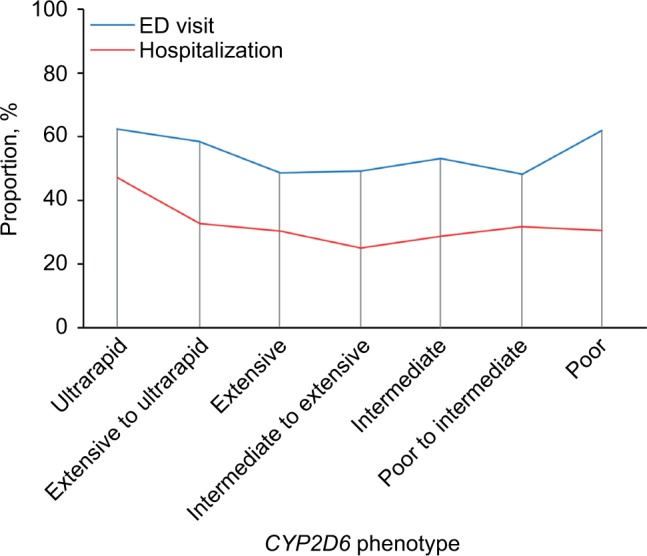
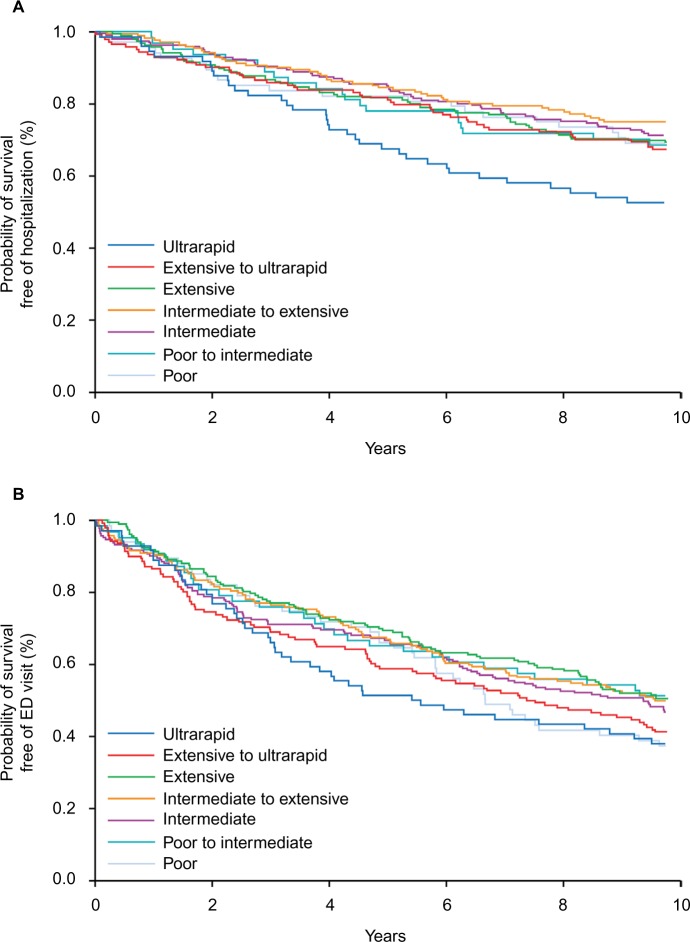
The median age was 49 years (interquartile range, 46-52 years); 74% of patients had 3 or fewer chronic conditions, 285 had at least 1 hospitalization, and 496 had at least 1 ED visit. The risk of hospitalization was higher among patients who were ultrarapid metabolizers compared to extensive metabolizers (47% vs 30%; HR, 1.69; 95% CI, 1.11-2.57), as was the risk of an ED visit (62% vs 49%; HR, 1.50; 95% CI, 1.05-2.14). For poor metabolizers compared to extensive metabolizers, there was no difference in the risk of hospitalization (HR, 0.95; 95% CI, 0.58-1.56), but there was an increase in the risk of an ED visit (HR, 1.38; 95% CI, 0.96-1.98) (the difference was not statistically significant).
We found an increased risk of hospitalization or an ED visit among ultrarapid compared to extensive metabolizers. Further research identifying the mechanisms of the association and ultimate clinical utility is warranted.
细胞色素P450 2D6()负责临床使用药物及其他环境暴露因素的代谢,但尚不清楚该表型是否与不良健康结局相关。本研究旨在确定一组初级保健患者中该表型与住院或急诊就诊风险之间的关联。
本研究中,929例成年患者接受了检测。主要结局为2005年1月至2014年9月期间的住院或急诊就诊风险。基因型被解读为7种临床表型之一,从超快代谢型到慢代谢型,以广泛代谢型患者作为参照组。采用Cox比例风险模型并对年龄和性别进行校正,以估计风险比(HRs)及95%置信区间(CIs),从而找出该表型与住院或急诊就诊风险之间的关联。
患者年龄中位数为49岁(四分位间距为46 - 52岁);74%的患者患有3种或更少的慢性病,285例患者至少有1次住院经历,496例患者至少有1次急诊就诊经历。与广泛代谢型患者相比,超快代谢型患者的住院风险更高(47%对30%;HR,1.69;95%CI,1.11 - 2.57),急诊就诊风险也是如此(62%对49%;HR,1.50;95%CI,1.05 - 2.14)。与广泛代谢型患者相比,慢代谢型患者的住院风险无差异(HR,0.95;95%CI,0.58 - 1.56),但急诊就诊风险有所增加(HR,1.38;95%CI,0.96 - 1.98)(差异无统计学意义)。
我们发现,与广泛代谢型患者相比,超快代谢型患者的住院或急诊就诊风险增加。有必要开展进一步研究以明确这种关联的机制及最终的临床应用价值。