Birba Agustina, Ibáñez Agustín, Sedeño Lucas, Ferrari Jesica, García Adolfo M, Zimerman Máximo
Laboratory of Experimental Psychology and Neuroscience (LPEN), Institute of Cognitive and Translational Neuroscience (INCyT), INECO Foundation, Favaloro UniversityBuenos Aires, Argentina; National Scientific and Technical Research Council (CONICET)Buenos Aires, Argentina.
Laboratory of Experimental Psychology and Neuroscience (LPEN), Institute of Cognitive and Translational Neuroscience (INCyT), INECO Foundation, Favaloro UniversityBuenos Aires, Argentina; National Scientific and Technical Research Council (CONICET)Buenos Aires, Argentina; Universidad Autónoma del CaribeBarranquilla, Colombia; Center for Social and Cognitive Neuroscience (CSCN), School of Psychology, Universidad Adolfo IbañezSantiago de Chile, Chile; Centre of Excellence in Cognition and its Disorders, Australian Research Council (ARC)Sydney, NSW, Australia.
Front Aging Neurosci. 2017 Feb 13;9:16. doi: 10.3389/fnagi.2017.00016. eCollection 2017.
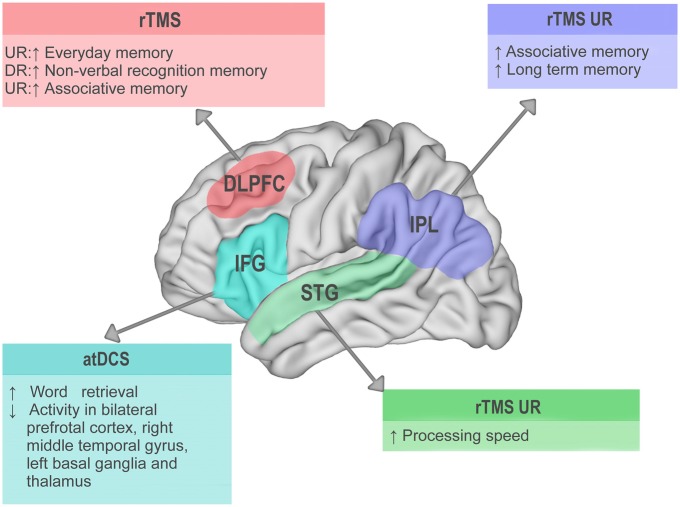
Non-invasive brain stimulation (NIBS) techniques can significantly modulate cognitive functions in healthy subjects and patients with neuropsychiatric disorders. Recently, they have been applied in patients with mild cognitive impairment (MCI) and subjective cognitive impairment (SCI) to prevent or delay the development of Alzheimer's disease (AD). Here we review this emerging empirical corpus and discuss therapeutic effects of NIBS on several target functions (e.g., memory for face-name associations and non-verbal recognition, attention, psychomotor speed, everyday memory). Available studies have yielded mixed results, possibly due to differences among their tasks, designs, and samples, let alone the latter's small sizes. Thus, the impact of NIBS on cognitive performance in MCI and SCI remains to be determined. To foster progress in this direction, we outline methodological approaches that could improve the efficacy and specificity of NIBS in both conditions. Furthermore, we discuss the need for multicenter studies, accurate diagnosis, and longitudinal approaches combining NIBS with specific training regimes. These tenets could cement biomedical developments supporting new treatments for MCI and preventive therapies for AD.
非侵入性脑刺激(NIBS)技术可显著调节健康受试者以及患有神经精神疾病患者的认知功能。最近,它们已被应用于轻度认知障碍(MCI)和主观认知障碍(SCI)患者,以预防或延缓阿尔茨海默病(AD)的发展。在此,我们回顾这一新兴的实证文献,并讨论NIBS对几种目标功能(例如,面孔-名字联想记忆和非言语识别、注意力、精神运动速度、日常记忆)的治疗效果。现有研究结果不一,这可能是由于它们的任务、设计和样本存在差异,更不用说样本量较小了。因此,NIBS对MCI和SCI认知表现的影响仍有待确定。为推动这一方向的进展,我们概述了一些方法,这些方法可以提高NIBS在这两种情况下的疗效和特异性。此外,我们讨论了多中心研究、准确诊断以及将NIBS与特定训练方案相结合的纵向研究方法的必要性。这些原则可以巩固生物医学的发展,为MCI的新治疗方法和AD的预防性治疗提供支持。