Haxim Yakupjan, Ismayil Asigul, Jia Qi, Wang Yan, Zheng Xiyin, Chen Tianyuan, Qian Lichao, Liu Na, Wang Yunjing, Han Shaojie, Cheng Jiaxuan, Qi Yijun, Hong Yiguo, Liu Yule
Center for Plant Biology, Tsinghua-Peking Joint Center for Life Sciences, MOE Key Laboratory of Bioinformatics, School of Life Sciences, Tsinghua University, Beijing, China.
Research Centre for Plant RNA Signaling, College of Life and Environmental Sciences, Hangzhou Normal University, Hangzhou, China.
Elife. 2017 Feb 28;6:e23897. doi: 10.7554/eLife.23897.
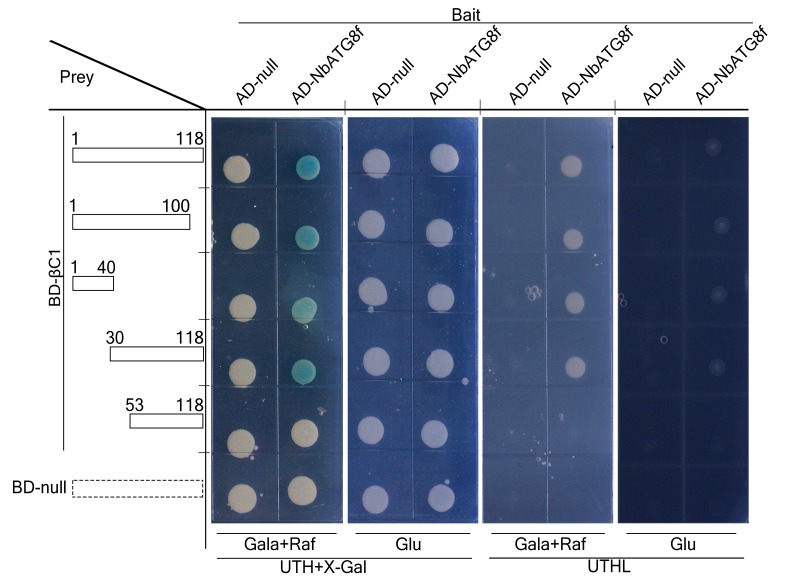
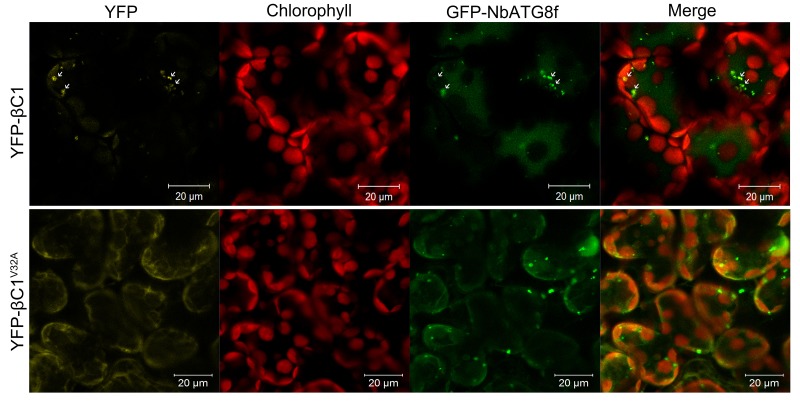
Autophagy is an evolutionarily conserved process that recycles damaged or unwanted cellular components, and has been linked to plant immunity. However, how autophagy contributes to plant immunity is unknown. Here we reported that the plant autophagic machinery targets the virulence factor βC1 of (CLCuMuV) for degradation through its interaction with the key autophagy protein ATG8. A V32A mutation in βC1 abolished its interaction with NbATG8f, and virus carrying βC1 showed increased symptoms and viral DNA accumulation in plants. Furthermore, silencing of autophagy-related genes and reduced plant resistance to the DNA viruses CLCuMuV, , and , whereas activating autophagy by silencing genes enhanced plant resistance to viral infection. Thus, autophagy represents a novel anti-pathogenic mechanism that plays an important role in antiviral immunity in plants.
自噬是一个进化上保守的过程,可循环利用受损或不需要的细胞成分,并且与植物免疫相关。然而,自噬如何促进植物免疫尚不清楚。在此,我们报道植物自噬机制通过与关键自噬蛋白ATG8相互作用,靶向棉花曲叶病毒(CLCuMuV)的致病因子βC1进行降解。βC1中的V32A突变消除了其与NbATG8f的相互作用,携带βC1的病毒在植物中表现出更严重的症状和病毒DNA积累。此外,自噬相关基因ATG5和ATG7的沉默降低了植物对DNA病毒CLCuMuV、番茄黄化曲叶病毒(TYLCV)和中国番茄黄化曲叶病毒(TYLCCNV)的抗性,而通过沉默RbohD基因激活自噬增强了植物对病毒感染的抗性。因此,自噬代表了一种新的抗病原体机制,在植物抗病毒免疫中发挥重要作用。