
选择性自噬受体 NbNBR1 阻止 NbRFP1 介导的 UPS 依赖性降解 βC1,从而促进双生病毒感染。
Selective autophagic receptor NbNBR1 prevents NbRFP1-mediated UPS-dependent degradation of βC1 to promote geminivirus infection.
机构信息
State Key Laboratory of Rice Biology, Institute of Biotechnology, Zhejiang University, Hangzhou, Zhejiang, China.
State Key Laboratory for Biology of Plant Diseases and Insect Pests, Institute of Plant Protection, Chinese Academy of Agricultural Sciences, Beijing, China.
出版信息
PLoS Pathog. 2021 Sep 27;17(9):e1009956. doi: 10.1371/journal.ppat.1009956. eCollection 2021 Sep.
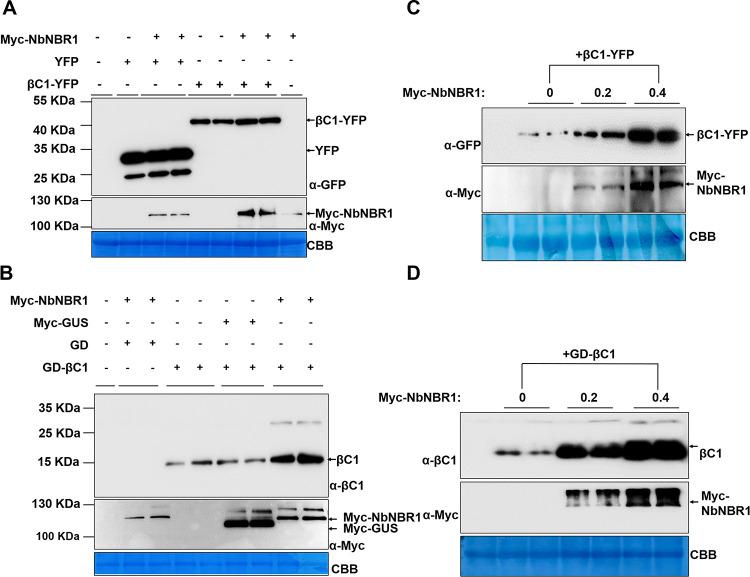
Autophagy is an evolutionarily conserved, lysosomal/vacuolar degradation mechanism that targets cell organelles and macromolecules. Autophagy and autophagy-related genes have been studied for their antiviral and pro-viral roles in virus-infected plants. Here, we demonstrate the pro-viral role of a selective autophagic receptor NbNBR1 in geminivirus-infected Nicotiana benthamiana plants. The βC1 protein encoded by tomato yellow leaf curl China betasatellite (TYLCCNB) that is associated with tomato yellow leaf curl China virus (TYLCCNV) enhanced the expression level of NbNBR1. Then NbNBR1 interacted with βC1 to form cytoplasmic granules. Interaction of NbNBR1 with βC1 could prevent degradation of βC1 by the NbRFP1, an E3 ligase. Overexpression of NbNBR1 in N. benthamiana plants increased βC1 accumulation and promoted virus infection. In contrast, silencing or knocking out NbNBR1 expression in N. benthamiana suppressed βC1 accumulation and inhibited virus infection. A single amino acid substitution in βC1 (βC1K4A) abolished its interaction with NbNBR1, leading to a reduced level of βC1K4A. The TYLCCNV/TYLCCNBK4A mutant virus caused milder disease symptoms and accumulated much less viral genomic DNAs in the infected plants. Collectively, the results presented here show how a viral satellite-encoded protein hijacks host autophagic receptor NbNBR1 to form cytoplasmic granules to protect itself from NbRFP1-mediated degradation and facilitate viral infection.
自噬是一种进化上保守的溶酶体/液泡降解机制,靶向细胞细胞器和大分子。自噬和自噬相关基因在病毒感染的植物中因其抗病毒和促病毒作用而受到研究。在这里,我们证明了一个选择性自噬受体 NbNBR1 在双生病毒感染的本氏烟植物中的促病毒作用。与番茄黄曲叶中国病毒(TYLCCNV)相关的番茄黄曲叶卷曲中国卫星βC1 蛋白增强了 NbNBR1 的表达水平。然后,NbNBR1 与 βC1 相互作用形成细胞质颗粒。NbNBR1 与 βC1 的相互作用可以防止 E3 连接酶 NbRFP1 降解 βC1。NbNBR1 在本氏烟植物中的过表达增加了 βC1 的积累并促进了病毒感染。相比之下,NbNBR1 在本氏烟中的沉默或敲除表达抑制了 βC1 的积累并抑制了病毒感染。βC1 中的单个氨基酸取代(βC1K4A)使其丧失了与 NbNBR1 的相互作用,导致 βC1K4A 水平降低。TYLCCNV/TYLCCNBK4A 突变病毒引起的症状较轻,感染植物中积累的病毒基因组 DNA 也较少。总之,这里呈现的结果表明,一种病毒卫星编码的蛋白如何劫持宿主自噬受体 NbNBR1 形成细胞质颗粒,以保护自身免受 NbRFP1 介导的降解并促进病毒感染。




 Zotero 插件